
Your incident response plan is 47 pages of carefully documented procedures. Your team has reviewed it. Leadership approved it. And when the ransomware hits at 2 AM on a Saturday, nobody can find it, nobody follows it, and everybody improvises. The plan failed its first real test.
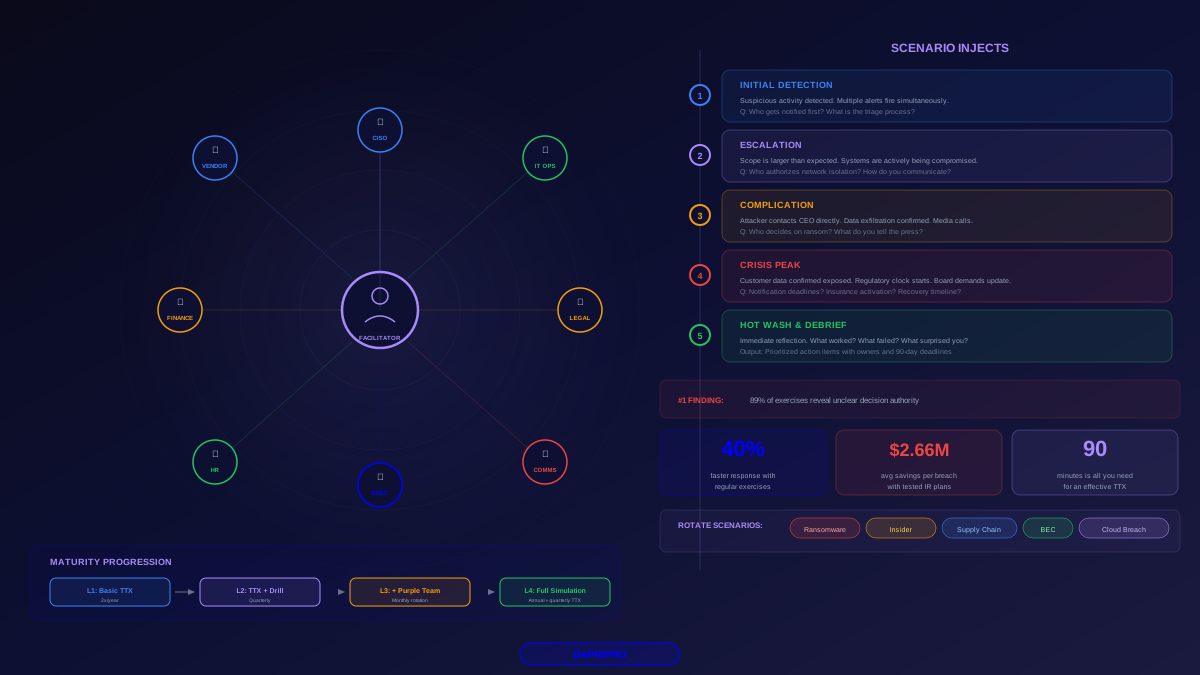
This happens more than you think. Organizations that never test their IR plans take 54% longer to contain breaches and spend an average of $2.66 million more per incident. A plan that has never been tested is not a plan — it is a document. Tabletop exercises are how you turn that document into muscle memory.
What Is a Tabletop Exercise and Why It Matters
A tabletop exercise (TTX) is a structured, discussion-based simulation where your incident response team walks through a realistic attack scenario step by step. No systems are actually tested. No attacks are simulated on production infrastructure. Instead, the exercise tests what matters most: can your people make the right decisions, communicate effectively, and follow the plan under pressure?
What tabletop exercises reveal that nothing else can:
- Decision-making gaps — who has authority to isolate production systems? To pay a ransom? To notify customers? In a real incident, confusion about authority wastes critical hours
- Communication breakdowns — the security team knows about the incident, but legal finds out from a reporter's phone call three hours later. Tabletop exposes these blind spots
- Plan vs. reality disconnects — your plan says "contact the IR retainer," but nobody has the phone number, the contract expired, and the retainer has a 12-hour SLA anyway
- Cross-team coordination failures — IT knows what to do technically, but HR does not know the employee communication plan, and PR has never drafted a breach notification
Planning Your Tabletop Exercise
Assemble the Right Participants
The biggest mistake in tabletop exercises is limiting participation to the IT security team. Real incidents involve every part of the organization. Your participant list should include:
| Role | Why They're Essential | Common Gap Exposed |
|---|---|---|
| CISO / Security Lead | Incident commander, coordinates all response activities | Authority limits unclear — when does the CEO need to decide? |
| IT Operations | System isolation, recovery, infrastructure decisions | Recovery time assumptions do not match reality |
| Legal Counsel | Regulatory obligations, liability assessment, privilege | Notification deadlines unknown or confused across jurisdictions |
| Communications / PR | External messaging, media response, customer comms | No pre-drafted statements, approval process takes too long |
| HR | Employee notifications, insider threat scenarios | Employee communication plan does not exist |
| Executive Leadership | Business-level decisions, resource authorization | Executives unfamiliar with IR plan and their expected role |
| Finance | Insurance activation, payment authorization | Cyber insurance policy not reviewed, coverage unclear |
Choose the Right Scenario
Your scenario should be based on threats relevant to your organization, not generic templates. Effective scenario selection criteria:
- Industry relevance — healthcare organizations should simulate HIPAA breach scenarios, financial firms should simulate wire fraud and trading system outages
- Threat intelligence alignment — base scenarios on threat actors that actually target your industry. Consult your CTI feeds and ISAC reports
- Gap targeting — if your last exercise revealed communication gaps, design the next scenario to stress-test communication specifically
- Rotate scenario types — do not run the same ransomware exercise every time. Rotate through ransomware, data breach, insider threat, supply chain compromise, and business email compromise
Five Ready-to-Use Scenarios
Scenario 1: Ransomware During Business Hours
Inject 1 — Tuesday 10:15 AM. Help desk receives 12 simultaneous tickets reporting file access errors. Desktop wallpapers on affected machines display a ransom note demanding 50 Bitcoin (approximately $3.2 million) for a decryption key. File shares are encrypting in real time.
Discussion: Who makes the call to isolate the network? How do you determine scope? What is your first communication to employees?
Inject 2 — 10:45 AM. Investigation reveals the ransomware entered through a phishing email opened by a finance department employee 3 days ago. The attacker has been in your environment for 72 hours. Active Directory may be compromised. Your email system is hosted on-premises and is starting to show signs of encryption.
Discussion: Do you shut down email? How do you communicate without email? Are your backups clean if the attacker has been inside for 72 hours?
Inject 3 — 11:30 AM. The attacker contacts your CEO directly via personal email, threatening to publish 2TB of exfiltrated customer data on their leak site within 48 hours unless the ransom is paid. Your cyber insurance carrier has been notified and is sending a breach coach and negotiator.
Discussion: Who decides whether to pay? What is your legal obligation to notify customers? Do you engage with the attacker?
Inject 4 — 2:00 PM. A journalist calls your PR team asking for comment on "reports of a major cyber incident" at your company. Employee posts on social media are discussing the outage. Your top customer's CISO calls asking if their data is affected.
Discussion: What do you tell the journalist? How do you handle customer inquiries before investigation is complete? Who approves external communications?
Scenario 2: Insider Data Theft
Inject 1 — Your DLP solution flags a departing employee who has downloaded 15,000 customer records to a personal USB drive. The employee's last day is Friday — it is currently Wednesday.
Discussion: Do you confront the employee? Involve law enforcement? What evidence do you need to preserve?
Inject 2 — HR review reveals the employee gave two weeks' notice after being passed over for promotion. They have also been forwarding emails to a personal Gmail account for two months. The emails include board meeting notes and quarterly financial projections.
Discussion: Is this a competitive intelligence theft scenario? Do you involve legal immediately? What is the notification obligation if customer data is exposed?
Inject 3 — A competitor announces a nearly identical product feature that your team has been developing in secret. Legal suspects the departed employee shared trade secrets. The competitor has also been recruiting from your engineering team.
Discussion: What evidence do you need for legal action? How do you protect remaining IP? Do you notify the board?
Scenario 3: Supply Chain Compromise
Inject 1 — your endpoint management vendor publishes an emergency advisory: a malicious update was pushed to all customers between 2:00 AM and 6:00 AM today. The update contains a backdoor that opens a reverse shell to an external C2 server. Your 5,000 endpoints all received the update.
Discussion: Do you shut down all endpoints? How do you verify which systems actually executed the payload? What is your communication to employees who now cannot work?
Inject 2 — network analysis confirms 340 endpoints made connections to the C2 server. The backdoor was used to deploy a credential harvester. It is unclear if domain admin credentials were compromised.
Discussion: Do you assume AD is compromised and rebuild? How long will that take? Can you maintain critical operations?
Scenario 4: Business Email Compromise
Inject 1 — the CFO's email account was compromised through session token theft. The attacker has been monitoring email for two weeks and has sent a fraudulent wire transfer instruction to accounts payable for $2.4 million to a vendor's "updated" bank account. The payment was processed yesterday.
Discussion: What is the window to recall a wire transfer? Who do you call first — the bank or law enforcement? Is this covered by cyber insurance?
Inject 2 — investigation reveals the attacker also sent emails from the CFO's account to three board members containing a link to a fake document portal that harvested their credentials. Two board members clicked the link.
Discussion: Board member accounts are now potentially compromised, but they are not employees — how do you secure personal accounts you do not control?
Scenario 5: Cloud Infrastructure Breach
Inject 1 — your cloud security monitoring tool detects that an IAM access key with admin privileges has been used from an IP address in a country where you have no operations. 47 S3 buckets have been accessed in the last 6 hours, including one containing production database backups.
Discussion: How do you revoke the key without breaking production? Do you know which services depend on this key? How do you assess data exposure?
Inject 2 — the exposed S3 bucket contained daily database exports with 2.3 million customer records including names, emails, hashed passwords, and partial payment information. The leaked key was hardcoded in a GitHub repository that a developer accidentally made public three weeks ago.
Discussion: What are your notification obligations across different jurisdictions? How do you determine if data was actually exfiltrated versus just accessed?
Facilitation Best Practices
The facilitator makes or breaks the exercise. Critical rules for effective facilitation:
- The facilitator does not participate — they observe, take notes, ask probing questions, and keep the discussion moving. They should never answer questions about what the team should do
- Create psychological safety — establish upfront that this is a learning exercise, not a test. There are no wrong answers. The point is to find gaps before a real incident does
- Probe uncomfortable areas — when participants give confident answers, challenge them. "You say you would call the FBI — do you have the local field office number? Who would make that call? Have you ever spoken with them before?"
- Track assumptions — when someone says "we would just restore from backup," the facilitator should ask: "How long does a full restore take? When was the last time you tested a restore? Are backups accessible if AD is down?"
- Manage dominant participants — some participants will try to take over. Redirect: "Legal, we have heard from IT — what is your perspective on notification timing?"
- Time management — keep a visible timer. If discussion on one inject runs long, summarize the gap and move on. The exercise should end on time, not drag into the afternoon
Questions That Expose Real Gaps
Ask these during any scenario to find the weaknesses hiding behind confident answers:
- "Where specifically is that documented? Can you pull it up right now?"
- "What if that person is on vacation? Who is the backup?"
- "How long would that actually take? Have you timed it?"
- "What happens if email is down — how do you communicate this decision?"
- "Do you have that vendor's emergency contact number? Not their sales rep — their incident response team."
- "Who has authority to approve that expenditure at 2 AM on a Saturday?"
- "What does your cyber insurance policy actually say about that? Not what you think it says — what does the policy language say?"
The 10 Most Common Gaps Found in Tabletop Exercises
Creating an Actionable Post-Exercise Report
The report is where value is captured or lost. A good post-exercise report is not a transcript — it is a prioritized action plan.
Report Structure
- Executive summary — 1-page overview of the scenario, key findings, and top 3 action items. This is what leadership will actually read
- Scenario recap — brief description of each inject and the decisions made
- Findings matrix — every gap identified, categorized as:
- Critical — gaps that would cause significant harm in a real incident (unclear decision authority, no out-of-band communication)
- Important — gaps that would slow response but not prevent it (outdated contact lists, untested backups)
- Improvement — opportunities to enhance already-functional processes
- Action items — every finding gets a specific action with an assigned owner, deadline, and success criteria
- Metrics — track findings resolved versus total findings, time to remediation, and findings that repeat across exercises
The 90-Day Remediation Window
Action items that are not completed within 90 days of the exercise are statistically unlikely to ever be completed. Build this cadence:
- Week 1 — distribute the report to all participants and leadership
- Week 2 — action item owners confirm acceptance and create implementation plans
- Day 30 — first progress check. Critical items should be resolved or have firm timelines
- Day 60 — second progress check. All important items should be in progress
- Day 90 — final review. Unresolved items escalate to leadership. Update the IR plan with all changes
Building an Exercise Program: From First TTX to Full Simulation
| Maturity Level | Exercise Type | Frequency | What It Tests |
|---|---|---|---|
| Level 1: Foundation | Basic tabletop exercise with a single scenario | 2x per year | IR plan awareness, role clarity, basic decision-making |
| Level 2: Developing | Tabletop with multiple injects + functional recovery drill | Quarterly | Cross-team coordination, communication plans, technical recovery |
| Level 3: Established | Tabletop + purple team exercise + live failover test | Monthly rotation | Detection capability, containment speed, business continuity |
| Level 4: Advanced | Full-scale simulation with red team, all teams live, media simulation | Annually + quarterly TTX | Complete organizational resilience under realistic conditions |
Measuring Exercise Effectiveness
Track these metrics across exercises to measure whether your program is actually improving your incident response capability:
- Decision time — how long does it take the team to reach key decisions (isolate systems, notify leadership, engage legal)? This should decrease across exercises
- Role clarity score — survey participants after each exercise: "Did you know exactly what was expected of you?" Target 90%+ agreement
- Findings recurrence rate — percentage of findings that repeat from previous exercises. If the same gaps keep appearing, your remediation process is failing
- Action item completion rate — percentage of action items resolved within the 90-day window. Target 85%+
- Time to first notification — in the scenario, how quickly does the team identify who needs to be notified and initiate contact? Measure against your SLA and regulatory requirements
- Cross-functional participation — are non-IT teams actually participating and contributing, or sitting silently? Track engagement by department
Seven Mistakes That Ruin Tabletop Exercises
- Making it a test instead of a learning exercise — if participants feel judged, they will give rehearsed answers instead of honest ones. You learn nothing
- Only inviting IT — the CEO who has never heard of your IR plan will be making critical decisions in a real incident. They need to practice too
- Using unrealistic scenarios — "nation-state APT exfiltrates all data in 5 minutes" is not useful. Use scenarios based on actual threat intelligence relevant to your industry
- Skipping the hot wash — the debrief immediately after the exercise captures the most honest reactions. If you skip it, you lose the most valuable feedback
- Writing reports nobody reads — a 40-page report guarantees nothing changes. One page of prioritized action items with owners and deadlines is worth more
- Never following up on action items — this is the most common and most destructive mistake. Without follow-through, tabletop exercises become theater
- Repeating the same scenario — teams get comfortable with familiar scenarios. Rotate between ransomware, insider threat, supply chain, BEC, and cloud breach scenarios
Getting Started: Your First Tabletop Exercise in 30 Days
- Week 1: Prepare — select a scenario from this article, identify 8-15 participants from at least 5 departments, schedule 90 minutes, book a conference room (or set up a video call for remote teams)
- Week 2: Customize — adapt the scenario to reference your real systems, vendors, and data types. Write 3-4 injects that escalate in severity. Prepare facilitator notes with probing questions for each inject
- Week 3: Facilitate — run the exercise. Record (with permission) for notes. Facilitator should track findings in real time. End with a 15-minute hot wash
- Week 4: Report and act — write the post-exercise report within 5 business days. Distribute to all participants and leadership. Assign action items with 90-day deadlines. Schedule the next exercise
Your incident response plan is only as good as the last time it was tested. A tabletop exercise takes 90 minutes and a few days of preparation. The alternative — discovering your plan's gaps during a real attack at 2 AM — costs millions of dollars, weeks of recovery, and the trust of your customers. Start with one exercise. Find one gap. Fix it. Then do it again.