
The incident is over. Systems are restored. Alerts are cleared. The natural organizational instinct is to move on to the next priority. This instinct is wrong. The post-incident review (PIR) is where the incident delivers its most valuable output: the organizational learning that prevents the next incident or ensures faster response when similar attacks occur.
Most organizations either skip post-incident reviews entirely or conduct them so poorly that they produce no actionable value. Common failure modes include blame-focused discussions that cause participants to become defensive and withhold information, reviews scheduled so late that participants cannot recall critical details, surface-level analysis that identifies symptoms rather than root causes, action items that are documented but never tracked or completed, and reviews limited to the technical team that miss organizational and process failures.
This guide covers how to structure, facilitate, document, and follow through on post-incident reviews that actually improve the organization's security posture. The techniques apply whether you are reviewing a minor phishing incident or a major breach.
The Blameless Imperative: Why Culture Determines PIR Value
The single most important factor in PIR effectiveness is whether the organizational culture supports blameless discussion. In blame-oriented cultures, post-incident reviews become performance evaluations where participants protect themselves by minimizing their involvement, deflecting responsibility, and withholding information that might reflect poorly on them. The organization loses the details it needs most: the mistakes, the near-misses, the moments of confusion, and the workarounds that reveal systemic weaknesses.
What Blameless Means (and Does Not Mean)
Blameless does not mean that individuals have no accountability. It means the review focuses on systemic factors rather than individual fault. An analyst who missed a critical alert is not blamed for the oversight. Instead, the review investigates the system conditions that made the oversight possible: how many alerts was the analyst processing that shift? Were the alerts prioritized effectively? Was there a secondary detection mechanism that should have caught what the first analyst missed? Was the analyst trained on this specific alert type?
The key insight behind blamelessness is that human error is inevitable. Individuals will make mistakes. Working tired, distracted, or under pressure increases the error rate. A resilient security operation accounts for human error in its design: redundant detections, clear alert prioritization, peer review of high-stakes decisions, and automation of error-prone tasks. When the system fails because of a single human error, the system design is the root cause, not the human.
Blamelessness does NOT mean:
- That negligence or willful misconduct is acceptable (these are HR and management issues separate from the PIR)
- That individual performance is never addressed (it is, through normal management channels, not the PIR)
- That the team avoids discussing what went wrong (the opposite: blamelessness enables MORE honest discussion of failures)
- That everyone did their best and nothing can be improved (this attitude shuts down learning)
Establishing Blameless Culture
Culture change does not happen by declaring blamelessness. It is demonstrated through leadership behavior over multiple reviews:
The facilitator sets the tone. Open every PIR with an explicit statement: "This review focuses on improving our systems and processes, not on evaluating individual performance. We need honest discussion about what happened, including mistakes and confusion, to identify the improvements that prevent recurrence." Enforce this throughout the review by redirecting blame-oriented comments.
Leadership must model blamelessness. If a CISO or SOC manager uses PIR findings to criticize individuals in performance reviews or team meetings, the team will learn that blamelessness is performative and will stop providing honest input. Leadership must visibly treat PIR findings as system improvement opportunities, not performance evidence.
Celebrate transparency. When a team member openly shares a mistake they made during the incident, thank them explicitly. Their transparency enables the organization to identify and fix a systemic gap. Over time, this positive reinforcement builds the trust necessary for genuinely blameless reviews.
PIR Preparation: Setting Up for a Productive Review
A well-prepared PIR produces better outcomes, runs more efficiently, and respects participants' time. The facilitator should invest 2-4 hours in preparation before the review meeting.
Data Collection
Gather all available data before the meeting so the team is not spending PIR time searching for logs or reconstructing events from memory:
- SIEM logs and alert timeline — The complete alert sequence from initial detection through resolution. Include alerts that fired but were not initially investigated if they were related to the incident.
- EDR telemetry — Process execution, file activity, network connections, and any automated containment actions taken by the endpoint agent.
- Communication records — Slack/Teams messages, email threads, and phone call logs related to the incident. These reveal coordination challenges, information bottlenecks, and decision-making timelines.
- Ticket and case management records — Incident tickets, case notes, status updates, and escalation records. These show the formal workflow and where it deviated from the playbook.
- Analyst notes and investigation logs — Individual investigator notes, including dead ends and theories that were explored but did not pan out. These are often the most valuable data source because they reveal the investigator's mental model and the information available at each decision point.
Draft Timeline Construction
Build a preliminary timeline from the collected data before the meeting. The timeline should include two parallel tracks:
Attacker timeline — What the threat actor did and when (initial access, reconnaissance, lateral movement, persistence, objective execution). This timeline is reconstructed from forensic evidence and may have gaps where the attacker's activity was not logged.
Defender timeline — What the security team knew and did at each point: when alerts fired, when they were acknowledged, when investigation began, when scope was determined, when containment actions were taken, and when recovery started. The defender timeline reveals detection and response delays.
The gap between attacker actions and defender responses is the core improvement opportunity. If the attacker established persistence on Day 1 and defenders detected it on Day 14, the PIR investigates why detection took 13 days.
Participant Selection and Scheduling
Invite everyone who participated in the incident response but limit the audience to participants, not observers. PIR quality degrades with large audiences because participants self-censor in front of senior management and large groups inhibit detailed technical discussion.
Schedule 60-90 minutes for the PIR meeting. Shorter meetings rush through critical analysis. Longer meetings lose participant attention and become unproductive. For complex incidents, split the PIR into two sessions: timeline and facts (session 1) and analysis and action items (session 2).
Facilitating the PIR: Structured Questioning
The facilitator's role is to guide discussion, enforce blamelessness, ensure all voices are heard, and drive toward actionable conclusions. The facilitator should NOT be someone who was deeply involved in the incident response, as they will bring biases and may inadvertently defend their own decisions.
Opening the Review
Begin with three elements:
- State the blameless ground rules explicitly: "We are here to improve our systems and processes. We need honest discussion about what worked, what did not, and what confused us. This review will focus on systemic improvements, not individual performance."
- Confirm the incident scope and resolution status: "Incident INC-2026-0147, ransomware on the finance department file server, detected June 15 at 14:23 UTC, resolved June 17 at 08:00 UTC. All systems are confirmed restored."
- Walk through the draft timeline and ask participants to validate and correct it. This establishes common ground and often surfaces details that were not captured in the logs.
Structured Question Framework
Use these question categories to guide the discussion systematically:
Detection questions:
- How was the incident initially detected? Was it an automated alert, analyst investigation, user report, or external notification?
- Were there earlier indicators that were not detected or were detected but not investigated?
- How long was the attacker present before detection? What is an acceptable detection window for this attack type?
- What detection improvements would reduce the detection time for this attack type in the future?
Response questions:
- Was the appropriate playbook available and used? If not, why not?
- Where did the response proceed smoothly and according to plan?
- Where did the response encounter delays, confusion, or unexpected challenges?
- Were the right people notified at the right time? Were there notification gaps or delays?
- Were the necessary tools and access available when responders needed them?
Decision questions:
- What were the critical decisions made during the incident? Who made them and with what information?
- In hindsight, would any decisions be made differently with the information available at the time? (Not with hindsight, but with the same information available at the decision point.)
- Were there decisions that were delayed because authorization was unclear?
Communication questions:
- Did internal communication work effectively? Were the right people informed at the right time?
- Was external communication (customers, regulators, media) handled appropriately?
- Were there communication breakdowns that caused confusion or duplicated effort?
Root Cause Analysis: Beyond Surface Symptoms
Root cause analysis determines WHY the incident happened and why the response unfolded as it did. The goal is identifying systemic causes that, if addressed, prevent recurrence or improve future response.
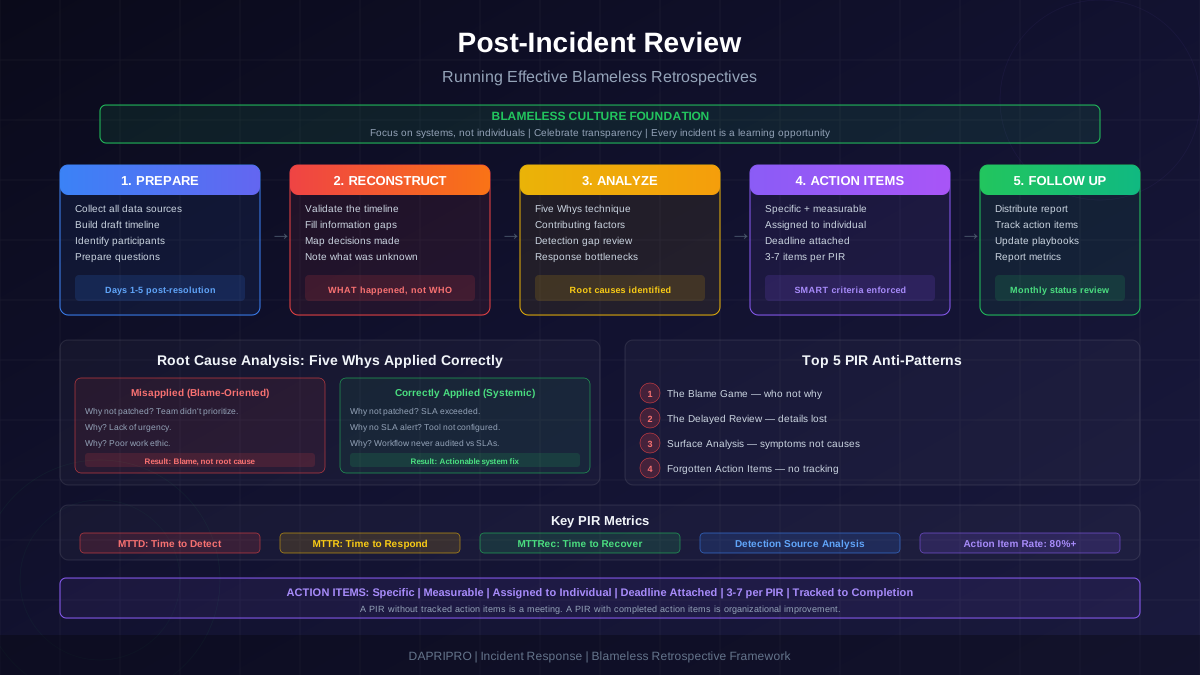
The Five Whys: Applied Correctly
The Five Whys technique works by repeatedly asking "why" until you reach a systemic cause that the organization can address. The technique is powerful but easily misapplied.
Misapplied example (blame-oriented):
- Why did the breach happen? Because the attacker exploited a VPN vulnerability.
- Why was the VPN vulnerable? Because it was not patched.
- Why was it not patched? Because the patching team did not apply the patch.
- Why did the patching team not apply the patch? Because they did not prioritize it.
- Root cause: The patching team failed to prioritize. (This is blame, not root cause.)
Correctly applied example (systemic focus):
- Why was the VPN vulnerability exploitable? Because the patch was not applied within the 30-day SLA for critical vulnerabilities.
- Why was the SLA exceeded? Because no automated alert notified the patching team when the SLA was approaching expiration.
- Why was there no SLA alert? Because the vulnerability management tool does not track SLA compliance for individual assets.
- Why does the VM tool not track this? Because asset-level SLA tracking was not configured during deployment, and no one has reviewed the VM workflow against SLA requirements.
- Root cause: The vulnerability management workflow lacks SLA compliance monitoring, allowing critical patches to silently exceed their remediation window.
The correctly applied version identifies a systemic gap (missing SLA monitoring) that can be fixed with a specific improvement (configure SLA alerting) rather than assigning blame to a team that "should have known."
Contributing Factor Analysis
Most incidents have multiple contributing factors, not a single root cause. Contributing factor analysis maps all the conditions that enabled the incident:
- Process factors — Were procedures documented? Were they followed? Were they adequate for this scenario?
- Technology factors — Did tools work as expected? Were there detection gaps? Did integrations function correctly?
- People factors — Was the team staffed appropriately? Were responders trained for this scenario? Was there adequate coordination?
- Environmental factors — Did timing (weekend, holiday, shift change) affect response? Were there concurrent incidents or competing priorities?
Each contributing factor becomes a potential improvement opportunity. Addressing multiple contributing factors creates defense in depth against recurrence: even if one improvement is not fully effective, the others still reduce risk.
Action Items: The PIR's Most Important Output
The action item list is the primary value output of the PIR. A review without action items is a storytelling session. Action items must be specific, measurable, assigned, and tracked.
Action Item Quality Criteria
Every action item should pass the SMART test:
- Specific — "Improve detection" is not an action item. "Create a SIEM correlation rule that detects lateral movement via PsExec across domain controllers" is specific.
- Measurable — The action item has a clear definition of done. You can objectively verify whether it was completed.
- Assigned — One specific person is responsible for completion (not a team or department). That person may delegate tasks but owns the outcome.
- Realistic — The action item is achievable within the assigned timeline with available resources.
- Time-bound — A specific deadline, not "when we get to it." Deadlines create accountability and enable tracking.
Action Item Categories
Categorize action items to ensure balanced improvement across the security program:
Detection improvements — New SIEM rules, EDR policies, or detection logic that would have detected this incident faster. These directly reduce MTTD for future similar incidents.
Response improvements — Playbook updates, role clarifications, communication template additions, or authorization pre-approvals that would have made the response faster or smoother. These reduce MTTR.
Architecture improvements — Network segmentation changes, access control tightening, or tool deployments that reduce the attack surface or limit attacker lateral movement. These reduce incident impact.
Process improvements — Workflow changes, training programs, tabletop exercises, or documentation updates that address the systemic gaps identified in root cause analysis.
Tracking and Follow-Through
Action items decay rapidly without active tracking. Implement these practices:
Central tracking system — Enter all PIR action items into your existing project tracking system (Jira, Asana, Azure DevOps). Do not maintain a separate spreadsheet that no one checks. Action items should be visible alongside other work items so they compete for resources against normal priorities.
Regular status reviews — Include PIR action item status in monthly security operations reviews. Visibility at the management level ensures that action items receive resources and attention.
PIR opening review — At the start of every PIR, review the status of action items from the previous PIR. This demonstrates that action items matter and creates accountability. If the team consistently sees previous action items incomplete, they will stop investing effort in generating new ones.
Completion metrics — Track the percentage of PIR action items completed on time. Target 80% completion rate. Below 80% indicates a systemic issue with follow-through that undermines the entire PIR program.
PIR Documentation: The Report Template
The PIR report serves multiple audiences and purposes: operational teams reference it for context when similar incidents occur, management uses it for risk assessment and resource allocation, compliance teams use it for regulatory documentation, and future PIR facilitators reference it to identify recurring themes.
Report Structure
Executive summary (1 paragraph) — What happened, when, impact, resolution, and key improvement actions. This section is for leadership who will not read the full report.
Incident timeline — The validated attacker and defender timelines with key events, decisions, and timestamps. This is the factual foundation of the report.
Impact assessment — What was affected (systems, data, users, business operations), quantified where possible. Include both actual impact and potential impact that was avoided through the response.
Root cause analysis — The contributing factors identified through Five Whys and contributing factor analysis. Clearly distinguish between the technical vulnerability (the how) and the systemic factors that allowed it (the why).
What went well — Equally important as what went wrong. Identifying effective practices reinforces them and provides positive feedback to the team. If the phishing detection worked exactly as designed but the escalation process was slow, the report should document both.
What needs improvement — Specific gaps, delays, and failures identified during the review, described in systemic terms (not individual blame).
Action items — The complete action item list with owner, deadline, category, and current status. This section is the most referenced part of the report after publication.
Metrics — MTTD, MTTR, MTTRec, detection source, containment effectiveness, and comparison to organizational benchmarks and historical performance.
PIR Metrics: Measuring Response Effectiveness
Metrics transform subjective impressions ("we responded well") into objective measurements ("we contained the incident in 2.3 hours, which is 40% faster than our 6-month average for this incident type"). Track metrics consistently across incidents to identify trends and measure improvement.
Core Incident Metrics
Mean Time to Detect (MTTD) — Time from initial compromise to detection. This measures your detection capability. Industry benchmarks from CrowdStrike and Mandiant report median dwell times of 10-16 days for externally-detected incidents and 5-7 days for internally-detected incidents. Your MTTD should be declining over time as you improve detection rules, add coverage for new attack types, and implement automated detection.
Mean Time to Respond (MTTR) — Time from detection to containment. This measures your response speed. Target MTTR depends on incident severity: Critical incidents should target containment within 1-4 hours, High within 4-24 hours, and Medium within 1-3 business days. Track MTTR by incident type to identify which attack scenarios your team handles efficiently and which need improved playbooks or tools.
Mean Time to Recover (MTTRec) — Time from containment to full service restoration. This measures your recovery capability and is heavily influenced by backup quality, infrastructure-as-code maturity, and recovery procedure documentation.
Detection source distribution — How incidents are discovered: automated alerts (best), analyst investigation (good), user reports (acceptable), external notification from partners or customers (concerning), or attacker communication like ransomware notes (worst). The distribution reveals detection maturity. A high percentage of externally-detected incidents indicates significant detection gaps.
PIR Program Metrics
In addition to per-incident metrics, track metrics for the PIR program itself:
PIR completion rate — Percentage of qualifying incidents that receive a PIR. Define which severities and incident types require a mandatory PIR. Target 100% completion for qualifying incidents.
Action item completion rate — Percentage of PIR action items completed by their deadline. This is the most important PIR program metric because it measures whether PIRs actually produce improvement. Target 80% or higher.
Action item aging — How long action items remain open. Items that remain open for months indicate either unrealistic scope, insufficient resourcing, or lack of follow-through. Set an escalation threshold: action items open for more than 90 days beyond their deadline get escalated to security leadership.
Recurrence rate — Are similar incidents recurring? If a PIR identified a detection gap and the action item to address it was completed, the same attack type should be detected faster in subsequent occurrences. Recurring incidents of the same type indicate that PIR action items were either not completed or not effective.
From Individual PIR to Continuous Improvement Program
Individual PIRs improve response to specific incident types. A PIR program improves the entire security operation by identifying recurring themes, systematic weaknesses, and organizational patterns.
Trend Analysis Across PIRs
Review PIR findings quarterly to identify patterns:
- Are the same contributing factors appearing across multiple incidents? (e.g., "lack of network segmentation" appearing in three separate PIRs over six months indicates a systematic architectural weakness that individual action items are not addressing)
- Are MTTD and MTTR trending downward over time? Flat or increasing trends indicate that PIR improvements are not having their intended effect.
- Which action item categories (detection, response, architecture, process) are most common? This reveals where the security program needs the most investment.
- Are detection sources shifting from external/user-reported toward automated internal detection? This indicates improving detection maturity.
Integrating PIR Findings into Security Operations
PIR findings should feed directly into four operational workflows:
Playbook updates — Every PIR that involves a playbook should produce at least one playbook improvement: a new step, a clarified decision criterion, an updated contact list, or a new automation integration point. Playbooks that are never updated from PIR findings stagnate and become unreliable.
Detection engineering — PIR-identified detection gaps become detection engineering tickets. If an incident was detected late because no SIEM rule covered the specific technique, that rule becomes a prioritized detection engineering task. PIR-driven detection rules have inherent validation: the incident provides a test case for the new rule.
Architecture reviews — PIR findings that identify architectural weaknesses (insufficient segmentation, overly permissive access, missing logging) feed into security architecture reviews and roadmap prioritization. Individual PIR action items may address immediate gaps, but recurring architectural themes require strategic investment.
Training and exercise programs — PIR findings that identify knowledge gaps, unfamiliar procedures, or coordination failures inform training priorities and tabletop exercise scenarios. If a PIR reveals that the team struggled with cloud forensics, schedule cloud forensics training. If a PIR reveals communication breakdowns during escalation, design a tabletop exercise that stress-tests the escalation process.
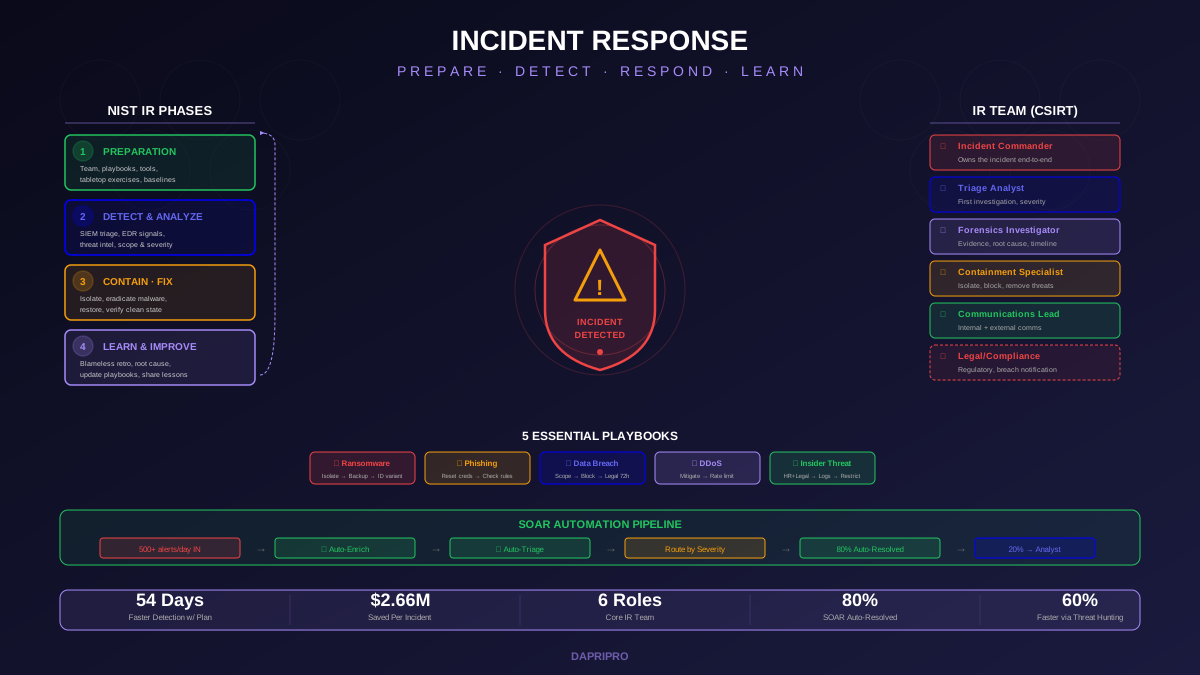
The post-incident review closes the learning loop in incident response. Without it, organizations make the same mistakes repeatedly, respond to familiar attacks as if encountering them for the first time, and invest in security improvements based on assumptions rather than evidence. With a consistent, blameless, well-facilitated PIR program that produces tracked action items, every incident makes the organization measurably more resilient.