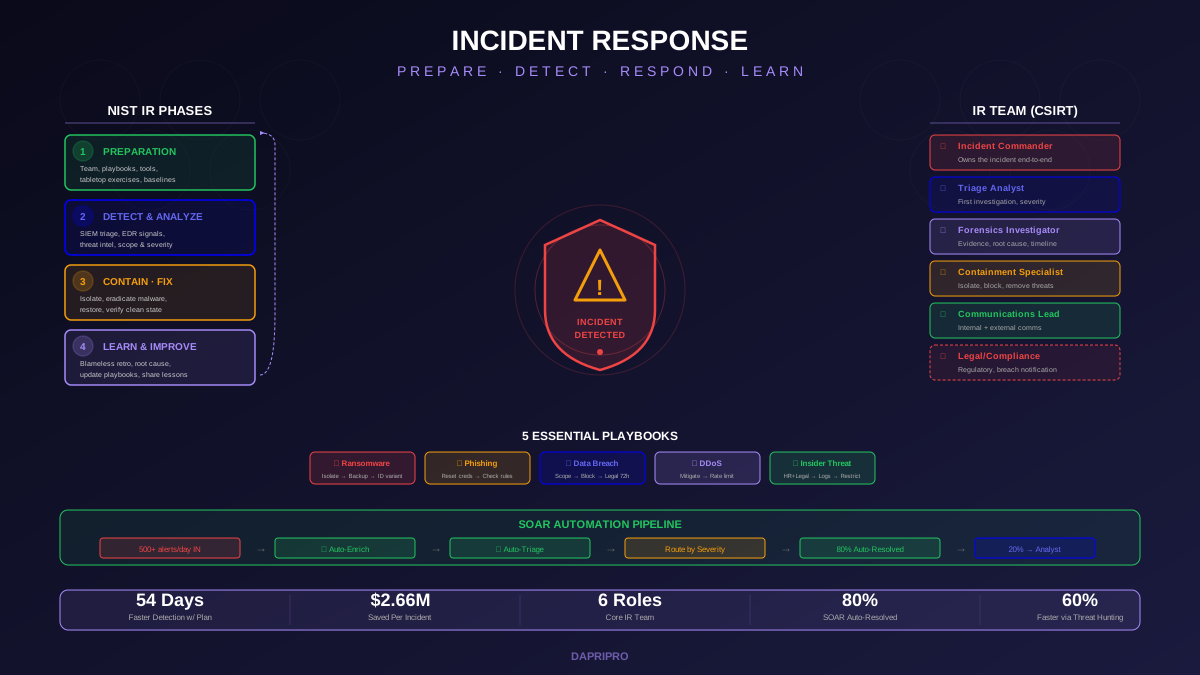

When a security incident hits, the quality of your response depends entirely on the people responding. The best detection tools, the most comprehensive playbooks, and the most expensive SIEM platforms are useless without a team that knows how to interpret alerts, make containment decisions, coordinate across business functions, and drive incidents to resolution while preserving evidence and meeting regulatory obligations.
Building an incident response team is not simply hiring security analysts. It is designing an organizational structure with clear roles, defined authority, tested processes, and sustainable operational rhythms that can function under the extreme pressure of an active security incident. This guide covers how to do that from a standing start through building a mature, scalable IR operation.
The Six Core IR Functions
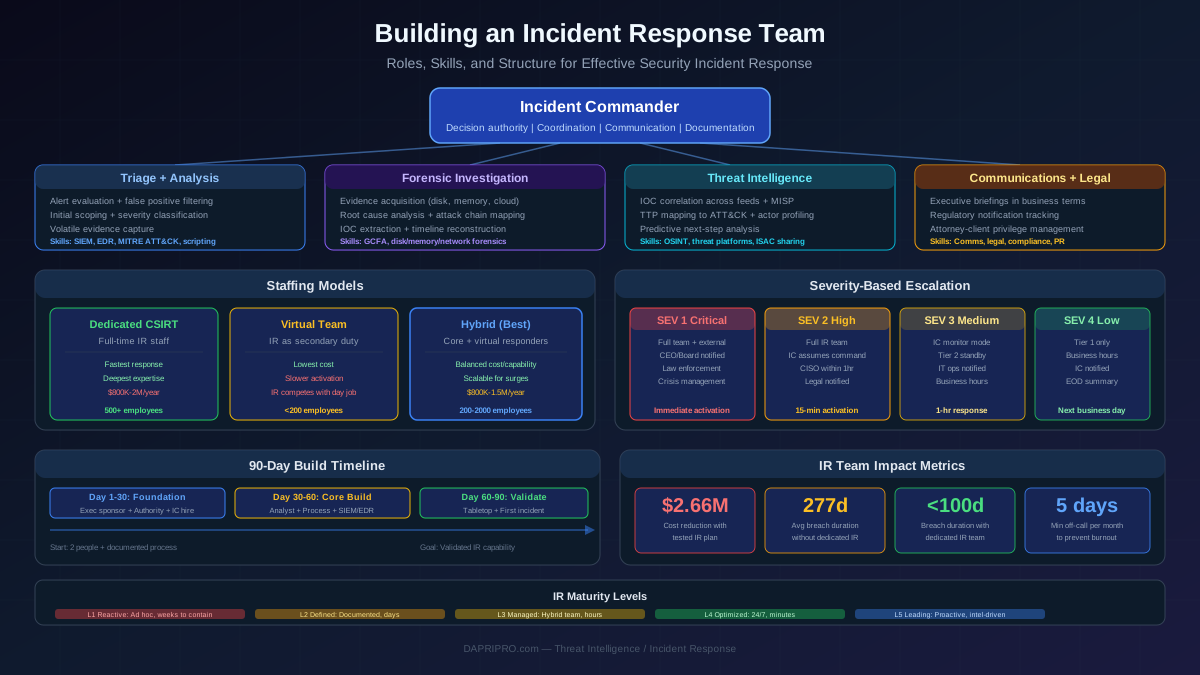
Regardless of team size, every incident response capability must cover six functions. In small teams, one person may cover multiple functions. In large teams, each function may have multiple people. But every function must be explicitly assigned to someone, because functions that are not assigned to anyone become functions that nobody performs during an incident.
1. Incident Command
The incident commander (IC) owns the incident from declaration to closure. The IC does not personally investigate every alert or perform every forensic acquisition. The IC coordinates the response, makes containment and escalation decisions, manages communications, and ensures the incident progresses toward resolution rather than drifting in reactive chaos.
Key responsibilities:
- Decision authority — The IC decides when to escalate severity, when to contain (isolate systems, block traffic, disable accounts), when to engage external resources (legal counsel, law enforcement, third-party forensics), and when to declare the incident resolved.
- Coordination — The IC ensures all team members are working on the right priorities, prevents duplication of effort, and manages dependencies between workstreams (forensics needs network logs, communications needs timeline, legal needs evidence preservation status).
- Communication — The IC provides regular status updates to executive stakeholders, ensures internal communication reaches affected business units, and coordinates with the communications lead on external notifications.
- Documentation oversight — The IC ensures the incident timeline, decisions, actions, and evidence are being documented in real time, not reconstructed from memory after the fact.
Required skills: The IC role requires a rare combination of technical depth (understanding what analysts are reporting), business acumen (assessing impact in business terms), communication skills (translating technical findings for executives), and decisiveness (making containment decisions with incomplete information). This is typically your most senior IR person.
2. Triage and Analysis
Triage analysts are the first line of incident response. They evaluate incoming alerts, perform initial investigation to determine whether an alert represents a real security incident, assess initial severity, and either resolve false positives or escalate confirmed incidents for deeper investigation.
Key responsibilities:
- Alert evaluation — Reviewing SIEM alerts, EDR detections, email security alerts, and user reports to distinguish real incidents from false positives, misconfigurations, and authorized activities.
- Initial scoping — Determining the initial blast radius: which systems are affected, what data may be involved, what the attacker's current access level appears to be.
- Severity classification — Applying the organization's severity framework to assign the appropriate priority level, which determines response timeline, team activation, and executive notification requirements.
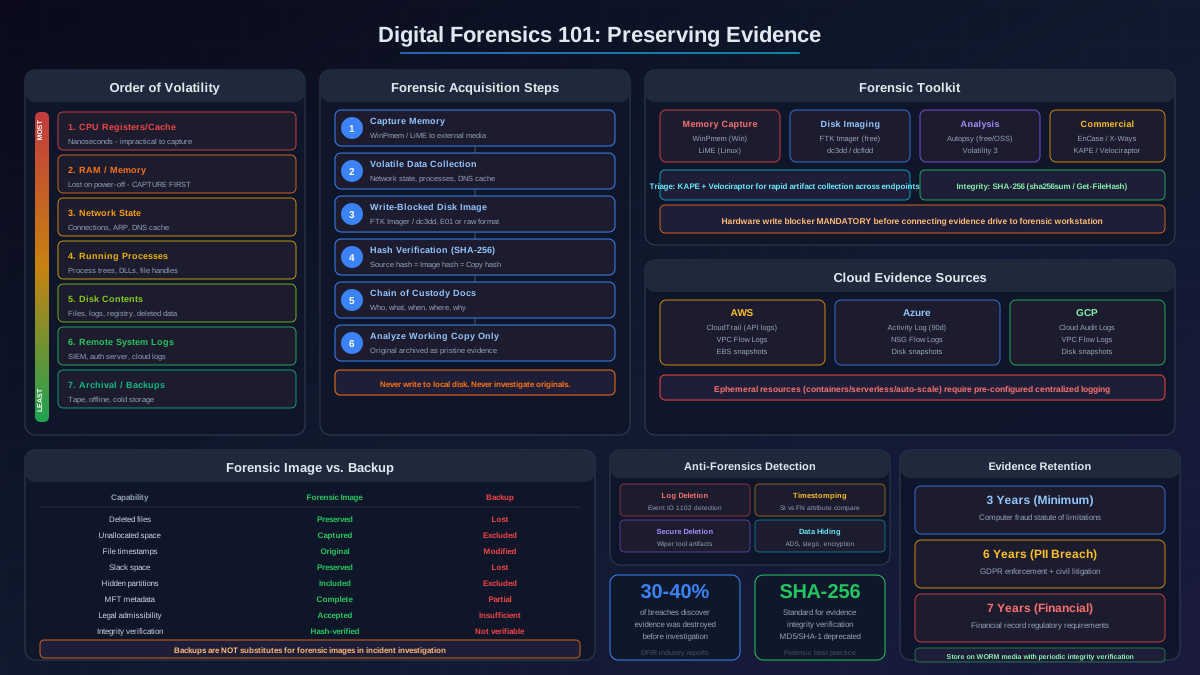
- Evidence collection initiation — Capturing volatile evidence (running processes, network connections, memory) before it is lost to system restarts or attacker cleanup.
Required skills: Log analysis across multiple platforms (SIEM, EDR, network, cloud), familiarity with common attack techniques (MITRE ATT&CK framework), scripting for rapid evidence gathering, and the judgment to distinguish true positives from false positives at scale.
3. Forensic Investigation
Forensic investigators conduct deep-dive analysis of confirmed incidents. While triage determines that an incident occurred and performs initial scoping, forensics determines exactly what happened, how the attacker gained access, what they did, what data they accessed or exfiltrated, and whether the attacker is still present.
Key responsibilities:
- Evidence acquisition — Creating forensically sound images of affected systems (disk images, memory dumps, log archives) using validated tools and documented chain-of-custody procedures.
- Root cause analysis — Tracing the attack from initial access through the entire attack chain: lateral movement, privilege escalation, persistence mechanisms, data staging, and exfiltration.
- Indicator extraction — Identifying indicators of compromise (file hashes, IP addresses, domain names, registry keys, command patterns) that enable detection of the same attacker across other systems.
- Timeline reconstruction — Building a comprehensive timeline of attacker activity from forensic artifacts, correlating events across multiple evidence sources.
Required skills: Disk forensics (file system analysis, timeline analysis, artifact recovery), memory forensics (process analysis, injection detection, rootkit identification), network forensics (PCAP analysis, protocol analysis), and cloud forensics (cloud-native log analysis, API activity reconstruction). Forensic investigators also need strong documentation habits because their findings may be used in legal proceedings.
4. Threat Intelligence
The threat intelligence function provides adversary context during incidents. Rather than investigating the incident in isolation, threat intelligence correlates observed attacker techniques, infrastructure, and targets with known threat actor profiles to inform response decisions.
Key responsibilities:
- Indicator correlation — Matching observed IOCs against threat intelligence feeds, internal historical data, and community sharing platforms (ISACs, MISP) to identify known attacker infrastructure.
- TTP mapping — Mapping observed attacker behavior to MITRE ATT&CK techniques and comparing against known threat actor profiles to predict likely next steps.
- Broader context — Answering questions the IC needs: Is this a targeted attack or opportunistic? Is this threat actor known to exfiltrate data or deploy ransomware? Are other organizations in our sector being targeted simultaneously?
5. Communications
The communications function manages all incident-related messaging to internal and external audiences. During a significant incident, communications becomes one of the highest-priority functions because poor communication creates organizational panic, inaccurate public statements create legal liability, and delayed notifications violate regulatory requirements.
Key responsibilities:
- Executive briefings — Regular (hourly during critical incidents) status updates to C-suite and board members using business language, not technical jargon.
- Internal notifications — Alerting affected business units, IT operations, customer support, and other teams that need to take action or prepare for customer inquiries.
- External communications — Coordinating with public relations, legal, and marketing on public statements, customer notifications, and media responses.
- Regulatory notifications — Tracking notification requirements across applicable regulations (GDPR 72-hour window, state breach notification laws, SEC disclosure rules) and ensuring timely compliance.
6. Legal and Compliance Liaison
The legal liaison ensures the incident response stays within legal bounds and meets regulatory obligations. This function is often underestimated until an organization discovers mid-incident that their forensic collection violated privacy laws, their evidence handling broke chain of custody, or their notification timeline missed a regulatory deadline.
Key responsibilities:
- Privilege management — Establishing attorney-client privilege over incident investigation communications where applicable, which can protect sensitive findings from discovery in subsequent litigation.
- Regulatory tracking — Maintaining a real-time checklist of notification obligations triggered by the incident's scope (data types, jurisdictions, affected populations).
- Evidence preservation — Ensuring forensic activities meet evidentiary standards if the incident leads to criminal prosecution, civil litigation, or regulatory enforcement.
- Third-party engagement — Managing contracts with external forensic firms, breach counsel, and notification service providers.
Choosing Your Staffing Model
The right staffing model depends on your organization's size, risk profile, incident volume, and regulatory environment. There is no single correct answer, but there are models that clearly fail: attempting to build a dedicated CSIRT in a 50-person company wastes budget, and relying on a purely virtual team in a heavily regulated enterprise with frequent incidents guarantees slow response and compliance failures.
Dedicated CSIRT
A dedicated Computer Security Incident Response Team has full-time staff whose primary responsibility is incident response. They do not manage firewalls, patch servers, or handle helpdesk tickets. They investigate incidents, maintain IR capabilities, conduct threat hunting, and improve detection and response processes.
When to choose dedicated: Organizations with more than 500 employees in regulated industries (financial services, healthcare, critical infrastructure), organizations that experience more than 50 confirmed security incidents per year, and organizations whose risk profile demands response times measured in minutes rather than hours. Annual cost for a basic dedicated team (IC plus 4 analysts) ranges from $800,000 to $2 million in fully-loaded compensation, tooling, and training.
Virtual Team
A virtual IR team consists of IT professionals who have incident response as a secondary responsibility. They hold their primary IT roles (network administration, system administration, application support) and activate for IR duties when an incident occurs.
When to choose virtual: Organizations with fewer than 200 employees, low incident volume (fewer than 20 confirmed incidents per year), limited security budget, and lower regulatory pressure. The primary risk with virtual teams is activation time: team members are in the middle of their primary responsibilities when an incident is declared, and it takes time to hand off their current work and shift to incident response mode. Virtual teams also struggle with skill maintenance because team members practice IR infrequently.
Hybrid Model (Recommended for Mid-Market)
The hybrid model combines a small dedicated core team (typically 2-4 full-time IR professionals) with a broader pool of trained virtual responders drawn from IT operations, security engineering, and other technical teams. The dedicated core handles incident command, initial triage, forensic investigation, and capability development. Virtual responders provide scale during significant incidents, contributing their domain expertise (network operations, cloud infrastructure, application architecture) to the response effort.
When to choose hybrid: Organizations with 200 to 2,000 employees that experience moderate incident volume, need faster-than-virtual response times, but cannot justify the cost of a fully dedicated team. The hybrid model is the most common structure for mid-market organizations because it provides dedicated expertise where it matters most (IC and forensics) while leveraging existing IT talent for scale.
Building from Scratch: The First 90 Days
If you are starting an IR program from zero, the first 90 days should follow a structured ramp that delivers value incrementally rather than attempting to build everything at once.
Days 1-30: Foundation
Secure executive sponsorship. Before hiring anyone, get a C-level sponsor (CISO, CIO, or CTO) who will champion the IR program, ensure cross-functional cooperation, and provide the budget authority for tooling and staffing. Without executive sponsorship, your IR team will fight organizational friction during every incident.
Define authority and escalation. Document what the IR team is authorized to do during an active incident without waiting for approval: isolate systems from the network, disable user accounts, block IP addresses, shut down services, engage external forensic support. Also document what requires approval and from whom: notifying customers, engaging law enforcement, issuing public statements, shutting down revenue-generating systems.
Hire your incident commander. Your first hire should be a senior IR professional who will serve as incident commander and build the program. This person needs at least 5 years of hands-on incident response experience, ideally in your industry. They will define processes, select tooling, hire additional team members, and establish relationships with IT operations, legal, and executive leadership.
Days 30-60: Core Capability
Hire or designate your triage analyst. Your second hire handles first-line alert review and initial investigation. In a hybrid model, this may be an existing SOC analyst or security operations engineer who takes on dedicated IR responsibilities.
Establish the incident response process. Document your incident lifecycle: detection, triage, declaration, investigation, containment, eradication, recovery, and post-incident review. Define severity levels with clear criteria and corresponding response actions. Create communication templates for executive updates, internal notifications, and regulatory reporting.
Deploy core tooling. At minimum, your team needs: a SIEM or log aggregation platform for centralized log analysis, an EDR platform for endpoint investigation and containment, a case management system (can start with a shared wiki or ticketing system), and a secure communication channel that does not depend on potentially-compromised corporate infrastructure (out-of-band communication).
Days 60-90: Validation
Conduct your first tabletop exercise. Run a scenario-based exercise with your full response team (IR staff, IT operations, legal, communications, executive stakeholders). Use a realistic scenario: ransomware impacting production servers, business email compromise targeting executive accounts, or data exfiltration detected by your DLP tools. The goal is not to test technical skills but to validate that the process works: can the IC reach the right people? Do escalation paths function? Does the authority matrix hold under pressure?
Handle your first real incident. With the foundation in place, your team should process their first real incident using the defined process. It will not go perfectly. Document every gap and friction point for improvement. The goal for the first real incident is not flawless execution but learning: identifying what works, what does not, and what needs to change.
On-Call Rotation Design
On-call is where IR team sustainability lives or dies. Poorly designed on-call rotations burn out analysts within 12-18 months, driving your most experienced people to leave for organizations with more sustainable operational models. The cost of losing a trained incident responder and hiring a replacement typically exceeds six months of salary in recruiting, training, and productivity loss.
Rotation Principles
Minimum 5 consecutive days off-call per month. Each team member needs at least one full week per month where they are not on-call and not expected to respond to after-hours incidents. This is not generous. It is the minimum required for sustained performance. Teams that provide fewer off-call days see measurable declines in analyst performance, increased error rates in investigations, and higher turnover.
Separate on-call tiers. Tier 1 on-call handles initial triage and determines whether an alert requires escalation. Tier 2 on-call provides deeper investigation capabilities and is only activated when Tier 1 escalates. This reduces the burden on senior responders who should not be woken up for false positives.
Compensate on-call appropriately. On-call carries a real quality-of-life cost. Compensate it through a combination of on-call stipends (typically $200-500 per on-call shift), incident response bonuses for after-hours activations, and compensatory time off after incident responses.
Monitor on-call health metrics. Track pages per on-call shift, after-hours activations per month, mean time to acknowledge, and false positive rate for after-hours alerts. Rising page counts or declining response times indicate the rotation is becoming unsustainable.
Coverage Models by Team Size
For a 2-person team, provide business-hours coverage only. After-hours incidents are handled by MDR provider or on-call IT operations with escalation procedures. This is not ideal, but attempting 24/7 coverage with two people guarantees burnout within months.
For a 4-6 person team, implement a follow-the-sun model if team members are geographically distributed, or a weekly rotation with Tier 1/Tier 2 split. Each analyst is on-call for one week per month as Tier 1, with a separate Tier 2 rotation for senior responders.
For an 8+ person team, implement full 24/7 coverage with three shifts (day, evening, night) and dedicated weekend coverage. This requires at least 8 people to provide sustainable coverage with adequate rest and vacation accommodation.
Escalation Framework
Escalation is not about finding someone to blame. It is about getting the right resources, authority, and visibility applied to an incident at the right time. Define escalation triggers clearly so that analysts do not have to make judgment calls about whether to wake up the CISO at 3 AM.
Severity-Based Escalation
Severity 4 (Low) — Contained, minimal-impact incidents such as isolated malware infections on non-critical endpoints, unsuccessful phishing attempts, and policy violations. Handled by Tier 1 analyst during business hours. IC notified but not activated. No executive notification.
Severity 3 (Medium) — Incidents with limited scope but potential for expansion: successful phishing with credential harvesting, detection of unauthorized scanning, or alerts on sensitive systems that require investigation. IC activated to monitor. IT operations notified for potential containment support.
Severity 2 (High) — Confirmed compromise with significant scope: active attacker presence on multiple systems, ransomware execution on production infrastructure, or confirmed data access involving sensitive data. Full IR team activation. IC assumes command. CISO briefed within 1 hour. Legal notified for privilege assessment. Business unit leaders notified for impact assessment.
Severity 1 (Critical) — Organization-threatening incidents: widespread ransomware, confirmed exfiltration of large volumes of sensitive data, compromise of critical business systems (payment processing, customer databases, core applications). Full team plus executive crisis management. CEO/Board notification. External forensic firm activation. Legal counsel engaged. Communication plan activated. Business continuity procedures may be invoked.
Cross-Functional Integration
An IR team that operates in isolation from the rest of the organization will fail. Incident response touches IT operations (who must execute containment and recovery actions), legal (who manage regulatory and litigation exposure), executive leadership (who make business impact decisions), HR (who handle insider threat cases), communications (who manage public messaging), and business units (who assess operational impact). Pre-incident relationship building is essential. The middle of a critical incident is the worst time to introduce yourself to the general counsel.
IT Operations Partnership
IT operations executes many of the containment and recovery actions the IR team directs. The IR team decides to isolate a server. IT operations performs the network change. The IR team determines a user account is compromised. IT operations disables the account and resets credentials. This partnership must be pre-established, with clear protocols for how IR team requests are communicated to IT ops, what priority they receive relative to other IT work, and what approvals are required.
Critical pre-agreements: IR containment actions bypass normal change management during declared incidents. IT operations designates an on-call contact for IR team requests. Network, systems, and identity teams each have documented procedures for common containment actions (host isolation, account disable, firewall rule addition, DNS sinkhole).
Legal Partnership
Legal counsel should be engaged early in significant incidents, not after the IR team has already made decisions with legal implications. Key integration points include: when to establish attorney-client privilege over investigation communications, when breach notification obligations are triggered, how to handle law enforcement requests without compromising the investigation, what evidence preservation standards apply if litigation is anticipated, and how to manage third-party forensic firm engagement under privilege.
Executive Communication
Executives need incident information in business terms, not technical terms. Instead of reporting "we detected Cobalt Strike beacons communicating with C2 infrastructure on three domain controllers," report "an advanced attacker has control of critical authentication infrastructure, affecting our ability to trust user logins across the organization. Estimated business impact is potential access to all enterprise applications and data. Containment actions will require temporary disruption to authentication services."
Create executive communication templates in advance with fields for: incident summary (2 sentences), business impact (current and potential), containment status, estimated time to resolution, decisions needed from leadership, and next update time. These templates prevent the common failure mode of overwhelm: dumping too much technical detail on executives who need impact assessment and decision support.
Skill Development and Training
IR team skills degrade without practice. An analyst who handled a complex ransomware incident 18 months ago but has not practiced forensics since will not perform at the same level when the next ransomware incident occurs. Continuous skill development takes three forms:
Tabletop Exercises
Monthly tabletop exercises test decision-making, communication, and process execution without the stress and time pressure of real incidents. Rotate scenarios across different attack types: ransomware, business email compromise, insider threat, supply chain compromise, DDoS, data exfiltration, and cloud infrastructure compromise. Include cross-functional participants (legal, communications, IT ops, business leadership) in at least quarterly exercises.
Good tabletop exercises include injects: mid-exercise developments that change the situation and force the team to adapt. Examples: during a ransomware tabletop, inject that the attacker is actively exfiltrating data. During a BEC tabletop, inject that the compromised executive's email was used to send wire transfer instructions to the finance team.
Technical Training
Allocate at least 40 hours per year per analyst for technical training. Priority areas include forensic analysis (disk, memory, network, cloud), malware analysis (static and dynamic), threat hunting (hypothesis-driven detection), and attack simulation (purple teaming). Training should include hands-on lab environments where analysts practice with real tools against realistic attack scenarios. Courses from SANS (GCIH, GCFA, GCFE, GNFA), SpecterOps, and CrowdStrike provide structured curricula.
Purple Team Exercises
Purple team exercises combine offensive (red team) testing with defensive (blue team) monitoring to validate that your detection and response capabilities actually work against realistic attack techniques. Unlike penetration tests where the blue team is not informed, purple team exercises are collaborative: the red team executes specific techniques while the blue team attempts to detect and respond in real time. After each technique, both teams compare notes: did the blue team detect it? How long did detection take? Was the alert actionable? What would need to change to detect it faster?
Maturity Assessment
IR team maturity develops progressively. Understanding where you are helps set realistic goals for improvement.
Level 1 — Reactive: No dedicated IR staff. Ad hoc response to incidents by IT operations. No documented process. No regular exercises. Mean time to detect and contain measured in weeks. This is where most organizations start.
Level 2 — Defined: Documented IR process exists. At least one person with defined IR responsibilities. Basic severity classification. Annual tabletop exercise. Response times measured in days. The minimum acceptable level for organizations with any regulatory obligations.
Level 3 — Managed: Dedicated IR team (hybrid or full). Defined on-call rotation. Regular tabletop exercises (quarterly+). Case management system in use. Cross-functional integration with IT ops, legal, and executives. Response times measured in hours. The target for most mid-market organizations.
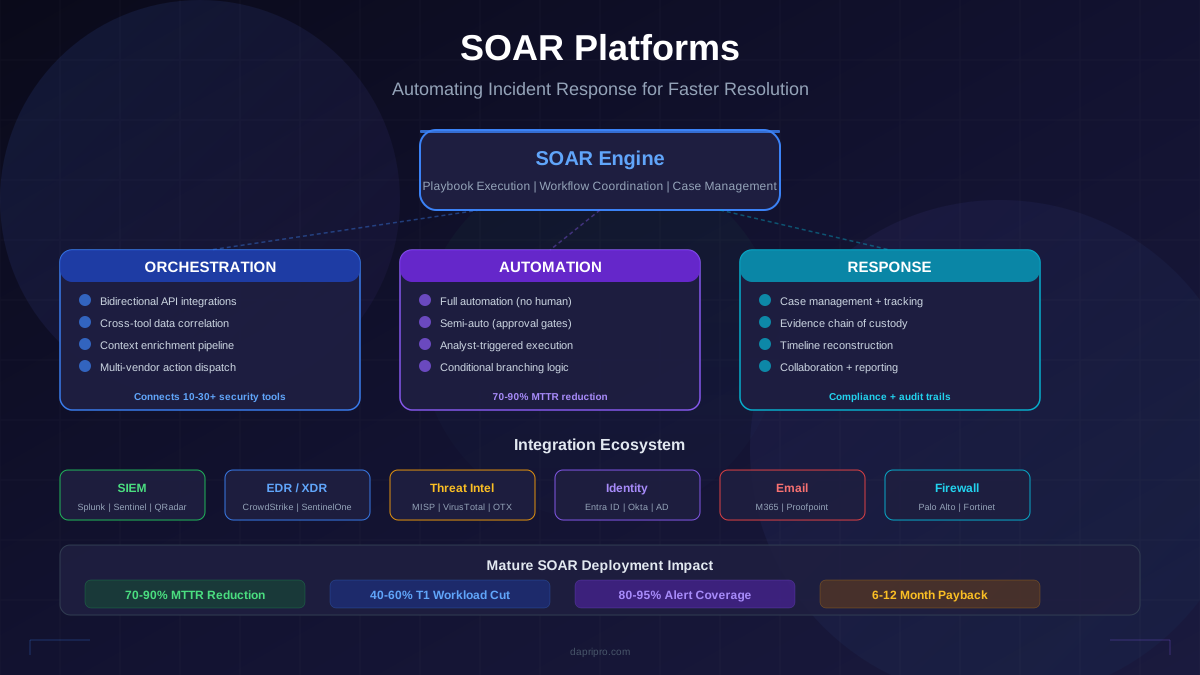
Level 4 — Optimized: Mature IR team with specialized roles. 24/7 coverage. Monthly exercises including purple team. Threat hunting program. SOAR automation for common response actions. Metrics-driven improvement. Response times measured in minutes for initial triage. The target for large enterprises and regulated industries.
Level 5 — Leading: Proactive threat detection and intelligence-driven operations. Active contribution to community threat sharing. Continuous improvement through post-incident reviews and exercise findings. Custom detection engineering. Research-level forensic capabilities. Only a small percentage of organizations reach this level, and maintaining it requires sustained investment and leadership commitment.
Building an incident response team is not a one-time project. It is an ongoing operational commitment to maintaining the people, processes, and tools that determine whether a security incident becomes a controlled event or an organizational crisis. Start with two people and a documented process. Add capabilities based on demonstrated need. Validate everything through exercises. And protect your team from burnout, because the best process in the world is worthless when the people who execute it are too exhausted to perform.