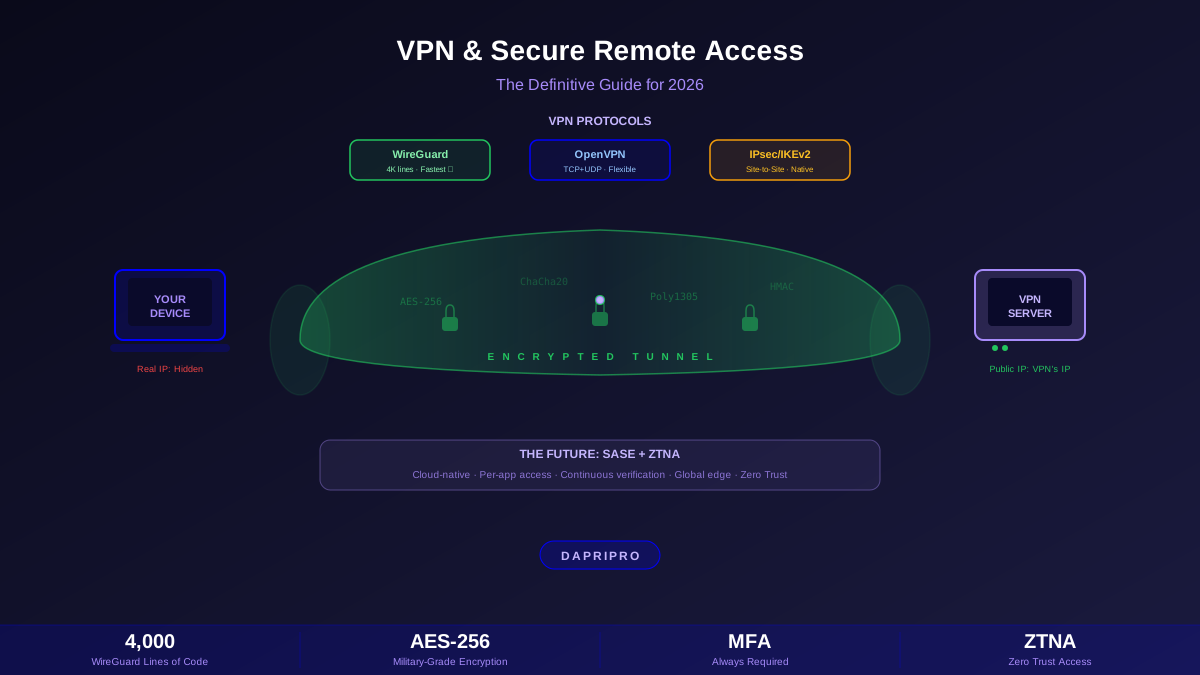

The VPN protocol you choose determines your connection speed, your security guarantees, and what networks you can connect through. Every other VPN decision — the vendor, the client software, the server hardware — is secondary to the protocol running underneath. A misconfigured protocol negates expensive hardware. The right protocol on commodity hardware outperforms the wrong one on enterprise gear.
This is a technical comparison of WireGuard, OpenVPN, and IPSec (with IKEv2) based on actual protocol mechanics, benchmark data, and deployment experience — not vendor marketing. Each protocol has clear strengths, clear weaknesses, and specific scenarios where it is the best or worst choice.
Protocol Architecture: How Each One Works
WireGuard
WireGuard is a Layer 3 VPN protocol that creates a virtual network interface (wg0) and routes encrypted UDP packets between peers. It runs as a Linux kernel module (in-kernel since Linux 5.6) or uses platform-specific kernel-level drivers on Windows (wintun) and macOS. Each peer is identified by a Curve25519 public key. There is no session negotiation, no cipher suite selection, and no handshake in the traditional sense — peers perform a 1-RTT (one round trip) Noise protocol handshake using pre-shared public keys, and data starts flowing immediately.
The cryptographic suite is fixed and not configurable:
| Function | Algorithm | Purpose |
|---|---|---|
| Symmetric encryption | ChaCha20-Poly1305 | Encrypts and authenticates each packet (AEAD) |
| Key exchange | Curve25519 (ECDH) | Derives shared secret between peers |
| Hashing | BLAKE2s | Key derivation and MAC operations |
| Hash table keying | SipHash24 | Prevents hash table collision attacks |
| Key derivation | HKDF | Derives session keys from handshake output |
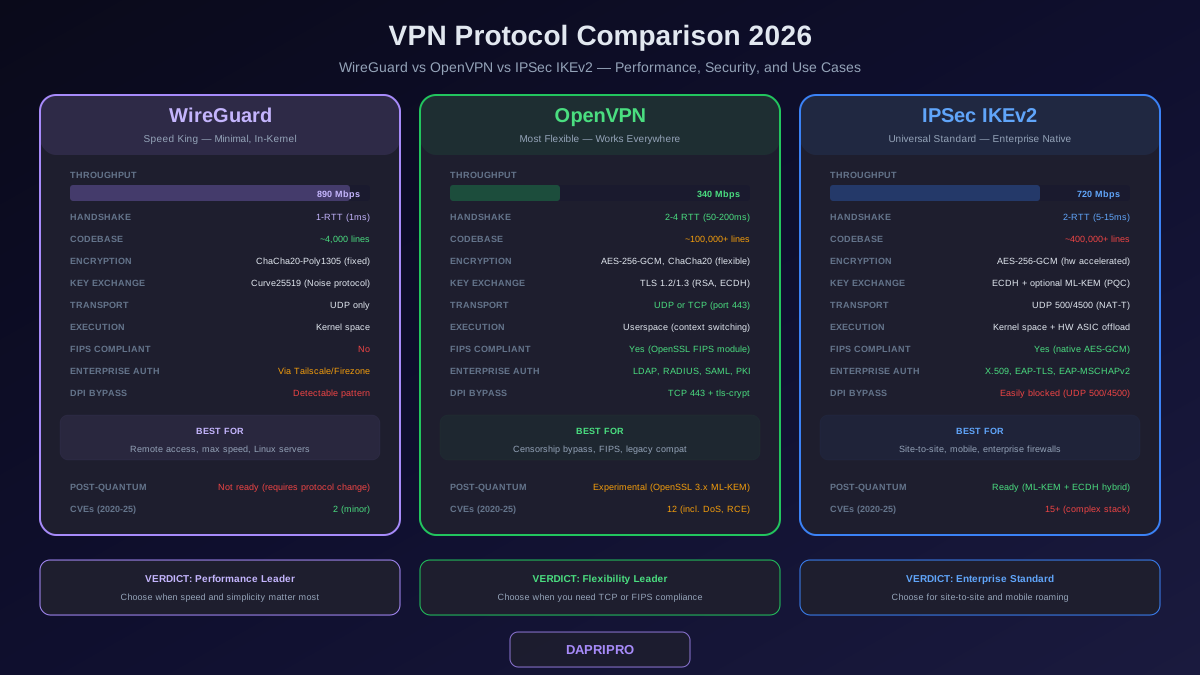
The entire WireGuard codebase is approximately 4,000 lines of C code in the Linux kernel implementation. For comparison, OpenVPN is over 100,000 lines, and the IPSec stack in the Linux kernel (StrongSwan) exceeds 400,000 lines. This matters for security auditing — every line of code is a potential vulnerability, and WireGuard's small surface area has been formally verified by multiple independent security firms.
OpenVPN
OpenVPN is a userspace VPN that uses the OpenSSL library (or mbedTLS) for cryptographic operations. It creates a virtual network interface (tun0 or tap0) and encrypts traffic using a TLS-based control channel for key exchange and a separate data channel for encrypted packet transport. The TLS control channel performs a full TLS 1.2 or 1.3 handshake (2-RTT minimum) to authenticate peers and negotiate cipher suites before any VPN traffic flows.
OpenVPN supports an extensive list of cipher suites, authentication methods, and transport modes:
Transport: UDP (recommended for performance) or TCP (for firewall traversal). TCP mode can run on port 443, making it indistinguishable from HTTPS traffic to most firewalls and DPI systems.
Encryption: AES-256-GCM (recommended), AES-128-GCM, ChaCha20-Poly1305 (OpenVPN 2.5+), and legacy options like AES-256-CBC with HMAC-SHA256.
Authentication: X.509 certificates (PKI), username/password with RADIUS or LDAP backend, SAML/OIDC via plugins, pre-shared keys, and any combination of these methods.
The key architectural difference from WireGuard: OpenVPN runs entirely in userspace. Every packet must be copied from the kernel network stack to the OpenVPN process (user space), encrypted, and then copied back to the kernel for transmission. This user-kernel context switching is the primary reason OpenVPN is slower than WireGuard at high throughput.
IPSec with IKEv2
IPSec is not a single protocol but a framework of protocols. IKEv2 (Internet Key Exchange version 2) handles authentication and key negotiation. ESP (Encapsulating Security Payload) handles the actual packet encryption and authentication. IPSec operates at the network layer (Layer 3) and is implemented directly in the operating system kernel on every major platform — Windows, macOS, Linux, iOS, and Android all have native IPSec stacks.
IKEv2 supports extensive cipher suite negotiation. A typical modern configuration uses:
| IPSec Phase | Recommended Algorithms | Purpose |
|---|---|---|
| IKE SA (Phase 1) | AES-256-GCM, SHA-384, DH Group 20 (NIST P-384) or 21 (NIST P-521) | Authenticates peers and establishes IKE security association |
| Child SA (Phase 2) | AES-256-GCM, SHA-384, PFS with DH Group 20 | Negotiates encryption for actual data traffic (ESP) |
| Authentication | X.509 certificates, EAP-TLS, EAP-MSCHAPv2 | Verifies peer identity |
IKEv2's standout feature for mobile users is MOBIKE (RFC 4555) — when a device switches from Wi-Fi to cellular (or vice versa), the IKEv2 session migrates to the new IP address without renegotiating the security association. The existing session keys remain valid, and the VPN connection survives the network change with zero packet loss. WireGuard handles this partially (peers can roam because they are identified by public key, not IP), but the roaming behavior requires the remote endpoint to send a keepalive packet after the address change, introducing a brief connectivity gap. OpenVPN must fully renegotiate the TLS session on address change, causing a multi-second reconnection delay.
Security Comparison: Cryptographic Strength and Attack Surface
Cipher Agility vs. Fixed Cryptography
This is the most debated architectural difference between the three protocols. OpenVPN and IPSec both support cipher agility — the ability to negotiate and switch between different encryption algorithms through configuration. If AES-256-GCM is found to have a vulnerability, you can switch to ChaCha20-Poly1305 by changing a configuration line. WireGuard takes the opposite approach: it uses a fixed, non-negotiable cryptographic suite. If ChaCha20 is broken, you cannot patch it with a configuration change — you must upgrade to a new version of WireGuard with a different protocol version (called a "protocol version bump").
Both approaches have valid security arguments:
Fixed crypto (WireGuard): Eliminates downgrade attacks entirely. There is no way for an attacker to force the connection to use a weaker cipher because there is only one cipher. Reduces implementation complexity and the risk of configuration errors. Easier to audit because there is one code path, not dozens.
Cipher agility (OpenVPN/IPSec): Provides migration flexibility when vulnerabilities are discovered. Allows organizations to meet specific compliance requirements that mandate particular algorithms (FIPS 140-2/3 requires AES, which WireGuard does not use). Enables post-quantum cryptography migration without replacing the entire protocol.
Attack Surface Comparison
| Metric | WireGuard | OpenVPN | IPSec (StrongSwan) |
|---|---|---|---|
| Lines of code | ~4,000 | ~100,000+ | ~400,000+ |
| Execution context | Kernel space | Userspace | Kernel space |
| External dependencies | None (uses kernel crypto API) | OpenSSL or mbedTLS | Kernel crypto API + multiple RFCs |
| CVEs (2020-2025) | 2 (minor information leak) | 12 (including DoS and RCE) | 15+ (across StrongSwan and kernel) |
| Formal verification | Yes (multiple) | Partial (OpenSSL audited separately) | No comprehensive verification |
| FIPS 140-2/3 compliant | No (ChaCha20 not FIPS-approved) | Yes (with OpenSSL FIPS module) | Yes (native AES-GCM support) |
Privacy Consideration: IP Address Logging
WireGuard has a privacy trade-off that is often overlooked: it requires static peer configurations with known public keys, and the last seen endpoint IP address of each peer is stored in memory (and visible via the wg show command) for the entire duration of the connection. This means the VPN server always knows the real IP address of every connected peer, and this information persists in memory until the interface is taken down. OpenVPN and IPSec can be configured to discard client IP addresses after session termination, and NAT makes the source IP less attributable in many deployments.
For privacy-focused VPN providers, this is a concern. Some have implemented workarounds (like Mullvad's NAT-based architecture and automatic key rotation), but the issue is inherent to WireGuard's design.
Choosing the Right Protocol for Your Scenario
Remote Access VPN (Employees Working from Home)
Best choice: WireGuard (via Tailscale, NetBird, or Firezone) or IKEv2
For remote access where you control both the client and server, WireGuard provides the best performance and simplest configuration. Use a management layer like Tailscale or Firezone to add the enterprise features (SSO, ACLs, audit logging) that WireGuard lacks natively. IKEv2 is the best alternative if you need native OS support without installing third-party software — Windows, macOS, iOS, and Android all have built-in IKEv2 clients.
Avoid OpenVPN for new remote access deployments unless you specifically need TCP port 443 tunnel capability for users behind restrictive firewalls (corporate guest networks, hotel Wi-Fi, some countries with DPI-based VPN blocking).
Site-to-Site VPN (Connecting Office Networks)
Best choice: IPSec IKEv2
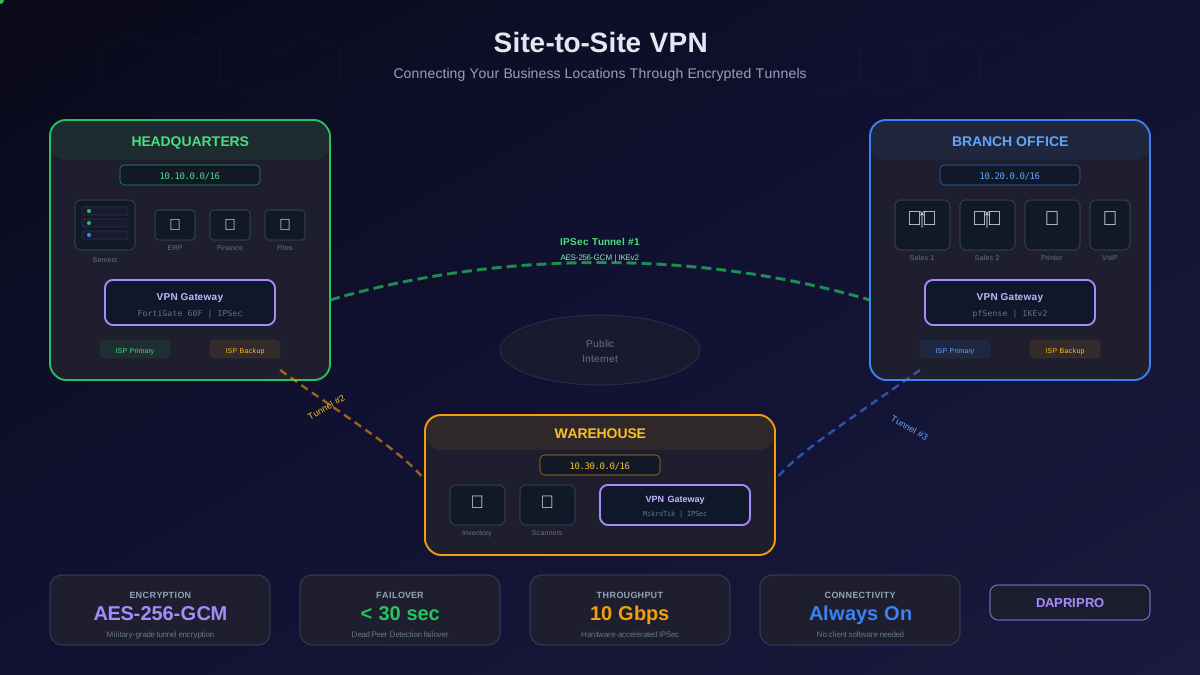
This is not even close. IPSec IKEv2 is supported by every enterprise firewall (FortiGate, Palo Alto, Cisco ASA/FTD, pfSense, OPNsense), every cloud VPN gateway (AWS Site-to-Site VPN, Azure VPN Gateway, GCP Cloud VPN), and every enterprise router. You can establish a site-to-site tunnel between a FortiGate at one site and a Palo Alto at another site using IPSec with zero compatibility issues. Try doing that with WireGuard or OpenVPN — the FortiGate does not support WireGuard, and OpenVPN compatibility between different vendor implementations is inconsistent.
WireGuard is a viable option for site-to-site if both endpoints run Linux, pfSense, or OPNsense. It delivers better throughput than IPSec on the same hardware, but you sacrifice the interoperability that makes IPSec the universal site-to-site standard.
Mobile VPN (Phone and Tablet Users)
Best choice: IKEv2 with MOBIKE
Mobile users switch between Wi-Fi and cellular networks constantly — walking from a conference room (Wi-Fi) to a parking lot (cellular) to a coffee shop (different Wi-Fi). IKEv2's MOBIKE extension handles these transitions seamlessly, keeping the VPN connection alive across network changes without renegotiating the session. WireGuard handles roaming reasonably well (because peers are identified by public key, not IP), but the roaming detection relies on keepalive packets and can introduce 5 to 15 seconds of connectivity gap during network transitions. OpenVPN must fully renegotiate TLS on network change, causing 10 to 30 second reconnection delays.
Bypassing Censorship and DPI
Best choice: OpenVPN over TCP port 443
When connecting from countries or networks that actively detect and block VPN traffic using deep packet inspection (DPI), OpenVPN over TCP 443 is often the only protocol that works. Because it uses TLS, the traffic resembles standard HTTPS web browsing. Adding the tls-crypt or obfsproxy options further obscures the traffic pattern. WireGuard uses UDP with a distinctive packet format that DPI systems can identify and block. IPSec uses well-known ports (UDP 500 and 4500) that are easy to block at the firewall level.
Configuration Examples for Each Protocol
WireGuard Server Configuration
A minimal WireGuard server configuration creates a tunnel interface, assigns an IP address, and defines peers by their public keys. The configuration file lives at /etc/wireguard/wg0.conf on Linux:
The [Interface] section defines the server's private key, the tunnel IP address (typically a /24 from a private range), the listening port (default 51820/UDP), and optional PostUp/PostDown commands for firewall rules. Each [Peer] section defines a client by its public key, the allowed IP range for that peer (their assigned tunnel IP), and optionally a PresharedKey for additional symmetric encryption on top of the Curve25519 key exchange.
Key management is simple but manual: you generate a key pair on each device, and you must distribute the public key to every peer that needs to communicate with that device. There is no certificate authority, no key revocation list, and no key expiration. When you need to revoke a user's access, you remove their [Peer] section from the server configuration and reload. For large deployments, this manual key management does not scale — which is why management layers like Tailscale and Firezone exist.
OpenVPN Server Configuration
OpenVPN's configuration is considerably more complex, reflecting its broader feature set. A production server configuration includes the TLS certificate chain (CA certificate, server certificate, server key, DH parameters), cipher suite selection, compression settings, pushed routes for split tunneling, and authentication backend configuration.
The critical settings for a secure 2026 deployment: use tls-version-min 1.2, set cipher AES-256-GCM, enable tls-crypt (not just tls-auth) to encrypt the control channel and prevent DPI fingerprinting, disable compression (compression oracles like VORACLE can leak plaintext), and set reneg-sec to force periodic rekeying (default is 3600 seconds / one hour).
IPSec IKEv2 with StrongSwan
StrongSwan uses swanctl.conf (or the legacy ipsec.conf) for configuration. A site-to-site configuration defines the IKE security association (Phase 1), the child security association (Phase 2), and the authentication method. The local and remote sections specify the endpoints, authentication type (typically X.509 certificates or PSK for testing), and the traffic selectors (which subnets should be encrypted).
For remote access VPN, StrongSwan acts as an IKEv2 server that assigns virtual IP addresses to connecting clients from a pool, pushes DNS servers, and optionally pushes routes for split tunneling — similar to how a commercial VPN concentrator works. The advantage is that clients use the native IKEv2 client built into their operating system, so there is nothing to install.
Performance Tuning for Each Protocol
WireGuard Performance Optimization
WireGuard's performance is limited primarily by CPU and MTU configuration. Ensure the MTU of the WireGuard interface is set correctly — typically 1420 for IPv4 (1500 minus 80 bytes of WireGuard overhead) and 1400 for IPv6. An incorrect MTU causes fragmentation, which halves throughput. On multi-core servers, WireGuard in the Linux kernel automatically parallelizes encryption across available CPU cores. No additional tuning is needed for multi-threaded performance.
OpenVPN Performance Optimization
OpenVPN's biggest performance bottleneck is its single-threaded architecture. The server process handles all encryption, decryption, and packet processing on a single CPU core. For multi-core systems, run multiple OpenVPN instances (one per core) with different port numbers and distribute clients across them using DNS round-robin or a load balancer. Enable AES-NI acceleration by using AES-256-GCM (which OpenSSL accelerates with hardware AES instructions on Intel/AMD CPUs). Set sndbuf and rcvbuf to 524288 (512 KB) to increase socket buffer sizes for high-throughput links. Use fast-io and multihome options for additional I/O performance on high-speed connections.
IPSec Performance Optimization
IPSec benefits from hardware acceleration more than any other protocol. Most Intel and AMD server CPUs include AES-NI instructions that accelerate AES-GCM operations to near-line-rate. Enterprise firewalls from Fortinet, Palo Alto, and Cisco include dedicated crypto ASIC chips that offload IPSec encryption entirely from the CPU. When selecting a firewall for high-throughput site-to-site VPN, check the IPSec throughput spec with hardware acceleration enabled — a FortiGate 200F, for example, handles 13 Gbps of IPSec VPN traffic with its NP7 ASIC.
Post-Quantum Cryptography Readiness
Quantum computing threatens all three protocols because their key exchange mechanisms (Curve25519 for WireGuard, RSA/ECDH for OpenVPN, DH/ECDH for IPSec) are vulnerable to Shor's algorithm. How prepared is each protocol?
IPSec: Most ready. RFC 8784 defines the use of post-quantum pre-shared keys in IKEv2, and StrongSwan 6.0+ supports hybrid key exchange using ML-KEM (CRYSTALS-Kyber) alongside classical ECDH. This means you can enable post-quantum protection today without waiting for the full post-quantum migration.
OpenVPN: Partially ready. OpenVPN 2.6+ supports post-quantum key exchange through the OpenSSL 3.x provider mechanism, using ML-KEM for TLS 1.3 handshakes. The implementation is functional but considered experimental in 2026.
WireGuard: Not ready yet. Because WireGuard uses a fixed cryptographic suite, adding post-quantum key exchange requires a protocol version change — not a configuration change. The WireGuard team has discussed post-quantum extensions, and a prototype using NTRU-HRSS has been demonstrated, but no production-ready implementation exists in 2026.
If post-quantum readiness is a requirement for your organization today, IPSec with StrongSwan's hybrid ML-KEM+ECDH key exchange is the only production-ready option. For most organizations, the quantum threat is still theoretical (practical quantum computers capable of breaking current cryptography are estimated to be 10 to 15 years away), and any of the three protocols provides adequate security for the foreseeable future.
The protocol you choose is a trade-off, not a hierarchy. WireGuard wins on performance and simplicity. OpenVPN wins on flexibility and firewall traversal. IPSec wins on interoperability and mobile support. No protocol is universally best. Match your protocol to your actual deployment scenario, and do not let marketing from any vendor convince you otherwise.
For implementation guides on each protocol, see our articles on VPN and Secure Access, including our guides on site-to-site VPN deployment and split tunneling configuration.