

Traditional security testing operates on a calendar. Annual penetration tests. Quarterly vulnerability scans. Monthly code reviews. Attackers do not follow your testing schedule. They probe your systems continuously, from every angle, using techniques your annual pentest vendor may never consider. Bug bounty programs close this gap by creating a continuous adversarial testing model where hundreds or thousands of independent security researchers search for vulnerabilities around the clock.
The concept is straightforward: you define what systems researchers can test, set rules of engagement, and pay for valid vulnerability discoveries. Google, Microsoft, Apple, and almost every major technology company operates one. But bug bounties are no longer exclusive to Big Tech. In 2026, organizations across healthcare, financial services, retail, government, and manufacturing operate programs that consistently find vulnerabilities their internal teams and contracted pentesters missed.
This guide covers the complete lifecycle of launching and operating a bug bounty program, from the foundational Vulnerability Disclosure Policy through scope definition, platform selection, bounty pricing, researcher management, triage operations, and ROI measurement. Whether you are building the business case for your first program or optimizing an existing one, the objective is a structured approach that maximizes security value per dollar spent.
VDP First: Building the Foundation Before Paying Bounties
Before launching a paid bug bounty program, every organization needs a Vulnerability Disclosure Policy (VDP). A VDP is a public document that tells security researchers three things: you welcome vulnerability reports, here is how to submit them, and you will not sue them for good-faith testing. Starting with a VDP before adding bounty payments is important for several reasons.
Why VDP Before Bounties
A VDP validates your operational readiness. When you receive your first vulnerability report through a VDP, you discover whether your intake channel works, whether your triage team can assess submissions competently, whether your remediation pipeline can handle externally-reported findings, and whether your legal and communications teams are prepared for the process. Discovering these gaps while processing free VDP reports is far better than discovering them while spending bounty budget on a program you cannot operationalize.
VDPs are also increasingly expected. CISA Binding Operational Directive 20-01 requires all US federal agencies to maintain VDPs. ISO 29147 (Vulnerability Disclosure) provides the international standard. The EU Cyber Resilience Act requires manufacturers to establish coordinated vulnerability disclosure processes. Organizations without VDPs are increasingly viewed as security laggards, and researchers who discover vulnerabilities without a disclosure channel face uncomfortable choices about what to do with their findings.
Essential VDP Components
A complete VDP includes:
- Safe harbor statement — Explicit commitment not to pursue legal action against researchers conducting good-faith security research consistent with the policy. Reference the DOJ's 2022 CFAA enforcement guidance which clarifies that good-faith security research should not be prosecuted.
- Scope definition — Which systems and assets are in scope for testing. Be specific: list domains, IP ranges, mobile applications, and APIs. Explicitly exclude systems you do not want tested (third-party services, production databases with real customer data).
- Rules of engagement — What testing methods are permitted and prohibited. Typical rules: no denial of service, no social engineering of employees, no physical attacks, no accessing customer data beyond minimum proof of concept, no automated scanning at volumes that affect production performance.
- Submission process — How to report findings. Provide a dedicated email address (security@yourdomain.com) or a submission form. Specify what information to include: affected URL/endpoint, steps to reproduce, proof of concept, impact assessment.
- Response commitments — Set expectations: initial acknowledgment within 48 hours, triage assessment within 5 business days, status updates at least every 14 days until resolution. These timelines are commitments, not suggestions. Researchers who receive no response for weeks will eventually disclose publicly.
- Disclosure timeline — Your policy on public disclosure. Industry standard is coordinated disclosure after 90 days (the timeline Google Project Zero established). State whether you will coordinate joint disclosure with the researcher or prefer they defer to your timeline.
Critical Program Design Decisions
Private vs. Public Programs
Private programs restrict participation to invited researchers. Public programs are open to anyone. The choice affects volume, quality, and cost:
Private programs invite 20-200 vetted researchers with demonstrated skill in your technology stack. Advantages: lower volume (manageable for small triage teams), higher signal-to-noise ratio (researchers are curated), controlled scope expansion. Disadvantages: limited researcher diversity, potential groupthink in testing approaches, smaller talent pool finding fewer unique vulnerabilities. Private programs are ideal for the first 6-12 months while building triage capacity.
Public programs accept submissions from any registered researcher. Advantages: maximum researcher diversity, highest vulnerability discovery rates, continuous testing pressure. Disadvantages: 40-60% of submissions are duplicates, out-of-scope, or invalid, requiring robust triage processes. Public programs require a mature triage team processing 50-200+ submissions per month.
The recommended progression: VDP (3-6 months) then private bug bounty (6-12 months) then public bug bounty. Each stage validates readiness for the next.
Managed Platform vs. Self-Hosted
Managed platforms handle the infrastructure, researcher community, and operational templates. Self-hosted programs give you complete control but require building everything yourself.
Scope Definition
Scope is the single most consequential program design decision. It determines what researchers test, what you pay for, and how much triage work you generate. Follow these principles:
Start narrow, expand methodically. Launch with 2-3 high-value assets: your primary web application, your public API, and your mobile application. These are the assets most likely to be attacked in the real world and most likely to contain exploitable vulnerabilities. Avoid including internal tools, marketing websites, or subsidiary properties in the initial scope.
Be explicit about boundaries. Researchers will test the edges of your scope. If your main application integrates with a third-party payment processor, explicitly state whether the payment integration is in scope. If your API documentation site is on the same domain, clarify whether it is included. Ambiguity creates disputes.
Define asset tiers within scope. Not all in-scope assets carry equal value. A vulnerability in your authentication system deserves a higher bounty than the same vulnerability type in a blog comment system. Communicate asset tiers clearly so researchers focus effort where it matters most.
Exclude what you cannot handle. If testing against your staging environment causes production issues due to shared infrastructure, either fix the infrastructure isolation before launch or exclude those assets. If you have compliance restrictions that prevent external testing of certain data types, document the exclusions with context so researchers understand why.
Bounty Structure and Pricing
Bounty pricing directly affects researcher engagement. Pay too little and skilled researchers ignore your program. Pay too much and you attract volume without proportional quality improvement. The key is competitive pricing calibrated to vulnerability impact.
Severity-Based Pricing Tiers
Structure bounties around vulnerability severity, adjusted by asset criticality:
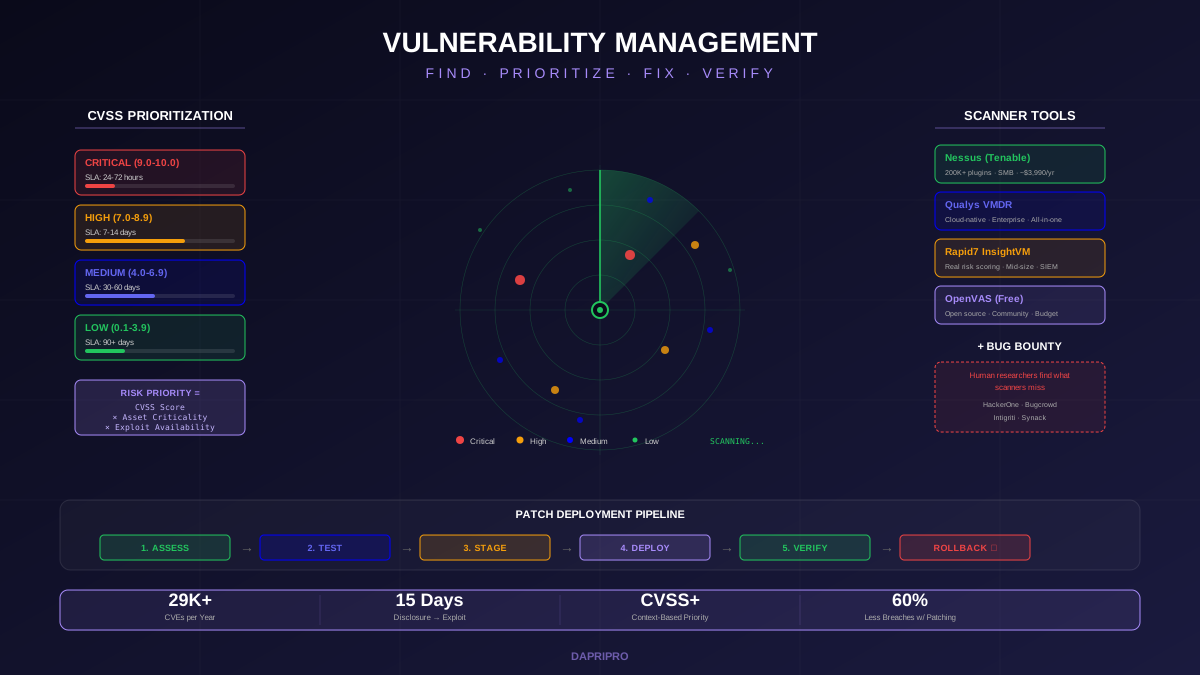
- Critical (CVSS 9.0-10.0) — Remote code execution, authentication bypass on primary application, SQL injection with data access, SSRF with internal network access. Range: $5,000-$25,000 for technology companies, $2,000-$15,000 for non-tech enterprises.
- High (CVSS 7.0-8.9) — Stored XSS on authenticated pages, IDOR with access to other users' data, privilege escalation from user to admin, server-side template injection. Range: $1,000-$10,000 for tech, $500-$5,000 for non-tech.
- Medium (CVSS 4.0-6.9) — Reflected XSS, CSRF on state-changing actions, information disclosure of non-sensitive internal data, open redirect. Range: $250-$2,000 for tech, $100-$1,000 for non-tech.
- Low (CVSS 0.1-3.9) — Missing security headers, verbose error messages, clickjacking on non-sensitive pages. Range: $50-$500 or recognition-only. Some programs exclude Low-severity findings entirely to reduce noise.
Pricing Strategy Principles
Research your competitive landscape. If similar companies in your industry pay $5,000 for Critical findings and you offer $500, top researchers will spend their time on those other programs. Check published bounty tables on HackerOne and Bugcrowd for companies with similar scope and industry positioning.
Consider bonus multipliers for specific vulnerability classes you particularly care about. If you are concerned about authentication weaknesses, offer 2x the standard bounty for authentication bypass findings. This signals to researchers where to focus and attracts specialists in that vulnerability domain.
Offer bounty ranges rather than fixed amounts. A Critical RCE that chains three vulnerabilities and takes days of research deserves more than a Critical RCE found through a single payload. Ranges let you reward effort and impact appropriately while maintaining budget predictability through published maximums.
Triage Operations: Processing Submissions at Scale
Triage is the operational core of any bug bounty program. Processing submissions accurately and quickly determines researcher satisfaction, remediation velocity, and program reputation. Poor triage drives away good researchers and wastes budget on false positives.
Triage Workflow
Every submission should follow a structured evaluation process:
- Initial review (within 24 hours) — Acknowledge receipt. Verify the submission is in scope. Check against known duplicates. Filter obvious invalid reports (scanner output, theoretical issues without PoC). Assign initial severity estimate.
- Technical validation (within 3 business days) — Attempt to reproduce the vulnerability. Follow the exact steps provided by the researcher. Test in a staging environment when possible. If reproduction fails, request clarification from the researcher before closing.
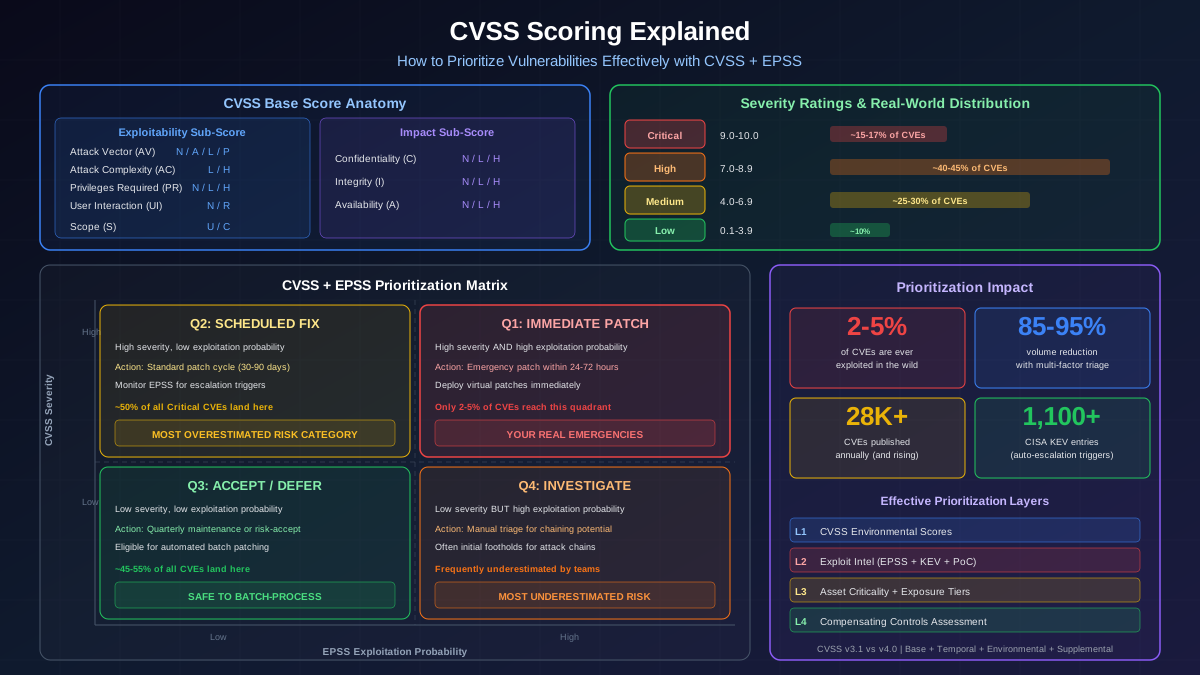
- Severity assessment (same day as validation) — Assign CVSS score and map to your bounty tier. Consider asset criticality multipliers. Assess whether the finding is novel or a variant of a previously-reported issue.
- Remediation handoff (within 5 business days) — Create engineering tickets with reproduction steps, impact assessment, and recommended fix. Tag with appropriate priority. Include researcher communication preferences for fix verification.
- Fix verification (after remediation) — Retest the vulnerability after the fix is deployed. Invite the researcher to verify the fix if the program supports researcher verification. Close the report with bounty payment upon confirmed remediation.
Handling Common Triage Challenges
Duplicates constitute 30-50% of submissions in public programs. Maintain a searchable database of all reported vulnerabilities with enough detail to quickly identify duplicates. When closing as duplicate, credit the original reporter's discovery date. Some programs offer small consolation payments (10-25% of the bounty) for well-written duplicate reports that provide additional exploitation context.
Informational/Low-value reports include things like missing HSTS headers, cookie without secure flag on non-sensitive cookies, and SPF record configurations that are technically imperfect but not exploitable. Define your out-of-scope list clearly to reduce these. Common exclusions: rate limiting issues, missing headers on non-sensitive endpoints, best practice recommendations without demonstrated impact, denial of service through resource exhaustion.
Chain vulnerabilities are reports where individual findings are Low or Medium severity but combine to achieve Critical impact. A directory listing (Low) combined with a configuration file exposure (Medium) combined with credential reuse (Medium) might enable full system compromise (Critical). Evaluate chains holistically and price them based on ultimate impact, not individual component severity.
Legal Framework and Safe Harbor
The legal foundation of your bug bounty program must balance protecting your organization with providing meaningful safe harbor for researchers. Without clear legal protections, skilled researchers will avoid your program entirely.
Safe Harbor Provisions
Your safe harbor clause should include:
- Authorization statement — Explicitly authorize security testing against in-scope systems by researchers who follow the rules of engagement. This is the core legal protection that distinguishes authorized research from unauthorized access.
- CFAA protection — Reference the DOJ's 2022 Computer Fraud and Abuse Act enforcement guidance and commit to not pursuing CFAA claims against good-faith researchers. For international programs, address equivalent laws in key researcher jurisdictions.
- Non-retaliation commitment — State that you will not seek injunctions, civil liability, or report researchers to law enforcement for authorized testing activity, even if the research accidentally exceeds scope boundaries, provided the researcher acts in good faith and reports the issue.
- Third-party protection — Commit to intervening with third parties (ISPs, hosting providers, CDN vendors) who may flag researcher activity as malicious. Provide a researcher verification contact for situations where researcher testing triggers third-party security alerts.
Rules of Engagement
Clear rules protect both parties. Standard rules include:
- No intentional access to customer data beyond minimum required for proof of concept. If you encounter personal data, stop, document the access path, and report immediately.
- No denial-of-service testing. Load testing and resource exhaustion attacks are excluded. If you discover a DoS vulnerability through normal testing, report it without exploiting it at scale.
- No social engineering of employees. Phishing, pretexting, and physical social engineering are excluded unless the program explicitly includes these and provides specific rules.
- No automated scanning at volumes that could affect production performance. Researchers should throttle automated tools to no more than 10 requests per second against production systems.
- Findings must be reported exclusively through the designated channel. No public disclosure before coordinated disclosure timeline (typically 90 days) unless the organization fails to respond.
Measuring Program ROI and Effectiveness
Bug bounty programs need measurable outcomes to justify ongoing investment. Track these metrics to demonstrate value and identify improvement opportunities:
Volume and Quality Metrics
- Submissions per month — Total report volume. Healthy public programs receive 50-200+ monthly. Declining volume may indicate scope fatigue, uncompetitive bounties, or poor researcher experience.
- Valid vulnerability rate — Percentage of submissions that result in confirmed vulnerabilities. Healthy programs achieve 20-40%. Below 15% suggests scope issues or poor researcher targeting. Above 50% may indicate your scope is so limited that only obvious issues get reported.
- Unique vulnerability types — Diversity of finding categories. Programs finding only XSS and CSRF are not attracting researchers with diverse skills. Look for server-side findings, business logic issues, and authentication vulnerabilities as indicators of high-quality researcher engagement.
- Critical/High percentage — Proportion of valid findings rated Critical or High. Programs where 90% of findings are Low/Medium may need scope expansion to higher-value assets or bounty adjustments that incentivize deeper research.
Operational Metrics
- Time to first response — Hours from submission to acknowledgment. Target under 24 hours. Researchers rank programs partly on responsiveness.
- Time to triage — Days from submission to severity assessment. Target under 5 business days. Extended triage times frustrate researchers and indicate capacity issues.
- Time to bounty — Days from submission to payment. Target under 14 days for straightforward findings. Programs that take 60+ days to pay develop reputations that repel top researchers.
- Time to fix — Days from triage to deployed remediation. Track by severity. Critical findings should be remediated within 30 days. High within 60 days. This metric is primarily an engineering efficiency indicator rather than a program metric.
Cost-Per-Vulnerability Analysis
The most compelling ROI metric for bug bounty programs is cost-per-vulnerability compared to alternative testing methods:
- Bug bounty — Median cost per valid finding ranges from $500 to $3,000 depending on program maturity and bounty levels. You only pay for results. If researchers find nothing, you pay nothing (beyond platform subscription fees).
- Traditional penetration testing — A typical web application pentest costs $15,000-$50,000 and finds 8-15 unique vulnerabilities, yielding a cost per finding of $2,000-$6,000. Additionally, pentests are point-in-time and do not catch vulnerabilities introduced after the engagement ends.
- Internal security testing — Cost depends on team size and tool licensing. Internal testers find issues continuously but are limited by team size, skill diversity, and the challenge of maintaining attacker perspective on systems they see daily.
The most effective approach uses all three: internal testing for continuous baseline coverage, annual pentests for structured compliance-driven coverage assurance, and bug bounties for continuous adversarial testing with maximum researcher diversity. Each method catches vulnerability classes the others miss.
Building and Maintaining Researcher Relationships
Your program is only as good as the researchers it attracts. Researcher satisfaction determines whether top talent spends time on your program or moves to a competitor's. The security researcher community is closely connected, and program reputation spreads quickly through researcher forums, Discord communities, and social media.
What Researchers Care About
- Fair compensation — Pay competitively for the researcher's market. Underpaying for Critical findings is the fastest way to lose top talent.
- Fast response times — Researchers submit to multiple programs. Programs that respond within 24 hours and triage within days earn loyalty. Programs that take weeks to acknowledge submissions lose researchers permanently.
- Respectful communication — Researchers are professionals contributing to your security. Treat their submissions with the same respect you would give a contracted consultant's deliverables. Never dismiss findings without technical explanation.
- Clear scope and rules — Ambiguity creates friction. Researchers who spend days researching a vulnerability only to learn it is out of scope will not return.
- Recognition — Many researchers value public acknowledgment alongside financial reward. Maintain a Hall of Fame page. Offer swag. Feature top researchers in program updates. Some researchers specifically target programs that provide CVE assignment for their findings.
Handling Difficult Situations
Scope disputes: When a researcher reports a legitimate vulnerability that falls in a gray area of your scope definition, err on the side of paying. The cost of a single bounty is trivial compared to the cost of a researcher who publicly shares a negative experience with your program.
Severity disagreements: Researchers and triage teams frequently disagree on severity. When this happens, provide detailed technical reasoning for your assessment. If the researcher provides additional exploitation context that changes the impact, be willing to re-evaluate. Rigid adherence to initial assessments when presented with new evidence damages relationships.
Disclosure pressure: If a researcher threatens public disclosure before your remediation timeline, engage constructively. Explain your remediation timeline with specific milestones. Offer partial disclosure (acknowledging the vulnerability class without revealing exploitation details). Most researchers are reasonable when they see genuine remediation progress. If a researcher discloses despite good-faith engagement, respond professionally and publicly credit their contribution.
Scaling from Launch to Maturity
As your program matures, several scaling challenges emerge that require proactive management:
Triage Capacity Scaling
A public program processing 150 monthly submissions requires approximately 1.5-2 FTE dedicated triage analysts. As volume grows, consider managed triage services from your platform vendor (HackerOne offers triage as a service at approximately 20-40% premium on bounty costs), training internal developers to handle initial triage for their own components, and automated triage assistance using tools that auto-classify common submission types, deduplicate against known issues, and route submissions to appropriate subject matter experts.
Scope Expansion Strategy
Expand scope methodically: add one new asset per quarter, monitor the submission volume and quality impact, and adjust before adding more. Common expansion paths move from web application to API to mobile application to infrastructure components. Each expansion should be announced to the researcher community to re-engage researchers who may have exhausted interesting targets in the existing scope.
Live Hacking Events
Mature programs benefit from periodic live hacking events: invite 20-50 top researchers for an in-person or virtual event focused on a specific scope with elevated bounties. These events generate high-value findings quickly, strengthen researcher relationships, and provide concentrated testing coverage on new features or recently-deployed systems. HackerOne and Bugcrowd both facilitate live hacking events with logistical support.
Your bug bounty program is a living security function, not a project with a completion date. It requires ongoing investment in researcher relationships, scope relevance, competitive pricing, and operational efficiency. Organizations that treat it as a checkbox exercise get checkbox results. Those that invest in program quality build a genuine security advantage through continuous adversarial testing from the world's most diverse pool of security talent.