
Your firewall is locked down. Your endpoints have EDR. Your employees pass phishing tests. And then a vendor you have trusted for five years pushes a compromised software update directly into your production environment. Your own security controls watch it happen and do nothing — because the update came from a trusted source.
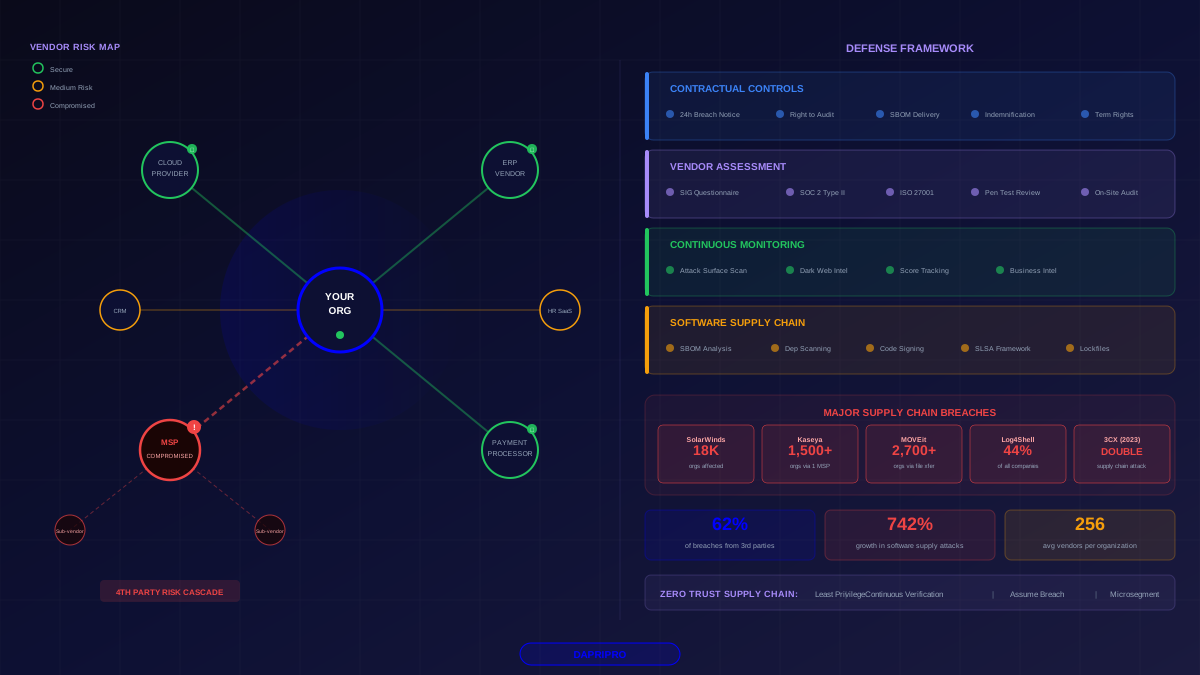
This is the supply chain attack problem, and it is the fastest-growing threat vector in cybersecurity. 62% of breaches in 2025 originated from third-party or supply chain compromises. Software supply chain attacks grew 742% between 2019 and 2025. The average organization connects to 256 third-party vendors, each one a potential entry point for attackers who have learned that the easiest way into a hardened target is through a softer one upstream.
Anatomy of a Supply Chain Attack
Supply chain attacks exploit trust relationships that your security controls are designed to allow. They come in two fundamental categories:
Software Supply Chain Attacks
These target the software development and distribution process itself:
- Compromised updates — attackers infiltrate a vendor's build pipeline and inject malicious code into legitimate software updates. The SolarWinds attack (2020) compromised 18,000 organizations through a single poisoned update
- Malicious packages — attackers publish packages with similar names to popular libraries (typosquatting) or compromise existing popular packages. Over 700,000 malicious packages were detected on npm, PyPI, and RubyGems in 2024
- Compromised CI/CD pipelines — attackers target the build infrastructure (GitHub Actions, Jenkins, CircleCI) to inject code during the build process. The Codecov breach (2021) exposed secrets from thousands of CI pipelines
- Dependency confusion — attackers register public packages that match internal package names, tricking build systems into pulling malicious code instead of the legitimate internal version
Vendor/Business Supply Chain Attacks
These exploit the business relationships and access that vendors have to your environment:
- MSP compromise — attackers breach a managed service provider to gain access to all their client environments. The Kaseya VSA attack (2021) hit 1,500+ organizations through a single MSP tooling compromise
- Credential theft — compromising a vendor's employees to steal VPN credentials, API keys, or SSO access to your systems
- Data exposure through vendors — vendors with access to your data suffer their own breach, exposing your customers' information without your systems being directly compromised
- Hardware supply chain — compromised hardware components, firmware backdoors, or counterfeit devices entering your infrastructure through vendor procurement channels
Building a Vendor Risk Assessment Framework
Step 1: Vendor Inventory and Classification
You cannot protect what you do not know about. Start with a complete inventory of every third-party relationship, then classify each vendor into tiers based on risk:
| Tier | Criteria | Examples | Assessment Level |
|---|---|---|---|
| Critical | Direct network access, processes sensitive data, single point of failure | Cloud provider, ERP vendor, MSP, payment processor | Full assessment + continuous monitoring + on-site audit |
| Important | Limited data access, replaceable with effort, cloud SaaS tools | CRM, email marketing, HR platform, collaboration tools | Questionnaire + SOC 2 review + annual re-assessment |
| Standard | No data access, no network access, easily replaceable | Office supplies, website analytics, social media tools | Basic screening + privacy policy review |
Step 2: Risk Assessment Process
Vendor questionnaires are necessary but insufficient on their own. A comprehensive assessment layers multiple methods:
- Standardized questionnaires — use SIG (Shared Information Gathering) or CAIQ (Consensus Assessment Initiative Questionnaire) for consistent evaluation. Do not create your own questionnaire — it burdens vendors and reduces quality
- Documentation review — request SOC 2 Type II reports, ISO 27001 certificates, penetration test summaries, and business continuity plans. SOC 2 Type I only shows controls at a point in time — Type II covers 6-12 months of operating effectiveness
- External attack surface scanning — tools like SecurityScorecard, BitSight, and UpGuard continuously scan your vendors' internet-facing infrastructure for vulnerabilities, misconfigurations, and compromised credentials
- On-site or remote audit — for critical vendors, exercise your right-to-audit clause. Walk through their security operations, review incident logs, and verify that what they claim matches what they practice
- Continuous monitoring — annual assessments create a false sense of security. Implement continuous monitoring through risk rating platforms, dark web monitoring for vendor credentials, and tracking vendor security news
Step 3: Risk Scoring and Decision Framework
Convert assessment findings into a risk score that drives decisions:
| Risk Score | Rating | Action Required | Review Cadence |
|---|---|---|---|
| 850-1000 | Low Risk | Approve with standard monitoring | Annual |
| 650-849 | Medium Risk | Approve with enhanced controls and compensating measures | Semi-annual |
| 450-649 | High Risk | Approve with remediation plan and executive sign-off | Quarterly |
| Below 450 | Critical Risk | Do not onboard. Existing vendors: remediation or offboarding | Monthly until resolved |
Securing Your Software Supply Chain
Modern software is assembled, not built. 70-90% of any application is third-party code — open-source libraries, commercial SDKs, runtime frameworks. Securing this requires specific technical controls:
Software Bill of Materials (SBOM)
An SBOM is a complete inventory of every component in your software, similar to a nutrition label on food. When a vulnerability like Log4Shell drops, an SBOM tells you in minutes which products are affected. Without one, you spend days or weeks investigating.
Requirements for an effective SBOM program:
- Require SBOMs from all software vendors — in SPDX or CycloneDX format. This is already mandatory for US federal software procurement under Executive Order 14028
- Generate SBOMs for all internal software — integrate SBOM generation into your CI/CD pipeline using tools like Syft, FOSSA, or Snyk
- Monitor SBOMs continuously — use platforms like Dependency-Track or Grype to automatically check every component against the NVD and other vulnerability databases
- Update SBOMs with every release — a stale SBOM is worse than no SBOM because it creates false confidence
Dependency Management
- Pin dependencies to specific versions — never use "latest" or floating version ranges in production. Every upgrade should be deliberate and tested
- Use lockfiles — package-lock.json, Pipfile.lock, go.sum. These ensure reproducible builds and prevent supply-chain injection through version manipulation
- Scan dependencies before merging — integrate Snyk, Dependabot, or Renovate into your PR workflow to catch vulnerable dependencies before they reach production
- Mirror critical packages internally — for your most critical dependencies, maintain internal mirrors (Artifactory, Nexus) so you are not dependent on public registries
Code Signing and Integrity Verification
- Verify signatures on all software updates — before deploying any vendor update, verify the digital signature against the vendor's published public key
- Sign your own software — use Sigstore or traditional code signing certificates to ensure your builds have not been tampered with
- SLSA framework adoption — Supply-chain Levels for Software Artifacts (SLSA, pronounced "salsa") provides a maturity framework from basic build integrity to hermetic builds
Non-Negotiable Contract Requirements
Security requirements that are not in the contract do not exist. When the breach happens, your vendor's security commitments are only as strong as the contractual language behind them.
| Clause | What to Include | Why It Matters |
|---|---|---|
| Breach notification | Within 24 hours of discovery, not just "as soon as reasonably practicable" | GDPR gives you 72 hours total — your vendor burning 71 of them leaves you exposed |
| Right to audit | Annual assessment rights with 30-day notice, or continuous monitoring via risk platform | Questionnaire answers age instantly. Audit rights keep vendors accountable year-round |
| SBOM delivery | Initial SBOM plus updates with every major release in SPDX or CycloneDX format | Without SBOMs, zero-day response requires days of manual investigation |
| Data handling | Encryption at rest (AES-256) and in transit (TLS 1.2+), data residency, retention, and disposal requirements | Without specific standards, "we encrypt data" could mean anything |
| Indemnification | Vendor liable for breach costs resulting from their negligence, including first and third-party costs | Without this, you absorb all financial impact of a vendor-caused breach |
| Termination rights | Right to terminate for material security failures with defined transition assistance period | You need an exit path when a vendor's security posture becomes unacceptable |
Continuous Monitoring: Beyond the Annual Assessment
Annual vendor assessments capture a snapshot. Continuous monitoring captures the movie. Here is what to monitor and how:
Vendor Risk Monitoring Platforms Compared
| Platform | Best For | Key Feature | Starting Price |
|---|---|---|---|
| SecurityScorecard | Large enterprises | Detailed risk scoring with 10 signal categories, board-ready reporting | Custom pricing |
| BitSight | Financial services | Industry benchmarking, regulatory mapping, 2,100+ data points | Custom pricing |
| UpGuard | Mid-market | Vendor risk + data leak detection, questionnaire automation | From $5,999/yr |
| Panorays | SMBs | Automated assessments, supplier collaboration portal | From $3,000/yr |
| RiskRecon (Mastercard) | Financial sector | Deep external assessment, Mastercard threat intelligence | Custom pricing |
Incident Response: When a Vendor Gets Breached
Your vendor just announced a breach. Clock is ticking. Here is the playbook:
First 4 Hours
- Assess exposure — what data and systems does this vendor have access to? Check your vendor inventory immediately
- Contain access — revoke the vendor's API keys, VPN credentials, SSO access, and any direct network connections
- Activate monitoring — increase logging and detection thresholds for any activity associated with the compromised vendor's access patterns
- Contact the vendor — demand a written incident briefing including scope, timeline, data affected, and remediation status
First 24 Hours
- Forensic analysis — search your logs for any suspicious activity originating from the vendor's access points during the compromise window
- Credential rotation — reset all shared credentials, API keys, and tokens associated with the vendor
- Legal review — assess your notification obligations based on what data the vendor accessed
- Executive briefing — inform leadership of exposure level, containment actions taken, and potential business impact
First Week
- Validate containment — confirm no attacker persistence in your environment from the vendor's access
- Evaluate vendor relationship — based on the breach severity, response quality, and root cause, decide whether to continue the relationship
- Regulatory notifications — file required notifications based on data exposure assessment
- Update contracts — if continuing the relationship, negotiate additional security requirements and monitoring rights
Lessons from the Biggest Supply Chain Attacks
- SolarWinds (2020) — 18,000 organizations compromised through a single software update. Russian SVR operators spent 14 months inside SolarWinds' build pipeline. Lesson: code signing alone is not enough if the build pipeline itself is compromised. Require vendors to demonstrate build pipeline integrity (SLSA Level 2+)
- Kaseya VSA (2021) — REvil ransomware pushed to 1,500+ organizations through a managed service provider's remote management tool. Lesson: MSP access is essentially admin access to your environment. Treat MSP tools as critical infrastructure with dedicated monitoring
- Log4Shell (2021) — a vulnerability in a ubiquitous Java logging library affected virtually every organization running Java. Organizations without SBOMs took weeks to identify affected systems. Lesson: you cannot respond to what you cannot find. SBOMs are not optional
- 3CX (2023) — a supply chain attack on 3CX was itself caused by a supply chain attack on Trading Technologies. The first "double supply chain" attack. Lesson: your vendors' vendors matter too. Fourth-party risk is real
- MOVEit (2023) — Cl0p ransomware group exploited a zero-day in Progress MOVEit Transfer, affecting 2,700+ organizations. Lesson: file transfer tools are high-value targets. Scrutinize any vendor that handles data in motion
Applying Zero Trust to Your Supply Chain
Zero trust principles apply perfectly to supply chain security — never trust a vendor just because they passed an assessment last year:
- Least privilege access — vendors get only the minimum access required. No broad network access, no persistent VPN connections, no shared admin accounts
- Continuous verification — validate vendor access at every session, not just during onboarding. Use conditional access policies that evaluate risk signals in real time
- Assume breach — design your systems so that a compromised vendor cannot access everything. Network segmentation, data classification, and access controls limit blast radius
- Microsegment vendor access — each vendor should only reach the specific systems they need, through a monitored, logged, just-in-time access mechanism
- Monitor everything — log all vendor access, analyze it for anomalies, and alert on deviations from established patterns
Your Supply Chain Security Action Plan
- Build your vendor inventory — catalog every third-party vendor with data access, network access, or software in your environment. You will likely discover vendors IT never knew about
- Classify into tiers — rank each vendor as Critical, Important, or Standard based on access level and business impact
- Assess critical vendors first — full assessment with questionnaire, SOC 2 review, external scanning, and right-to-audit exercise
- Implement continuous monitoring — deploy a vendor risk platform for real-time scoring and alerting on your top 50 vendors
- Require SBOMs — add SBOM delivery requirements to all software vendor contracts starting with new purchases and renewals
- Update contracts — negotiate the six non-negotiable clauses into every vendor agreement during renewal cycles
- Practice vendor breach response — run a tabletop exercise simulating a critical vendor breach at least annually
Supply chain security is not about achieving perfect visibility into every vendor — that is impossible. It is about concentrating your resources on the vendors that matter most, building contractual leverage to enforce security standards, and preparing your response for when (not if) a vendor compromise affects your organization.