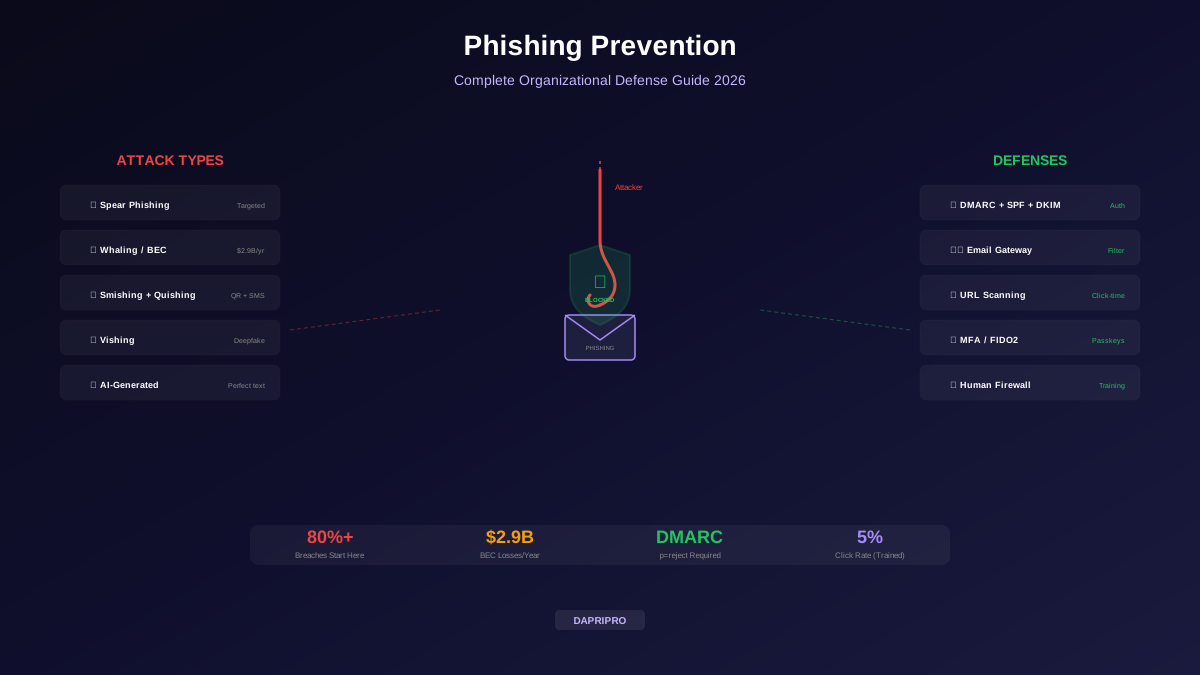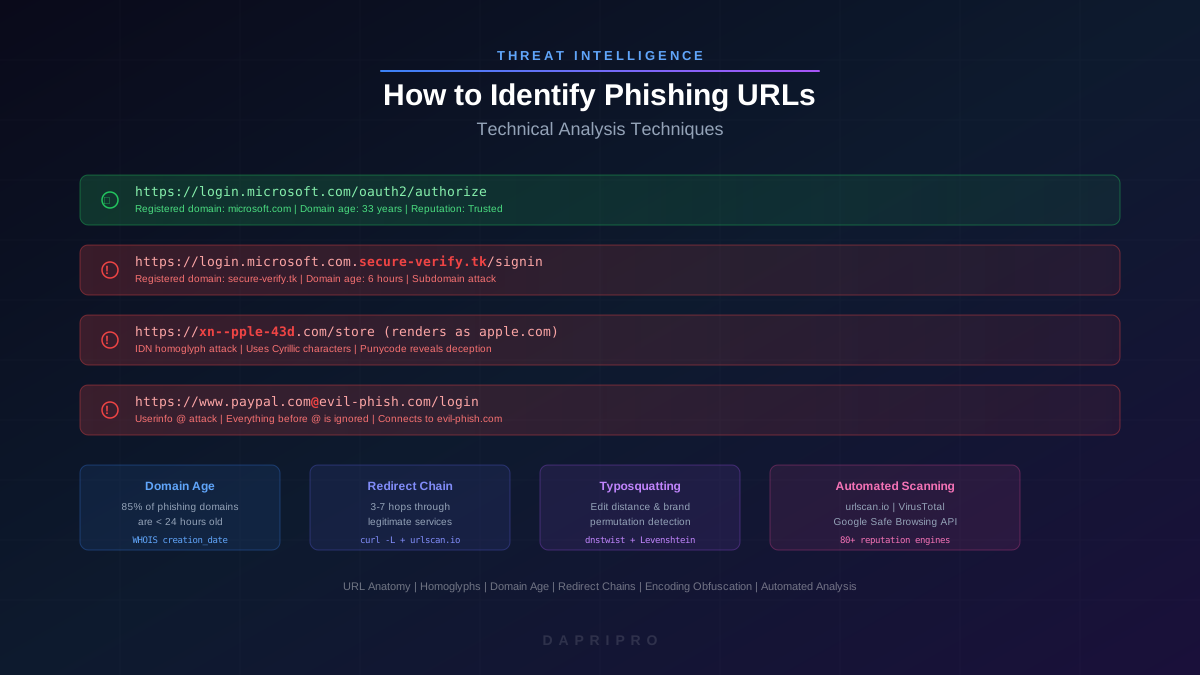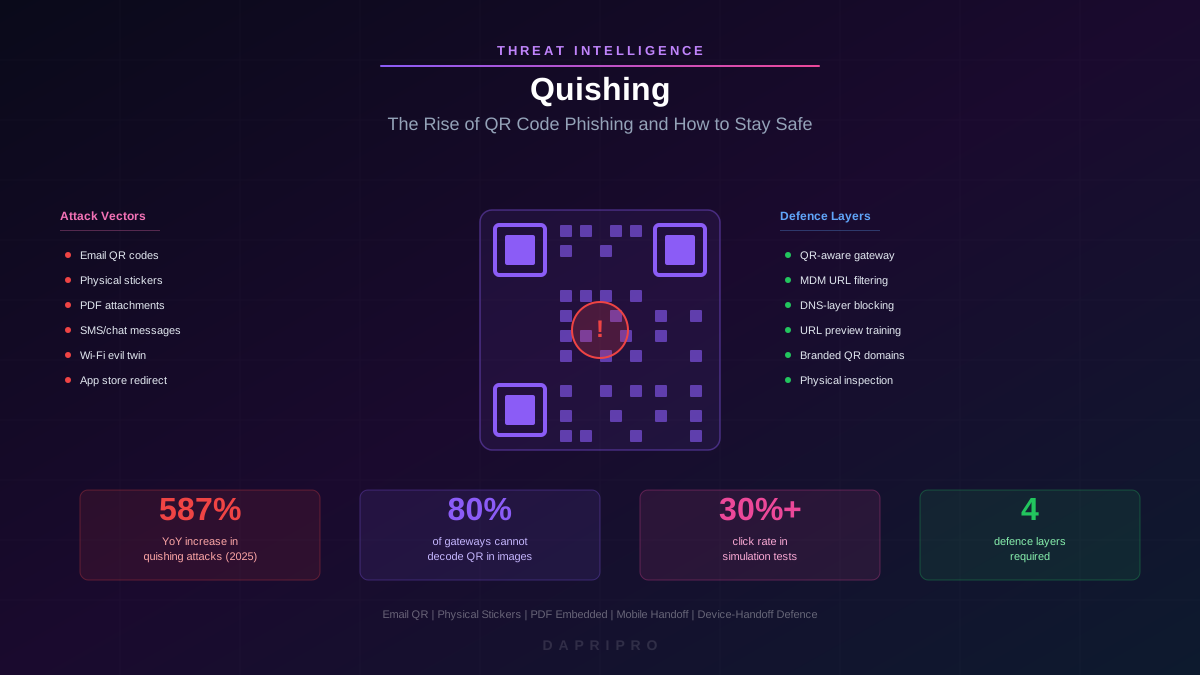

Phishing exists on a spectrum. At one end, bulk phishing campaigns send identical messages to millions of addresses, relying on volume to produce a handful of victims. At the other end, targeted phishing invests hours or days of reconnaissance into crafting a single message for a single person, but the payoff from that one compromise can exceed all bulk campaigns combined. Spear phishing and whale phishing (whaling) occupy this targeted end of the spectrum, and defending against them requires fundamentally different strategies than filtering bulk spam.
Taxonomy: Where Spear Phishing and Whaling Fit
The terminology is often confused. Clear definitions matter because they drive different defence priorities:
- Bulk phishing — identical or near-identical messages sent to thousands or millions of recipients. Low effort per target, low success rate (0.1-1%), low impact per compromise. Example: "Your Netflix account has been suspended."
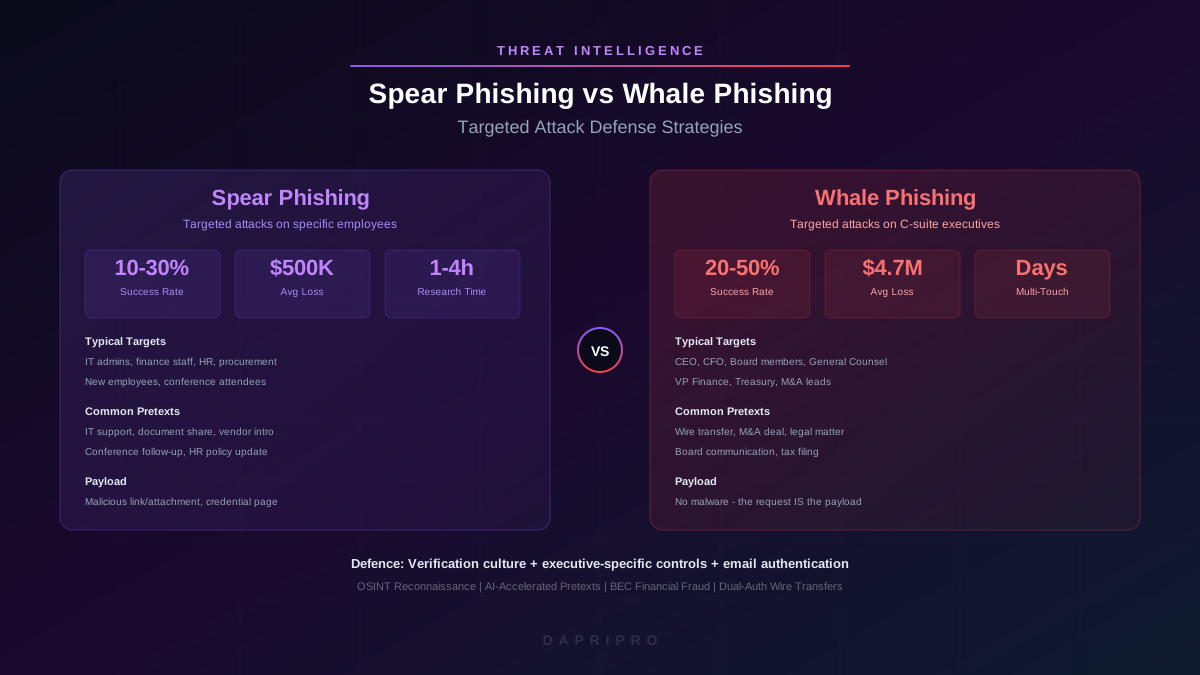
- Spear phishing — personalised messages targeting specific individuals or small groups, using information gathered through reconnaissance. Moderate effort per target, moderate success rate (10-30%), variable impact. Example: "Hi Sarah, following up on our conversation at the RSA Conference last week — here are the threat reports I mentioned."
- Whaling (whale phishing) — spear phishing specifically targeting senior executives, board members, or other high-authority individuals. High effort per target, high success rate (when well-crafted), extremely high impact. Example: an email to the CFO from what appears to be the CEO, requesting an urgent wire transfer for a confidential acquisition.
- Business Email Compromise (BEC) — the financial-fraud outcome of spear phishing or whaling. BEC is not a separate technique; it is the monetisation strategy. The FBI IC3 reported $2.9 billion in BEC losses in 2023 alone.
Reconnaissance: How Attackers Build Target Profiles
The defining characteristic of spear phishing and whaling is research. The quality of the attack is directly proportional to the quality of the reconnaissance.
OSINT Sources for Spear Phishing
- LinkedIn — job title, reporting chain, recent role changes, endorsements, group memberships, and the goldmine of "started a new position" announcements (new employees are prime targets because they have not yet learned internal verification procedures)
- Corporate website — executive bios, organisational structure, press releases, partner announcements, and technology stack disclosures
- Social media — personal interests, travel schedules, family events, political views, and charitable involvement (all useful for pretext crafting)
- SEC filings — for public companies, 10-K and 8-K filings reveal financial details, key personnel, ongoing litigation, and merger activity
- Conference programmes — speaker bios, presentation topics, and networking events provide context for convincing pretexts
- Data-breach dumps — email addresses and passwords from previous breaches confirm active email addresses and reveal personal information
- Domain registration records — WHOIS data reveals technical contacts, administrative contacts, and hosting infrastructure
AI-Accelerated Reconnaissance
Large language models have transformed the economics of spear phishing. Previously, crafting a convincing spear-phishing email required a human attacker to manually research the target (1-4 hours per target), write a contextually appropriate message, and choose a plausible pretext. AI now automates each step:
- Target profiling — an LLM can synthesise a comprehensive target profile from LinkedIn, social media, and corporate website data in under 60 seconds
- Pretext generation — given the profile, the LLM generates multiple contextually appropriate pretexts (conference follow-up, vendor introduction, internal IT request, HR benefits notification)
- Message crafting — the LLM produces linguistically flawless, tonally appropriate messages that match the target's communication style, including appropriate formality, industry jargon, and cultural context
- Personalisation at scale — what previously took 4 hours per target now takes 60 seconds, enabling targeted attacks at near-bulk volumes
This AI acceleration means the traditional detection signal — "this message is generic or contains errors, so it might be phishing" — is no longer reliable. Defenders must assume that spear-phishing messages will be linguistically perfect and contextually plausible.
Spear Phishing: Techniques and Case Studies
Common Spear-Phishing Pretexts
- IT support — "Your password expires in 24 hours. Click here to update." Targets: all employees. Effective because it mimics legitimate IT notifications.
- HR policy update — "Please review the updated remote-work policy and acknowledge receipt." Targets: all employees. Exploits compliance anxiety.
- Conference follow-up — "Great meeting you at [Conference Name] last week. Here are the resources I mentioned." Targets: attendees of recent events. Uses real context.
- Vendor introduction — "I was referred to you by [Mutual Contact]. I would like to discuss our new security platform." Targets: procurement and IT decision-makers.
- Document share — "I have shared a document with you in OneDrive/Google Drive/SharePoint." Targets: all employees. Mimics legitimate collaboration.
Case Study: APT29 Diplomatic Spear Phishing
In 2023-2024, the Russian state-sponsored group APT29 (Cozy Bear) conducted a spear-phishing campaign targeting European diplomatic missions. The attack chain was instructive:
- Reconnaissance — identified diplomats attending a specific wine-tasting event hosted by an embassy
- Pretext — emails sent from a compromised embassy account, referencing the wine-tasting event and including a link to "event photos"
- Payload — the link delivered a malicious ISO file containing a DLL side-loading payload that established a Cobalt Strike beacon
- Impact — sustained access to diplomatic communications for an estimated 6 months before detection
The campaign succeeded because every element was contextually perfect: the sender was a real embassy, the event was real, the pretext was plausible, and the timing matched the event date. No email gateway flagged it because the compromised account had legitimate SPF, DKIM, and DMARC records.
Whaling: Techniques and Case Studies
What Makes Whaling Different
Whaling is not simply spear phishing aimed at important people. It differs in several operational dimensions:
- Longer engagement — whaling attackers may exchange multiple emails over days or weeks, building rapport before making the fraudulent request. This multi-touch approach mimics legitimate business relationships.
- No malware — the majority of whaling attacks involve no malicious links or attachments. The payload is the request itself: "Please wire $340,000 to this account for the Johnson acquisition." There is nothing for email security to flag.
- Authority exploitation — whaling exploits the hierarchical dynamics of organisations. When the CEO emails the CFO, the CFO acts. Questioning the CEO's request feels disrespectful or insubordinate.
- Confidentiality pretext — whaling emails frequently invoke confidentiality: "This is a sensitive M&A transaction. Do not discuss with anyone else." This prevents the target from seeking verification.
- Timing exploitation — attacks are timed to coincide with the target's travel (when quick mobile-email responses are expected), quarter-end (when financial transactions are routine), or board meetings (when executive communications spike).
Case Study: Ubiquiti Networks ($46.7 Million)
In 2015, Ubiquiti Networks lost $46.7 million to a whaling attack. The attack was pure social engineering with no malware:
- Attackers impersonated a senior executive via email to the finance department
- The email requested wire transfers to accounts in Hong Kong and other overseas locations
- The finance team complied because the request appeared to come from an executive with authority
- The attack was only discovered after $46.7 million had been transferred
- The company recovered approximately $8.1 million; the remainder was lost
Case Study: FACC ($55.8 Million)
Austrian aerospace manufacturer FACC lost approximately 42 million euros ($55.8 million) when attackers impersonated the CEO and instructed the finance department to transfer funds for a "secret business project." The CFO was subsequently fired for failing to implement adequate verification controls. This case illustrates that whaling creates both financial loss and executive accountability risk.
Defence Strategies: Layered Controls
Controls for All Employees (Spear-Phishing Defence)
- Email authentication at enforcement — deploy SPF, DKIM, and DMARC at
p=rejecton all organisation domains. This prevents exact-domain spoofing but does not prevent lookalike domains or compromised-account attacks. - Display-name spoofing detection — configure email gateways to flag messages where the display name matches an internal executive but the sending domain is external. Banner the email with a warning: "This message appears to be from [Executive Name] but was sent from an external address."
- External-email banners — tag all emails from external senders with a visible banner. This simple control reminds recipients that the message originated outside the organisation, even if the display name suggests otherwise.
- Phishing simulations with spear-phishing scenarios — standard phishing simulations test bulk-phishing resilience. Add scenarios that use personalised pretexts: recent hires receive simulated IT onboarding emails; finance staff receive simulated vendor invoice requests.
- Out-of-band verification culture — train employees to verify any request for sensitive actions (credential sharing, financial transfers, data access) through an independent channel. Call the requester on a known phone number; do not reply to the email.
Controls for Executives (Whaling Defence)
- Executive-specific phishing simulations — simulate whaling scenarios targeting the C-suite: fake board communications, fabricated M&A requests, impersonated legal counsel. Executives who have never been tested will fail at rates comparable to untrained employees.
- Financial-transaction verification procedures — require dual-authorisation and independent verbal confirmation for all wire transfers above a defined threshold. No wire transfer should be approved based solely on an email, regardless of the apparent sender.
- Social-media exposure audit — review executives' public profiles for information that attackers could use. LinkedIn travel posts, conference schedules, and personal details all provide ammunition for whaling pretexts. Provide executives with social-media OPSEC guidance.
- Personal device security — many executives use personal mobile devices for email. Ensure these devices have MDM enrolment, email containerisation, and URL filtering. Personal devices should not be a gap in the security perimeter.
- Domain monitoring — register defensive domains for executive names and the organisation (e.g., ceofirstname-companyname.com). Monitor for newly registered lookalike domains using tools like dnstwist, DomainTools, or PhishLabs.
- Email forwarding restrictions — prevent automatic email forwarding from executive mailboxes to external addresses. Attackers who compromise executive accounts often set forwarding rules to maintain access after password changes.
Building a Verification Culture
The single most effective defence against both spear phishing and whaling is a culture where verification is expected, not exceptional. This means:
Policy: Every Sensitive Request Gets Verified
Define "sensitive requests" explicitly:
- Any financial transaction above a defined threshold (even $1,000 is reasonable)
- Any change to payment details (bank account numbers, routing information)
- Any request for credentials, MFA codes, or access tokens
- Any request to share sensitive data (employee records, customer lists, strategic plans)
- Any request marked as "urgent" or "confidential" that comes via email
Verification must use an independent channel: call the requester on a known phone number (not a number provided in the suspicious email), walk to their office, or use an authenticated internal messaging platform. Email replies do not count as verification because the attacker controls the reply address.
Executive Modelling
Verification culture must start at the top. If the CEO refuses to verify their own requests ("I am the CEO, my email should be sufficient"), they undermine the entire programme. Executives must actively participate in verification procedures and publicly endorse them. An executive who says "I appreciate that you verified before wiring" normalises the behaviour for the entire organisation.
Eliminating the Authority Bypass
The most dangerous dynamic in whaling is the authority bypass: "The CEO said to do it, so I will not question it." Training must explicitly address this:
- "No legitimate executive will be angry at you for verifying a financial request."
- "If someone pressures you to skip verification, that is itself a red flag."
- "The more urgent and confidential the request, the more important verification becomes."
Incident Response for Targeted Attacks
When a spear-phishing or whaling attack is detected or reported:
Immediate Actions (0-30 Minutes)
- Preserve the evidence — save the original email with full headers. Do not forward it (forwarding strips headers).
- Check for lateral impact — search the email gateway for all messages from the same sender, subject, or domain to identify other targets.
- Quarantine related messages — if the attack targeted multiple recipients, quarantine all matching messages across all mailboxes.
- Assess compromise — if the target clicked a link or provided credentials, immediately reset passwords, revoke active sessions, and check for inbox-rule changes (forwarding rules, deletion rules).
Investigation (30 Minutes - 4 Hours)
- Analyse the attack infrastructure — examine the sending domain, phishing page, and any payloads. Extract IOCs (IP addresses, domains, file hashes) for blocking and threat-intelligence sharing.
- Determine the attack goal — credential harvesting, malware delivery, BEC fraud, or data exfiltration. The goal determines the impact scope.
- Check for financial impact — if the attack involved a wire-transfer request, immediately contact the bank to initiate a recall. Speed is critical; funds are typically laundered within 24-48 hours.
- Timeline reconstruction — map the attacker's reconnaissance (when did they research the target?) and engagement (how many emails were exchanged before the malicious request?).
Recovery and Prevention
- Block the attack infrastructure across all security controls (email gateway, web proxy, DNS, firewall)
- If credentials were compromised, monitor for lateral movement and account abuse for 30 days
- Conduct a targeted debrief with the affected employee or executive (educational, not punitive)
- Update phishing-simulation scenarios to include the tactics, techniques, and pretexts from the real attack
- Share sanitised IOCs and TTPs with your industry ISAC
Spear phishing and whaling will continue to grow in sophistication, particularly as AI eliminates the linguistic and contextual barriers that previously limited targeted attacks. Organisations that combine rigorous email authentication, executive-specific controls, and a verification culture where no request is too important to verify will be resilient. Organisations that rely solely on email gateways to catch everything will learn the cost of that assumption the hard way.