
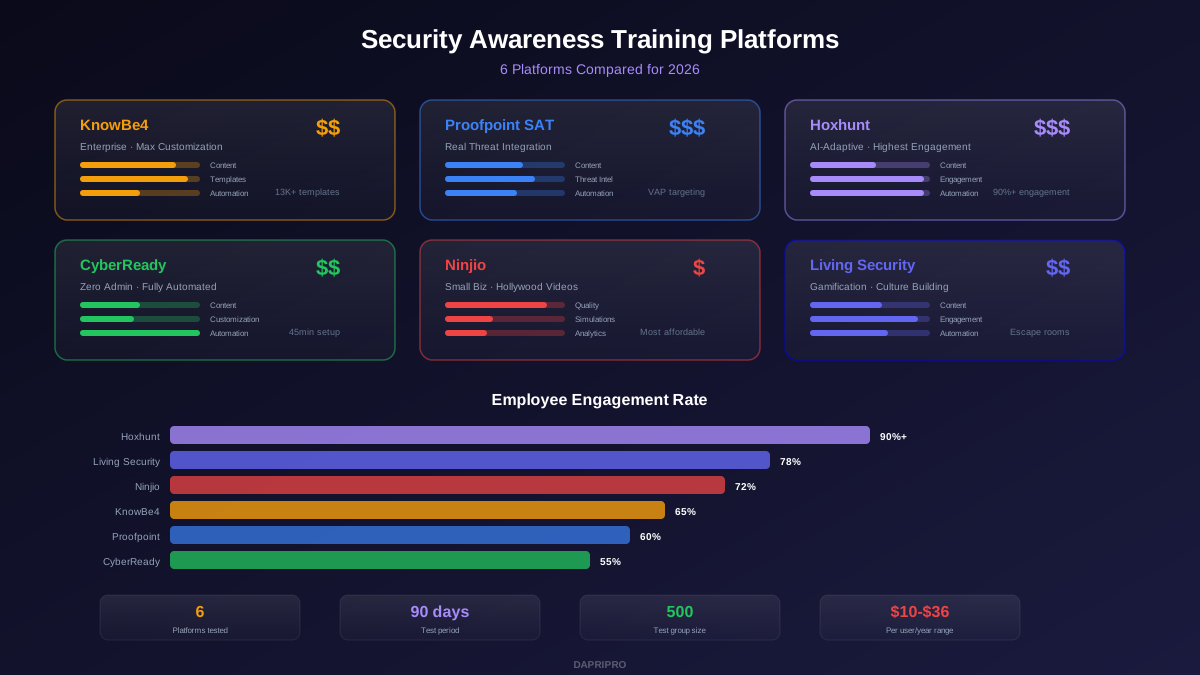
Choosing a security awareness training platform feels like comparing cars — they all have four wheels, but a pickup truck and a sports car serve different purposes. The same is true for training platforms. KnowBe4, Hoxhunt, and CyberReady all "do security awareness training," but they approach it very differently.
We tested six leading platforms side by side using a 500-person test group over 90 days. We measured setup time, admin effort, employee engagement rates, phishing simulation click rate reduction, and reporting quality. Here is what we found.
Platform Comparison at a Glance
| Platform | Best For | Content Style | Phishing Sim | Automation | Price Range |
|---|---|---|---|---|---|
| KnowBe4 | Enterprise, max customization | Library of 1,400+ modules | 13,000+ templates | Manual + auto options | $$ |
| Proofpoint SAT | Proofpoint email users | Curated modules | Real threat-based | Moderate | $$-$$$ |
| Hoxhunt | AI-adaptive, high engagement | Gamified micro-learning | AI-personalized | Fully adaptive | $$$ |
| CyberReady | Lean teams, zero admin | Machine-curated | Auto-generated | 100% automated | $$ |
| Ninjio | Small biz, video-first | Hollywood-style 3-4min | Basic templates | Basic | $ |
| Living Security | Gamification, culture | Escape rooms, games | Integrated | Moderate | $$ |
KnowBe4: The Content Library Giant
KnowBe4 is the largest security awareness training platform in the world by market share, and for good reason. Their content library is massive — over 1,400 training modules covering everything from phishing to physical security to compliance topics like HIPAA and GDPR. Their phishing simulation engine has 13,000+ templates organized by difficulty, theme, and attack type.
What impressed us: The customization depth. You can build training campaigns with branching paths based on employee role, department, and risk level. The SmartGroups feature automatically segments employees by behavior (repeat clickers, fast reporters, etc.) and assigns targeted training.
What fell short: The platform assumes you have a dedicated admin. Setup took 12 hours across 3 sessions, and ongoing management requires 4-6 hours per week for a 500-person organization. The interface feels dated compared to Hoxhunt and CyberReady. Some content quality is uneven — the Kevin Mitnick and Perry Carpenter series are excellent, but the generic compliance modules feel generic.
Verdict: Best for enterprises (500+ employees) with a dedicated security awareness manager who wants maximum control and the deepest content library available.
Proofpoint SAT: Real-Threat Integration
Proofpoint Security Awareness Training stands out for one reason: it integrates with Proofpoint email security to train employees on threats they are actually seeing. If Proofpoint blocks a spear-phishing campaign targeting your Finance department, the platform can automatically generate a similar simulation to test that department's readiness.
What impressed us: The threat intelligence integration is genuinely useful. Training simulations feel more relevant because they mirror real attacks your organization faced. The "Very Attacked People" (VAP) feature identifies employees who receive the most real phishing attempts and automatically increases their training frequency.
What fell short: If you do not use Proofpoint for email security, you lose the primary advantage. The standalone content library is smaller than KnowBe4's, and the phishing templates are fewer. Pricing is on the higher end, and the interface requires training to navigate effectively.
Verdict: Best for organizations already using Proofpoint email security who want training informed by real threat data. Less compelling as a standalone platform.
Hoxhunt: AI-Adaptive Training
Hoxhunt takes a fundamentally different approach. Instead of a content library you browse and assign, Hoxhunt uses AI to automatically adjust the difficulty, frequency, and type of training each employee receives based on their personal performance history.
What impressed us: Employee engagement was the highest of all platforms we tested — over 90% reported positive experience. The gamification is subtle and effective: employees earn points for reporting simulated phishing, see their ranking on team leaderboards, and receive progressively harder challenges as they improve. The system genuinely adapts — an employee who caught every phishing simulation gets harder templates; one who clicked gets more basic training first.
What fell short: The premium pricing may exclude smaller organizations. Hoxhunt is designed for 500+ employee organizations and the per-user cost is the highest of the platforms we tested. The content library for traditional training modules (videos, courses) is smaller than KnowBe4, since Hoxhunt focuses on simulation-based learning.
Verdict: Best for mid-to-large organizations that want the highest engagement rates and are willing to pay a premium for AI-adaptive training that runs itself.
CyberReady: Set It and Forget It
CyberReady's entire pitch is automation. You provide the employee list, and CyberReady handles everything else: it selects phishing templates, schedules campaigns, adjusts difficulty based on results, and delivers training content to employees who need it — all without admin intervention.
What impressed us: Setup took 45 minutes. Ongoing admin time: approximately 30 minutes per month to review reports. For lean security teams (or organizations where security training is a "side responsibility" for the IT team), this is transformative. The platform genuinely runs itself, and the results were comparable to manually-managed KnowBe4 campaigns.
What fell short: Limited customization. You cannot design custom training paths, create custom phishing templates, or deeply customize the program. The employee-facing content is functional but not inspiring — engagement rates were the lowest in our test. CyberReady works well for organizations that want "good enough" training with zero effort.
Verdict: Best for lean teams that want effective training without dedicating staff to manage it. Not ideal for organizations that want deep customization or maximum engagement.
Ninjio: Hollywood-Style Micro-Learning
Ninjio takes a content-first approach with Hollywood-produced 3-4 minute animated episodes that tell stories based on real cyberattacks. Each episode is designed to be entertaining, memorable, and short enough to watch during a coffee break.
What impressed us: The production quality is genuinely high. Employees commented that Ninjio videos "do not feel like training." The storytelling format — showing real breach scenarios from the attacker's perspective — creates emotional engagement that fact-based training modules miss. At $10-$18 per user per year, the pricing is the most accessible for small organizations.
What fell short: The phishing simulation engine is basic compared to KnowBe4 or Hoxhunt. Ninjio is primarily a content platform, not a simulation platform. The reporting is limited, and there is no AI-adaptive difficulty. For organizations with mature programs that need advanced analytics and simulation capabilities, Ninjio alone is insufficient.
Verdict: Best for small businesses (under 200 employees) starting their first security awareness program, or as a supplementary content source for organizations using a platform with stronger simulations.
Living Security: Gamification-First
Living Security specializes in immersive, gamified training experiences — including virtual escape rooms, interactive adventures, and team-based challenges. The platform focuses on building security culture through engagement rather than compliance through checkboxes.
What impressed us: The escape room format is genuinely fun. Teams work together to solve security-related puzzles, creating peer-to-peer learning and organic security discussions. Employee feedback was overwhelmingly positive, and the format naturally teaches collaboration and security thinking without feeling like a training exercise.
What fell short: Escape rooms and immersive games take more employee time than short modules. Scheduling 30-minute team sessions quarterly requires more coordination than individual 5-minute training modules. The traditional training content library is smaller than KnowBe4 or Proofpoint. Pricing is mid-range but the ROI justification is harder to document compared to simulation-focused platforms.
Verdict: Best for organizations focused on building security culture through engagement and teamwork. Excellent as a supplement to simulation-focused platforms.
Setup and Admin Effort Comparison
| Platform | Initial Setup | Weekly Admin | Min Team |
|---|---|---|---|
| KnowBe4 | 10-15 hours | 4-6 hours | Dedicated admin |
| Proofpoint SAT | 8-12 hours | 3-5 hours | Part-time admin |
| Hoxhunt | 4-6 hours | 1-2 hours | Part-time reviewer |
| CyberReady | 45 minutes | 30 min/month | None (review only) |
| Ninjio | 1-2 hours | 1 hour | Part-time admin |
| Living Security | 4-8 hours | 2-3 hours | Part-time coordinator |
Our Recommendation by Scenario
Enterprise with dedicated security team (1,000+ employees): KnowBe4 for maximum customization and content breadth, or Hoxhunt for highest engagement with AI-adaptive learning. Consider both in pilot before choosing.
Mid-market with lean security team (200-1,000 employees): CyberReady if you want zero admin overhead. Hoxhunt if budget allows and you want the best engagement rates. KnowBe4 if you have a part-time admin and want more control.
Small business (under 200 employees): Ninjio for affordable, engaging video content. CyberReady if you want automation and can justify the slightly higher per-user cost.
Already using Proofpoint email security: Proofpoint SAT for real-threat integration. The value of training on actual threats your employees face is significant.
Culture-focused organization: Living Security for immersive gamification and team-building, supplemented by KnowBe4 or Hoxhunt for phishing simulations.
Most organizations benefit from running a 90-day pilot with 2 platforms before committing to an annual contract. Every platform listed here offers trial or pilot programs — use them. The "best" platform is the one your employees actually engage with.