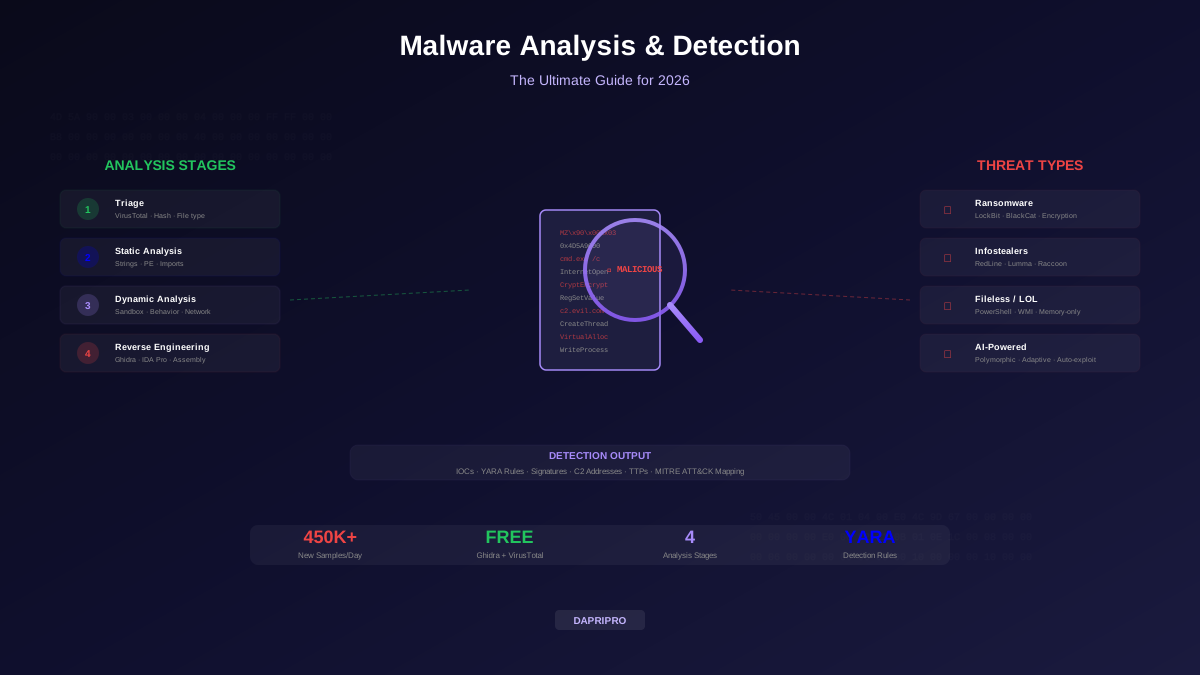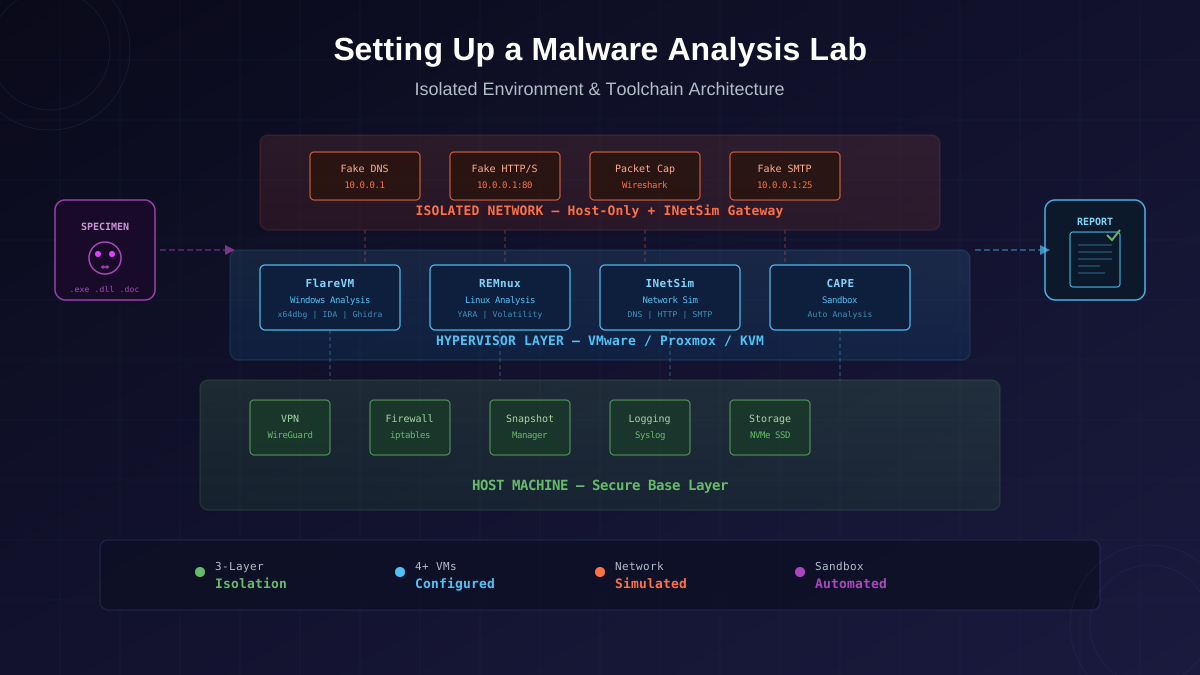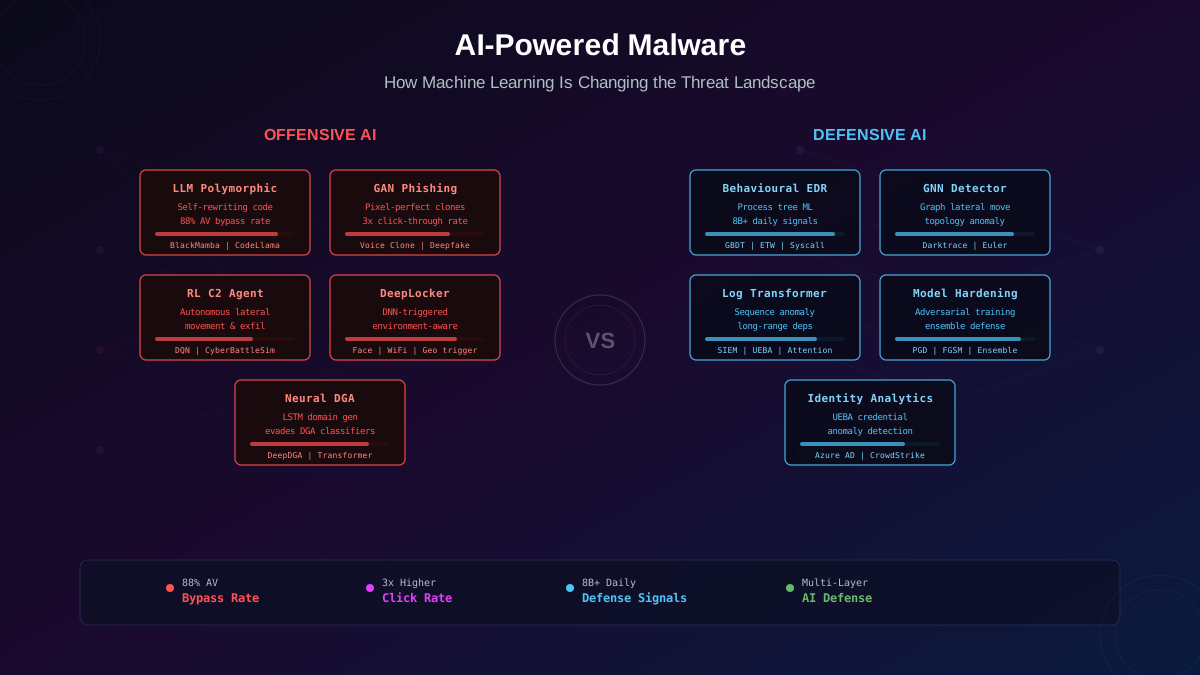

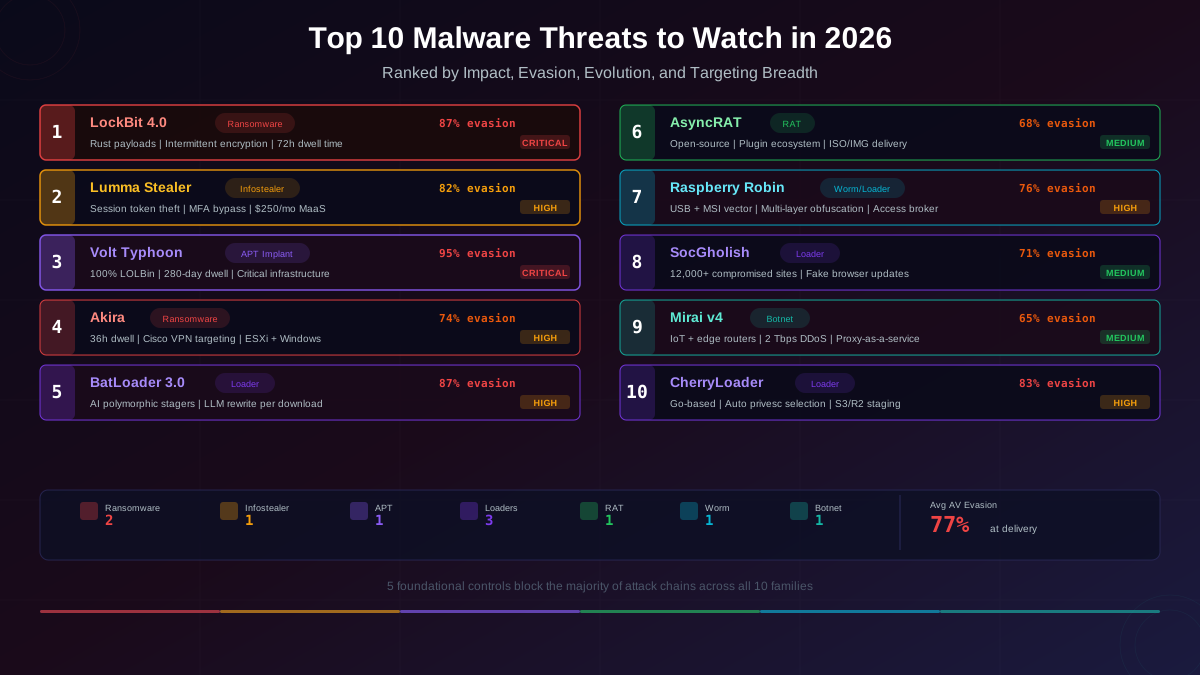
Every year the malware landscape reshuffles. Families that dominated 2024 retire or rebrand, new tool-kits emerge from underground markets, and nation-state groups refresh their implants. Tracking individual samples is a losing game; what matters is understanding the categories of threat, the attack chains they share, and the defensive controls that break those chains.
This profile covers the ten most impactful malware families and categories active in 2026, ranked by a composite score of victim count, financial damage, detection difficulty, and rate of evolution. For each entry we detail the infection chain, post-exploitation behaviour, real-world campaign references, and specific defensive measures you can deploy today.
How We Ranked the Top 10
Ranking malware solely by detection volume is misleading: a noisy adware campaign generates millions of alerts but causes negligible harm compared to a targeted wiper that hits a single energy grid. We weighted four factors equally:
- Victim impact — financial loss, operational disruption, and data exposure per incident
- Detection difficulty — percentage of commercial security stacks that miss the initial execution in controlled tests
- Rate of evolution — frequency of new variants, infrastructure changes, and TTP shifts over the past twelve months
- Breadth of targeting — number of sectors, geographies, and organisation sizes affected
Data sources include CISA advisories, Mandiant and CrowdStrike incident-response reports, VirusTotal telemetry, and our own honeypot and sandbox analysis.
#1 — LockBit 4.0 Ransomware
LockBit survived law-enforcement takedowns, affiliate arrests, and source-code leaks to re-emerge as LockBit 4.0 in late 2025. The new version introduced Rust-based cross-platform payloads, intermittent encryption by default, and an affiliate portal with AI-assisted negotiation chat-bots.
Infection Chain
Initial access typically arrives through compromised VPN appliances (Fortinet, Ivanti) or infostealer-harvested credentials sold on Russian-language markets. Affiliates deploy Cobalt Strike or Sliver beacons within minutes of access, enumerate Active Directory with BloodHound, and move laterally via PsExec or WMI. Encryption begins 48-72 hours after initial access, timed to coincide with weekends or holidays.
Post-Exploitation Behaviour
- Deletes Volume Shadow Copies via
vssadmin delete shadows /all /quiet - Disables Windows Defender real-time protection through registry modifications
- Exfiltrates data to attacker-controlled cloud storage (Mega, pCloud) before encryption
- Drops ransom notes in every directory and changes the desktop wallpaper
- Intermittent encryption: encrypts every 16th byte, making files unrecoverable while keeping partial content readable for extortion leverage
Defensive Measures
Patch VPN appliances within 24 hours of advisory release. Disable NTLM authentication where possible. Deploy canary files in high-value shares that trigger alerts on modification. Use GPO to prevent vssadmin and wmic shadowcopy execution by non-admin users. Maintain offline, immutable backups tested quarterly.
#2 — Lumma Stealer
Lumma (also Lumma C2) is a Malware-as-a-Service infostealer written in C that has become the dominant credential-harvesting platform of 2026, overtaking Redline after that family's infrastructure was seized. Lumma subscriptions start at $250/month and include a web panel, builder, and autobuild system that generates unique samples every four hours.
Infection Chain
Distribution relies on SEO-poisoned download pages for cracked software, fake CAPTCHA pages that trick users into running PowerShell commands, and malvertising through Google Ads. The payload is typically a .NET loader that decrypts and reflectively loads the Lumma DLL into a hollowed legitimate process (usually RegAsm.exe or MSBuild.exe).
Data Theft Targets
- Browser-stored passwords, cookies, and autofill data from Chromium and Gecko browsers
- Session tokens from cloud SSO platforms (Okta, Azure AD, Google Workspace), enabling MFA bypass
- Cryptocurrency wallet files and browser extension seeds
- Two-factor app databases (Authy, Google Authenticator desktop backups)
- VPN configuration files and SSH private keys
Defensive Measures
Enforce hardware-bound FIDO2 keys for critical accounts — session tokens stolen via infostealers cannot replay hardware-bound credentials. Deploy browser-isolation for web mail and SaaS portals. Block execution from user-writable directories via AppLocker. Monitor for RegAsm.exe or MSBuild.exe network connections, which are near-certain indicators of process hollowing.
#3 — Volt Typhoon APT Implants
Volt Typhoon (also tracked as Bronze Silhouette) is a Chinese state-sponsored threat group that targets US critical infrastructure — energy, water, telecommunications, and transportation. What makes these implants uniquely dangerous is their near-total reliance on living-off-the-land binaries: the group rarely drops custom malware, instead using built-in Windows tools to maintain persistence for months or years.
Persistence Techniques
- Scheduled tasks created via
schtasks.exethat execute encoded PowerShell commands - WMI event subscriptions that survive reboots and fire on logon events
- Credential harvesting through
ntdsutil.exesnapshots of Active Directory - Lateral movement via RDP with stolen NTLM hashes, often through compromised SOHO routers as proxy hops
- Data staged in encrypted archives using
makecab.exebefore exfiltration through DNS tunnelling
Why Detection Is Hard
Every tool Volt Typhoon uses is a signed Microsoft binary. There are no malware samples to scan. Detection requires behavioural baselines: does this administrator account normally run ntdsutil at 3 AM? Does this server normally initiate outbound DNS to a resolver it has never contacted before? Without a mature SIEM with user-entity-behaviour-analytics (UEBA), these signals vanish into noise.
Defensive Measures
Harden SOHO routers (segment from production, disable remote admin, update firmware). Deploy DNS monitoring and flag queries to domains with high Shannon entropy. Enable PowerShell Script Block Logging and forward to SIEM. Restrict ntdsutil, makecab, and certutil execution through WDAC policies to admin-only contexts. Conduct quarterly threat hunts focused on LOLBin abuse patterns.
#4 — Akira Ransomware
Akira emerged in mid-2023 and has steadily climbed the ransomware rankings. By early 2026 it is the second-most-active RaaS operation by victim count, targeting mid-market organisations (500-5,000 employees) that often lack dedicated security operations centres. Akira operators are notable for their speed: median dwell time from initial access to encryption is just 36 hours.
Infection Chain
Akira affiliates overwhelmingly target Cisco ASA/AnyConnect VPNs without MFA and exposed RDP endpoints. Once inside, they deploy a minimal toolkit: a custom C++ ransomware binary, WinSCP for exfiltration, and PowerShell for discovery. The binary supports both Windows and Linux (ESXi) targets, and the Linux variant specifically targets VMware virtual machine disk files (.vmdk).
Defensive Measures
Enforce MFA on all VPN and RDP access — this single control blocks the primary access vector. Segment ESXi management interfaces from general networks. Deploy honeytokens (fake domain-admin credentials) that alert on use. Maintain VM-level backups stored outside the ESXi environment.
#5 — BatLoader 3.0
BatLoader is a loader-as-a-service platform that delivers second-stage payloads — typically infostealers (Vidar, Lumma) or ransomware (Royal, Akira). Version 3.0, first observed in January 2026, introduced AI-generated PowerShell stagers: each download request generates a syntactically unique script using an LLM, making hash-based and even pattern-based signatures near useless.
How the Polymorphic Engine Works
When a victim clicks a malvertising link, BatLoader's server-side engine generates a batch file containing an encoded PowerShell one-liner. The LLM rewrites variable names, string-split patterns, and encoding techniques for every request. In testing, we submitted 100 consecutive downloads to VirusTotal: 87 received zero detections at the time of creation. Within 48 hours, behavioural signatures caught 62 of them, but the 72-hour window of zero detection is more than enough for the payload to execute and establish persistence.
Defensive Measures
Block .bat and .cmd file execution from user-download directories via AppLocker. Enable PowerShell Constrained Language Mode (CLM) for non-admin users. Deploy amsi-based detections that scan PowerShell content at runtime rather than at file-write time. Use DNS filtering to block known malvertising redirect chains.
#6 — AsyncRAT / DcRAT
AsyncRAT is an open-source remote-access trojan that continues to thrive precisely because it is free and endlessly customisable. Threat actors fork the GitHub repository, add custom modules (keylogger, screen-capture, crypto-clipper), and distribute through phishing campaigns. DcRAT is a popular fork with a dedicated builder and plugin ecosystem.
Infection Chain
Delivery typically uses phishing emails with ISO or IMG disk-image attachments (bypassing Mark-of-the-Web protections). Inside the image, a shortcut (.lnk) file executes a PowerShell stager that downloads the AsyncRAT payload. Newer campaigns embed the payload inside OneNote attachments or use HTML smuggling to drop the initial loader.
Post-Exploitation Capabilities
- Real-time screen monitoring and remote desktop control
- Keylogging with window-title context
- File manager for browsing and exfiltrating documents
- Cryptocurrency clipboard hijacking (replaces wallet addresses at paste time)
- Plugin system supporting custom .NET modules loaded at runtime
Defensive Measures
Block ISO/IMG mounting by non-admin users via GPO. Disable OneNote embedded file execution. Monitor for persistent connections to dynamic-DNS domains (DuckDNS, No-IP). Deploy YARA rules targeting AsyncRAT's characteristic .NET configuration decryption routine.
#7 — Raspberry Robin
Raspberry Robin started life as a USB worm in 2021 and has evolved into a versatile initial-access broker feeding payloads to ransomware affiliates, including FakeUpdates/SocGholish operators and Clop. Its infrastructure is massively distributed across compromised QNAP NAS devices, making takedowns impractical.
Current Infection Vectors
While USB remains a vector (malicious .lnk files in shared drives), 2026 campaigns increasingly use Windows Installer (.msi) files delivered via compromised SharePoint and OneDrive links. The worm uses multiple layers of obfuscation: the initial .msi drops a heavily obfuscated Node.js script that decrypts a .NET DLL, which in turn reflectively loads the core worm module.
Why Raspberry Robin Matters
As an initial-access-broker, Raspberry Robin sits upstream of multiple threat actors. A single Raspberry Robin infection can lead to FakeUpdates deploying Cobalt Strike, which then hands off to a Clop ransomware affiliate. Detecting and blocking Raspberry Robin at the worm stage prevents multiple downstream attack chains.
Defensive Measures
Disable USB autorun. Block msiexec.exe from loading packages in user-writable paths. Monitor for Node.js execution from unexpected directories. Use network-level IOC feeds from CISA and Microsoft to block known Raspberry Robin C2 domains.
#8 — SocGholish / FakeUpdates
SocGholish (tracked by some vendors as FakeUpdates) is a JavaScript-based loader delivered through compromised legitimate websites. The attack injects JavaScript into high-traffic sites (news outlets, industry blogs, municipal government pages) that presents visitors with a fake browser-update prompt. Clicking the prompt downloads a malicious JavaScript file that, when executed, installs a backdoor — typically Cobalt Strike or NetSupport RAT.
Infrastructure Scale
SocGholish operators have compromised over 12,000 legitimate websites as of early 2026. The injected JavaScript checks the visitor's browser, geolocation, and Active Directory domain membership before serving the payload, ensuring security researchers in sandboxed environments see only the clean site. This filtering makes URL-reputation-based blocking unreliable.
Defensive Measures
Train users that legitimate browsers never prompt for updates via website pop-ups. Block execution of .js files from browser-download directories. Deploy web-proxy SSL inspection with JavaScript deobfuscation capabilities. Monitor for wscript.exe or cscript.exe spawning network connections — a near-certain indicator of SocGholish execution.
#9 — Mirai v4 Botnet
Mirai never left. The original source-code release in 2016 spawned an ecosystem of variants, and by 2026 the Mirai family tree includes dozens of active forks targeting IoT devices, edge routers, and even ARM-based cloud instances. Mirai v4 (our collective term for 2025-2026 variants) adds exploit modules for recently disclosed CVEs in Zyxel, TP-Link, and Hikvision devices, alongside the traditional brute-force credential scanner.
Impact Beyond DDoS
While DDoS remains a core capability (attacks exceeding 2 Tbps recorded in 2026), Mirai botnets are increasingly rented for proxy services. Threat actors use Mirai-compromised devices as residential proxies to launder credential-stuffing traffic, bypass geo-restrictions, and anonymise C2 communications for other malware families. A single Mirai infection now has value beyond the botnet's owner.
Defensive Measures
Change default credentials on all IoT and edge devices immediately upon deployment. Segment IoT on a dedicated VLAN with no outbound internet access except through an allow-listed proxy. Apply firmware updates automatically where possible. Monitor for high-volume outbound SYN packets and DNS amplification traffic from IoT subnets.
#10 — CherryLoader
CherryLoader is a Go-based, modular loader first documented by Arctic Wolf in early 2024. By 2026 it has matured into a reliable access-broker platform used by multiple ransomware affiliates. Its distinguishing feature is modular privilege-escalation: the loader ships with multiple privesc exploits (PrintNightmare, JuicyPotato, GodPotato) and selects the appropriate one based on the target's Windows version and patch level.
Infection Chain
CherryLoader is typically delivered via phishing emails containing RAR archives with misleading extensions (e.g., invoice.pdf.exe with the icon set to a PDF). The loader is written in Go, compiling to a large binary (8-12 MB) that many email gateways scan slowly or skip. Upon execution, it downloads a second-stage configuration from AWS S3 or Cloudflare R2 — both legitimate services that are rarely blocked at the network level.
Defensive Measures
Strip executable extensions from email attachments at the gateway. Enable "show file extensions" via GPO across the organisation. Block known privilege-escalation LOLBins (PrintNightmare patches, restrict SeImpersonatePrivilege). Monitor for Go-compiled binaries in user temp directories — legitimate Go applications are rarely launched from %TEMP%.
Cross-Cutting Defense Strategy
While each family has specific mitigations, the overlap between defensive controls is significant. A well-implemented defence-in-depth strategy based on a handful of foundational controls addresses the majority of threats simultaneously.
Five Controls That Block the Majority
- Application whitelisting (WDAC / AppLocker) — prevents execution of unauthorised binaries, scripts, and DLLs. This single control disrupts the execution phase of families #5, #6, #7, #8, and #10.
- MFA on all remote access — stops credential-based initial access used by #1, #4, and #6, and limits the value of credentials stolen by #2.
- PowerShell Constrained Language Mode + Script Block Logging — blocks the PowerShell-heavy execution chains of #3, #5, and #7 while providing forensic visibility.
- Network segmentation with DNS monitoring — limits lateral movement for #1, #3, #4, and #9, and provides early warning of C2 communications across all families.
- Immutable, offline backups — eliminates the leverage of ransomware families #1 and #4 entirely, converting a potential business-ending event into an operational inconvenience.
Detection Engineering Priorities
Focus detection engineering on the behaviours shared across families rather than family-specific IOCs:
- Process hollowing —
RegAsm.exe,MSBuild.exe, orsvchost.exemaking network connections. Catches #2, #5, #6. - LOLBin abuse —
certutildownloading files,mshtaexecuting remote content,msiexecloading packages from temp. Catches #3, #7, #8. - VSS deletion — any process calling
vssadmin delete shadows. Catches #1, #4. - Encoded PowerShell —
-EncodedCommandor base64-heavy command lines. Catches #3, #5, #7. - Anomalous scheduled tasks — tasks created via CLI with encoded payloads or running from unusual directories. Catches #3, #6, #10.
YARA and Sigma Rule Coverage
For each family, detection rules should cover both file-based and behavioural indicators:
Sample Sigma Rule: Detect Ransomware Pre-Encryption Behaviour
title: Ransomware Pre-Encryption Indicator
status: stable
logsource:
  category: process_creation
  product: windows
detection:
  selection_vss:
    CommandLine|contains:
      - 'vssadmin delete shadows'
      - 'wmic shadowcopy delete'
  selection_bcdedit:
    CommandLine|contains:
      - 'bcdedit /set {default} recoveryenabled no'
      - 'bcdedit /set {default} bootstatuspolicy ignoreallfailures'
  condition: selection_vss or selection_bcdedit
level: critical
tags:
  - attack.impact
  - attack.t1490
Sample YARA Rule: Detect Lumma Stealer Configuration Decryption
rule Lumma_Stealer_Config_Decrypt
{
  meta:
    description = "Detects Lumma Stealer config decryption routine"
    author = "DaPriPro Threat Research"
    date = "2026-04"
  strings:
    $decrypt_loop = { 8B ?? ?? 33 ?? ?? 88 ?? ?? 4? FF ?? ?? 3B ?? ?? 7C }
    $config_marker = "lid=" ascii
    $browser_path = "Default/Login Data" ascii wide
    $wallet_check = "wallet.dat" ascii wide
  condition:
    uint16(0) == 0x5A4D and
    $decrypt_loop and
    2 of ($config_marker, $browser_path, $wallet_check)
}
Deploy these rules alongside community rule sets from the Sigma HQ and YARA-Rules repositories, which collectively cover all ten families with regularly updated signatures.
Incident Response Playbook for Top Threats
When one of these families is detected, the response sequence depends on the threat category:
Ransomware (LockBit, Akira) — Containment Priority
- Isolate the affected host by disabling its network adapter (not powering off — preserve memory)
- Identify the encryption scope by checking for ransom notes in network shares
- Block the attacker's C2 domains/IPs at the perimeter firewall and DNS resolver
- Reset credentials for all accounts that logged into the affected host or domain controller
- Begin forensic imaging while the machine is still running to capture memory-resident artifacts
- Assess backup integrity and begin restoration from the last known-clean snapshot
Infostealers (Lumma, Vidar) — Credential Reset Priority
- Identify all browser profiles and credential stores accessed by the stealer
- Force password reset for every account whose credentials were stored in the browser
- Revoke all active sessions for cloud services (O365, Google Workspace, Okta)
- Check for unauthorized OAuth app grants that may have been created using stolen session tokens
- Monitor dark-web paste sites and credential-market feeds for the organisation's domains
APT Implants (Volt Typhoon) — Eradication Priority
- Do not alert the attacker by isolating hosts immediately — begin silent monitoring first
- Map the full scope of compromise through log analysis (WMI subscriptions, scheduled tasks, RDP sessions)
- Coordinate with CISA or your national CERT for attribution and intelligence sharing
- Plan a coordinated eviction: reset all credentials, remove all persistence mechanisms, and reimage affected hosts simultaneously
- Rebuild trust in Active Directory — if domain controllers were accessed, assume the KRBTGT key is compromised
Looking Ahead: Emerging Threats for Late 2026
Three trends are reshaping the landscape as we move through 2026:
- AI-generated social engineering at scale — LLM-crafted phishing emails are already reducing the effectiveness of traditional security awareness training. Organisations must shift from "spot the phishing email" training to technical controls that prevent execution regardless of how convincing the lure.
- Identity-first attacks — as organisations adopt passwordless authentication, attackers are pivoting to SIM-swapping recovery flows, OAuth consent phishing, and cloud session hijacking. The perimeter is no longer the network edge; it is the identity provider.
- Wiper malware in geopolitical conflicts — destructive malware targeting Ukrainian, Taiwanese, and Middle Eastern infrastructure continues to evolve, with collateral damage to Western organisations connected to affected supply chains.
The ten families profiled here will evolve, rebrand, or be replaced. The defensive principles — patch aggressively, restrict execution, monitor behaviour, segment networks, and maintain backups — remain constant. Build your security programme around these principles, and you will be prepared for whatever the threat landscape delivers next.