
Snort and Suricata are the two open-source IDS/IPS engines that dominate network intrusion detection. Both analyze network traffic against rule databases to detect exploits, malware, and suspicious behavior. Both can operate in IDS mode (monitor and alert) or IPS mode (inline blocking). Both support the same core rule formats.
But they are architecturally different engines with different strengths, different performance characteristics, and different ecosystems. Choosing between them is not a matter of "which is better" — it is about which fits your specific deployment, hardware, team skills, and integration requirements.
This comparison breaks down every meaningful difference based on real-world deployment experience, not marketing material.
Architecture: The Fundamental Difference
Architecture is the single biggest differentiator between Snort and Suricata. Everything else — performance, scalability, feature support — flows from this foundational design choice.
Snort: single-threaded heritage
Snort was originally designed as a single-threaded engine. One process captures packets, decodes protocols, runs detection rules, and logs alerts — all in a single execution thread. Snort 2, still widely deployed, operates exclusively in this mode.
Snort 3 (released in 2021 and now the primary development branch) introduced multi-threading through a multi-instance model. It uses multiple packet processing threads, each running a complete detection pipeline. However, shared state between threads (flow tracking, session data, counters) requires synchronization that limits scaling efficiency compared to a native multi-threaded design.
Snort 3 also introduced a completely new configuration language (Lua-based), new rule syntax extensions, and a modular plugin architecture. These improvements make Snort 3 significantly more capable than the legacy Snort 2, but the migration from Snort 2 to Snort 3 requires substantial effort — configuration files, custom preprocessors, and some rules need reworking.
Suricata: multi-threaded from the ground up
Suricata was designed from day one with multi-threading as a core architectural requirement. The OISF (Open Information Security Foundation) started the project in 2009 specifically to build a modern alternative that could leverage multi-core CPUs.
Suricata uses a pipeline architecture with separate thread pools for packet acquisition, stream reassembly, protocol decoding, rule detection, and output logging. Each stage runs in parallel, with lock-free data structures and per-thread state that minimize contention. Adding CPU cores adds proportional processing capacity — double the cores, roughly double the throughput.
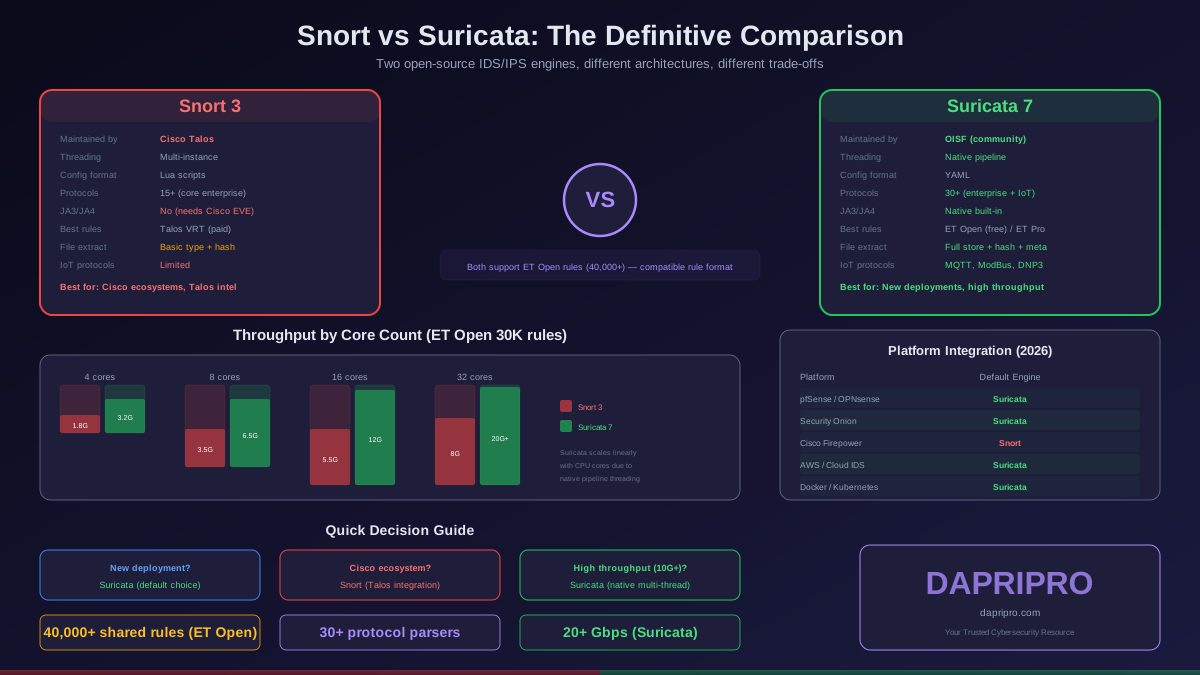
The practical result: on the same hardware, Suricata consistently handles higher traffic volumes than Snort. On an 8-core system, Suricata can process 4 to 6 times the traffic that single-threaded Snort 2 handles, and roughly 2 to 3 times what Snort 3 achieves with its multi-instance approach.
Performance: Real Numbers on Real Hardware
Performance comparisons must control for hardware, rule count, and traffic mix. Here are representative benchmarks from standardized testing environments:
| Hardware | Rule Count | Snort 2 | Snort 3 | Suricata 7 |
|---|---|---|---|---|
| 4 cores / 8 GB RAM | 20,000 (ET Open) | 800 Mbps | 1.8 Gbps | 3.2 Gbps |
| 8 cores / 16 GB RAM | 30,000 (ET Open) | 800 Mbps | 3.5 Gbps | 6.5 Gbps |
| 16 cores / 32 GB RAM | 40,000 (full) | 800 Mbps | 5.5 Gbps | 12+ Gbps |
| 32 cores / 64 GB RAM | 40,000+ | 800 Mbps | 8 Gbps | 20+ Gbps |
Notice that Snort 2 plateaus at roughly 800 Mbps regardless of core count — the single-threaded design cannot leverage additional processors. Snort 3 scales better with its multi-instance model but hits synchronization bottlenecks beyond 8 to 12 instances. Suricata continues scaling nearly linearly up to 32 cores and can go further with DPDK-accelerated packet capture.
Memory consumption
Suricata uses more memory than Snort for the same ruleset. Each detection thread maintains its own copy of rule structures, and the protocol parsers consume additional memory per tracked flow. Expect Suricata to use 2 to 3 times the memory of Snort for equivalent rule coverage. The trade-off is throughput: higher memory usage buys you proportionally higher packet processing rates.
Packet capture methods
Both engines support standard libpcap capture, but high-performance deployments require kernel-bypass technologies. Suricata supports AF_PACKET (zero-copy on Linux), DPDK (Data Plane Development Kit for 10/40/100 Gbps), and Netmap. Snort 3 supports DAQ (Data Acquisition) modules including AF_PACKET and DPDK, though Suricata documentation and community experience with DPDK is more mature.
Rule Ecosystem and Compatibility
Rules are the intelligence that powers detection. The quality and freshness of your rule sources matters more than the engine running them.
Shared rule formats
Both Snort and Suricata support a common rule format. A standard rule like this works in both engines:
alert http any any -> any any (msg:"ET WEB_SERVER SQL Injection Attempt"; flow:established,to_server; content:"UNION"; nocase; content:"SELECT"; nocase; sid:2100498; rev:7;)
The Emerging Threats (ET) Open ruleset — maintained by Proofpoint — is the most widely used free rule source. It contains 40,000+ rules covering malware, exploits, phishing, command-and-control, and policy violations. ET Open rules are tested against both Snort and Suricata and work identically on either engine.
Snort-specific rule sources
Snort VRT Rules (Talos) — developed by the Cisco Talos team, the largest commercial threat intelligence organization. The Community ruleset is free but delayed by 30 days. The Subscriber ruleset provides real-time updates and costs around 400 dollars per year for commercial use. Talos rules are specifically optimized for Snort detection engine behavior.
Snort 3 rule extensions — Snort 3 introduced new rule options like service for application-layer matching, js_data for JavaScript normalization, and improved http_header handling. These rules do not translate directly to Suricata without modification.
Suricata-specific capabilities
Extended rule keywords — Suricata adds rule keywords that Snort does not support: ja3.hash for TLS fingerprinting, filemagic for file type detection, dns.query for DNS-specific matching, tls.sni for Server Name Indication matching, and mqtt.topic for IoT protocol inspection. These keywords enable detection use cases that are impossible in Snort without custom preprocessors.
ET Pro ruleset — the commercial version of ET Open, maintained by Proofpoint. It adds 20,000+ additional rules with faster update cycles. ET Pro is specifically maintained for both Snort and Suricata compatibility but takes full advantage of Suricata extended keywords when running on Suricata.
Protocol Support and Application Layer Analysis
Modern IDS engines need to understand application protocols, not just TCP and UDP. Both engines include protocol parsers, but the scope differs significantly.
Suricata protocol parsers
Suricata includes native Rust-based protocol parsers for over 30 protocols:
- Web — HTTP/1.1, HTTP/2, WebSocket
- Email — SMTP, POP3, IMAP
- DNS — full query/response parsing with domain extraction
- TLS/SSL — certificate extraction, JA3/JA3S/JA4 fingerprinting, ALPN, SNI
- File sharing — SMB/CIFS (v1, v2, v3), NFS, FTP
- Databases — MySQL protocol detection, PostgreSQL
- IoT — MQTT, ModBus, DNP3, IEC 104
- Remote access — SSH (version detection, key exchange), RDP, VNC
- Tunneling — VXLAN, GRE, Geneve, MPLS, ERSPAN
Each parser generates structured metadata (logged as EVE JSON) that can be queried, searched, and correlated without writing signatures. For example, Suricata automatically logs every DNS query, TLS certificate, HTTP request, and SMB file transfer — creating a complete network metadata record that complements signature-based detection.
Snort protocol support
Snort 3 expanded protocol awareness through its "inspectors" (replacing Snort 2 "preprocessors"). Key inspectors include HTTP (unified HTTP inspector for normalization), SSL/TLS (certificate logging), DNS, SMB, SSH, and several others. Snort covers the core enterprise protocols but has fewer protocol parsers than Suricata, particularly for IoT and industrial protocols.
Snort does not provide native JA3 fingerprinting or equivalent TLS handshake analysis. For encrypted traffic detection, Snort relies on Cisco integration through Encrypted Visibility Engine (EVE) — which requires a Cisco Firepower or Secure Firewall deployment.
File Extraction and Analysis
Both engines can extract files from network traffic for analysis, but the implementations differ.
Suricata file extraction
Suricata can extract files from HTTP, SMTP, FTP, SMB, and NFS traffic. Extracted files are stored to disk with associated metadata (filename, size, protocol, source/destination IPs). Suricata also computes MD5, SHA1, and SHA256 hashes of every extracted file, enabling integration with malware analysis platforms like VirusTotal, CuckooSandbox, or YARA scanning pipelines.
The file extraction works in both IDS and IPS modes and can be configured to extract all files, files above a certain size, or only files matching specific MIME types. In production, most deployments extract executable files (PE, ELF), Office documents, and PDFs — the most common malware carriers.
Snort file inspection
Snort 3 file inspection focuses on identifying file types through magic byte detection and can block file downloads by type. File hash lookup is supported through the reputation inspection module. However, full file extraction to disk for offline analysis requires additional scripting or integration — it is not as streamlined as Suricata built-in file store feature.
Logging and Output Formats
Log quality determines how useful your IDS is for investigation and threat hunting.
Suricata EVE JSON
Suricata primary output format is EVE (Extensible Event Format) JSON — a single JSON log file containing alerts, protocol metadata, flow records, file information, and statistics. Each log entry is a self-contained JSON object with consistent fields, making it directly ingestible by Elasticsearch, Splunk, Graylog, and any JSON-compatible SIEM.
EVE JSON includes structured protocol logs: every HTTP request with full headers, every DNS query with response data, every TLS handshake with certificate details, every file transfer with hash data. This metadata is logged regardless of whether a signature fired, providing visibility even for attacks that evade rule-based detection.
Snort output formats
Snort 3 supports multiple output formats: unified2 (binary format for Barnyard2 processing), alert_fast (one-line per alert), alert_full (full packet dump), and alert_json. The alert_json output approaches EVE JSON functionality but protocol metadata logging is less comprehensive — Snort focuses on alert events rather than continuous protocol metadata.
For SIEM integration, Snort typically requires Barnyard2 (a dedicated log processor) to convert unified2 output into database-friendly formats. Suricata EVE JSON can be shipped directly to Elasticsearch or Splunk via Filebeat without intermediate processing.
Deployment Platforms and Integration
Where you deploy the engine affects which one you should choose.
pfSense and OPNsense
Both firewall distributions support Suricata as the primary IDS/IPS package. pfSense includes a polished Suricata GUI for rule management, interface assignment, blocklist integration, and alert viewing. OPNsense integrates Suricata through its plugins system with similar management capabilities. While a Snort package exists for pfSense, it receives less active development and the community has largely standardized on Suricata for these platforms.
Security Onion
Security Onion — the popular network security monitoring distribution — uses Suricata as its default IDS engine. The platform pairs Suricata with Zeek for network metadata, Elasticsearch for log storage, and Kibana for visualization. Snort is available as an alternative but is not the recommended configuration.
Cisco ecosystem
If your organization runs Cisco Firepower (Secure Firewall), Snort is the built-in detection engine. The Firepower Management Center provides centralized rule management, threat intelligence from Talos, and correlation with other Cisco security products. In this context, Snort is the correct choice — fighting the platform integration to use Suricata instead would be counterproductive.
Cloud deployments
Suricata is the dominant choice for cloud-based network monitoring. AWS VPC Traffic Mirroring feeds into Suricata sensors for cloud workload monitoring. Google Cloud IDS uses Palo Alto (not open-source), but custom deployments typically use Suricata. Azure Network Watcher provides basic flow logging, with Suricata VMs handling deep packet inspection.
Docker and Kubernetes
Suricata offers official Docker images and is commonly deployed as a DaemonSet in Kubernetes clusters for pod-to-pod traffic monitoring. Snort 3 Docker support exists but is less mature. For containerized environments, Suricata integrates more naturally with container orchestration workflows.
Management and Day-to-Day Operations
Configuration complexity
Suricata configuration lives in a single YAML file (suricata.yaml) that is well-structured and extensively commented. Changes are straightforward: edit the YAML, validate syntax, restart/reload the engine.
Snort 3 uses Lua-based configuration files which provide more flexibility but require understanding Lua syntax. For administrators coming from Snort 2 (which used a simple text format), the migration to Lua configuration is a significant learning curve.
Rule management
Both engines support suricata-update (for Suricata) and pulledpork3 (for Snort 3) for automated rule downloads and management. Suricata-update is well-integrated and handles rule source merging, enable/disable lists, and automatic reload without restart. PulledPork3 works but requires more manual configuration for multi-source setups.
Live rule reload
Suricata supports live rule reloading via SIGUSR2 or the Unix socket — new rules take effect without dropping a single packet. This is essential for production IPS deployments where rule updates should never cause traffic interruption. Snort 3 also supports rule reload but requires a reload command through the shell interface.
Monitoring and statistics
Suricata provides detailed engine statistics through its stats log: packets processed, packets dropped, decoder errors, flow counts, memory usage, and per-thread performance metrics. This data feeds into monitoring dashboards (Grafana, for example) for real-time engine health visibility. Snort 3 provides similar statistics through its perf_monitor module.
When to Choose Snort
- Cisco ecosystem — if you run Firepower/Secure Firewall, Snort is already your engine
- Talos intelligence — if your threat model demands the fastest commercial rule updates and you are willing to pay for Talos Subscriber rules
- Existing Snort expertise — if your team has years of Snort experience and custom preprocessors, migrating to Suricata has an opportunity cost
- Low-throughput environments — for small networks under 1 Gbps where Snort single-threaded performance is sufficient, it works fine
- Lua extensibility — if you need deep customization through the scripting configuration model
When to Choose Suricata
- High-throughput networks — anything above 1 Gbps benefits significantly from Suricata multi-threaded architecture
- Protocol metadata visibility — if you want rich DNS, TLS, HTTP, SMB logging beyond just signature alerts
- pfSense or OPNsense deployment — Suricata is the standard and best-supported engine on both platforms
- Encrypted traffic analysis — native JA3/JA4 fingerprinting without additional products
- File extraction pipelines — built-in file carving and hashing for malware analysis workflows
- New deployments — if starting fresh with no legacy Snort investment, Suricata is the default recommendation
- Container and cloud environments — better Docker support and cloud integration
- IoT and OT monitoring — native MQTT, ModBus, DNP3, and IEC 104 parsers for industrial networks
Can You Run Both?
Yes, and some organizations do. The most common dual-deployment scenario: Suricata as the primary IDS/IPS engine handling traffic inspection, with Snort deployed separately to take advantage of Talos commercial rules that some teams consider superior for specific threat categories. Both engines send alerts to the same SIEM for unified correlation.
Another pattern: Suricata for network monitoring and metadata generation (DNS logs, TLS fingerprints, HTTP logs) paired with Snort for signature-based alerting with Talos rules. Zeek often fills the metadata role better than either IDS engine, making the most common triple-stack: Suricata (IPS) + Zeek (metadata) + SIEM (correlation).
Migrating from Snort to Suricata
If you are currently running Snort and considering a migration:
- Rule compatibility check — run your existing ruleset through Suricata in IDS mode. Most Snort rules work without modification. Note any rules that produce parsing errors — these typically use Snort-specific syntax
- Configuration translation — map your Snort preprocessor settings to Suricata YAML configuration. Key mappings: Snort stream5 to Suricata stream, Snort http_inspect to Suricata app-layer.protocols.http, Snort frag3 to Suricata defrag
- Parallel deployment — run Suricata alongside your existing Snort installation using SPAN/mirror traffic. Compare alert output for 2 to 4 weeks to identify detection gaps or false-positive differences
- Performance baseline — establish throughput and latency baselines with your actual traffic before cutting over
- Cutover — switch monitoring traffic to Suricata, keeping Snort available for rollback. Monitor for 1 to 2 weeks before decommissioning Snort
The Bottom Line
For new deployments in 2026, Suricata is the default recommendation. Its multi-threaded architecture, comprehensive protocol support, native JA3 fingerprinting, EVE JSON logging, and file extraction capabilities make it the more capable engine out of the box. The community momentum (Security Onion, pfSense, cloud deployments) has standardized on Suricata, which means better documentation, more community rules, and faster bug fixes.
Snort remains a strong choice within Cisco environments and for organizations that value Talos threat intelligence above all else. Do not migrate a working Snort deployment just because Suricata is newer — migrate when you have a concrete need that Snort cannot meet (throughput, protocol coverage, or metadata logging).
Whichever engine you choose, the real work is in rule tuning, not engine selection. A well-tuned Snort deployment outperforms a default Suricata installation every time. For tuning guidance, see our IDS vs IPS deep dive, or explore the full Firewall and IDS section.