
In a microservices architecture, the network is the attack surface. When you decompose a monolith into 50, 100, or 500 services, every service-to-service call crosses the network. Without encryption, any compromised container can eavesdrop on traffic between other services. Without authentication, any workload can impersonate any other workload. Without authorization, a compromised frontend service can call the payment processing API directly. The traditional approach — trusting everything inside the network perimeter — fails completely in a containerized environment where workloads from different teams and trust levels share the same cluster network.
A service mesh solves this by inserting a proxy sidecar next to every workload. This proxy handles encryption (mTLS), authentication (cryptographic identity verification), authorization (policy-based access control), and observability (request metrics, distributed tracing) — all without modifying application code. The two production-grade, open-source service meshes in 2026 are Istio (backed by Google, IBM, and the broader Envoy ecosystem) and Linkerd (a CNCF graduated project built on a purpose-built Rust proxy).
Why Service Mesh Security Matters
The core security problem in Kubernetes is that the default cluster network is flat and permissive. Every pod can communicate with every other pod. There is no encryption, no authentication, and no authorization for east-west traffic (service-to-service calls within the cluster). This means:
| Attack Scenario | Without Mesh | With Mesh (mTLS + Policies) |
|---|---|---|
| Compromised pod eavesdrops on traffic | All traffic is plaintext. Attacker captures database credentials, API tokens, and user data from adjacent service calls | All traffic is encrypted with mTLS. Captured packets are ciphertext. No credentials visible. |
| Compromised pod impersonates another service | No identity verification. Attacker sends requests appearing to come from a trusted service | Every service has a cryptographic identity (SPIFFE SVID). Impersonation requires possessing the private key of the target identity. |
| Lateral movement after initial breach | Compromised frontend pod calls database API, payment service, admin endpoints with no restrictions | Authorization policies enforce that frontend can only call the API gateway. Any attempt to reach other services is denied and logged. |
| Credential theft from network traffic | Service A sends database password to Service B in plaintext HTTP body. Attacker intercepts with tcpdump | mTLS encrypts the entire HTTP body. Even inter-service traffic containing credentials is protected in transit. |
| Unauthorized data exfiltration | Compromised pod opens connection to external endpoint and streams captured data out of the cluster | Egress policies control which services can communicate externally and to which destinations. Unauthorized egress is blocked. |
SPIFFE: The Identity Foundation
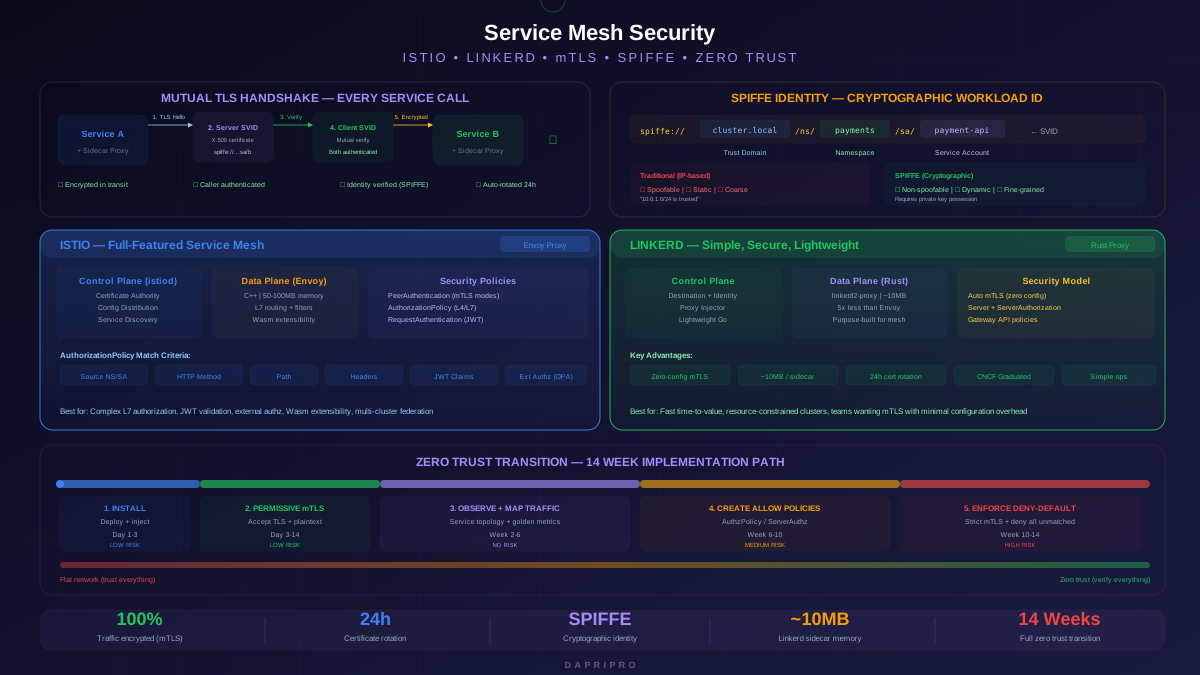
Both Istio and Linkerd use SPIFFE (Secure Production Identity Framework for Everyone) as their workload identity standard. SPIFFE provides a way to identify workloads across heterogeneous environments using a URI-based identity (SPIFFE ID) and short-lived X.509 certificates (SVIDs — SPIFFE Verifiable Identity Documents).
A SPIFFE ID looks like: spiffe://cluster.local/ns/payments/sa/payment-api. This identity encodes the trust domain (cluster.local), namespace (payments), and service account (payment-api). When two services communicate, their sidecar proxies exchange SVIDs and verify each other's identity before allowing the connection.
Why SPIFFE Matters
| Traditional Identity | SPIFFE Identity |
|---|---|
| IP-based: "requests from 10.0.1.0/24 are trusted" | Cryptographic: "requests with SVID from spiffe://cluster.local/ns/payments/sa/api are trusted" |
| Spoofable: IP addresses can be forged in many network configurations | Non-spoofable: requires possessing the private key corresponding to the SVID |
| Static: IP ranges rarely change, even when workload trust levels change | Dynamic: new SVIDs issued automatically when workloads are deployed, rotated every 24 hours |
| Coarse: entire subnet is trusted, including compromised workloads | Fine-grained: each service account has a unique identity, policies target individual identities |
Istio Security Model
Istio is the most feature-rich service mesh available. Its security model is built on three pillars: PeerAuthentication (how services verify each other), RequestAuthentication (how services verify end-user identity via JWT), and AuthorizationPolicy (who can access what).
Automatic mTLS
Istio enables automatic mTLS by default in permissive mode. This means services within the mesh communicate using mTLS when both sides have sidecars, and fall back to plaintext when communicating with services outside the mesh. To enforce mTLS strictly (rejecting any non-mTLS connection), you apply a PeerAuthentication resource with mtls mode set to STRICT.
The Istio control plane (istiod) acts as a certificate authority. When a sidecar proxy starts, it generates a private key and sends a certificate signing request (CSR) to istiod. Istiod issues a short-lived X.509 certificate containing the SPIFFE identity. The default certificate lifetime is 24 hours.
AuthorizationPolicy: L4/L7 Access Control
AuthorizationPolicy is Istio's most powerful security primitive. It allows you to create allow-list, deny-list, or custom action policies at the network layer (L4) or application layer (L7).
| Policy Type | Match Criteria | Use Case |
|---|---|---|
| Source-based | Source namespace, service account, IP range | Only pods in the "backend" namespace can call the database service |
| Operation-based | HTTP method, path, port | The frontend service can only GET from the product API, not POST or DELETE |
| Condition-based | Request headers, JWT claims | Only requests with a valid admin JWT claim can access the admin endpoint |
| Deny rules | Same criteria as above, but with DENY action | Block all traffic from the monitoring namespace to the production database, even if other rules would allow it |
| Custom action | Delegates to external authorizer (OPA, OAuth2) | Route authorization decisions to Open Policy Agent for complex business logic |
Linkerd Security Model
Linkerd takes a deliberately simpler approach to service mesh security. Its philosophy is that security should work out of the box — mTLS is enabled automatically with zero configuration when you install Linkerd and inject sidecars.
Automatic mTLS in Linkerd
When Linkerd is installed, every injected pod receives a sidecar proxy that automatically establishes mTLS connections with every other meshed pod. There is no permissive mode configuration, no PeerAuthentication resource to create — mTLS just works. The Linkerd identity component acts as the certificate authority, issuing short-lived certificates with 24-hour expiry by default.
You can verify mTLS is active across the cluster using the Linkerd CLI, which shows the percentage of meshed connections using mTLS (target: 100 percent for all meshed traffic).
Linkerd Policy: Server and ServerAuthorization
Linkerd's authorization model uses two resources:
| Resource | Purpose | Example |
|---|---|---|
| Server | Defines which ports and protocols a workload exposes to the mesh | Server resource declaring that the payment-api pod serves HTTP on port 8080 |
| ServerAuthorization | Defines which identities can access a Server | Only pods with the service account "checkout" in namespace "frontend" can access the payment-api Server |
| AuthorizationPolicy | Newer policy resource using Gateway API types for richer matching | Allow traffic from specific MeshTLSAuthentication identities to an HTTPRoute matching specific paths |
| Default policy | Cluster-wide default when no explicit policy matches | Set default to "deny" (all-unauthenticated, all-authenticated, cluster-authenticated, deny) |
mTLS Deep Dive: The Handshake
Understanding how mutual TLS works in practice is essential for debugging connection failures and certificate issues:
- Client sidecar initiates TLS — the source pod's sidecar proxy intercepts the outgoing TCP connection and begins a TLS handshake with the destination sidecar.
- Server sidecar presents its certificate — the destination sidecar presents its SVID (X.509 certificate containing its SPIFFE identity) to the client sidecar.
- Client verifies server certificate — the client sidecar checks that the server certificate is signed by the mesh's trust anchor (root CA), has not expired, and contains the expected SPIFFE identity for the destination service.
- Client presents its certificate — the client sidecar presents its own SVID to the server. This is the "mutual" in mutual TLS — both sides authenticate.
- Server verifies client certificate — the server sidecar verifies the client's SVID against the trust anchor and checks authorization policies to determine if this identity is allowed to access this service on this port/path.
- Encrypted channel established — both sides have verified each other's identity. All subsequent data is encrypted with the negotiated session keys. The entire application payload (HTTP headers, body, paths) is encrypted in transit.
Certificate Rotation
| Certificate Type | Istio Default | Linkerd Default | Purpose |
|---|---|---|---|
| Root CA (trust anchor) | 10 years | 1 year (must be rotated) | Top of the trust hierarchy. All certificates chain to this root. |
| Intermediate CA (issuer) | 5 years | 1 year | Signs workload certificates. Allows root CA to be kept offline. |
| Workload SVID | 24 hours (configurable) | 24 hours | Identity certificate for each pod. Short-lived to limit blast radius. |
The Zero Trust Implementation Path
Transitioning from a flat network to zero trust service mesh security is a multi-week process. Attempting to enforce strict policies on day one will cause service outages because you do not yet know all the legitimate traffic patterns.
The Five-Phase Transition
| Phase | Timeline | Actions | Risk Level |
|---|---|---|---|
| 1. Install and inject | Day 1-3 | Install mesh control plane. Inject sidecars into workloads namespace by namespace. Verify applications function with sidecars | Low — sidecars are transparent by default |
| 2. Permissive mTLS | Day 3-14 | Enable permissive mTLS (Istio) or verify auto-mTLS (Linkerd). Monitor for connection failures from non-meshed services | Low — mesh accepts both plaintext and mTLS |
| 3. Observe and map | Week 2-6 | Deploy observability (Grafana dashboards, service topology map). Document all legitimate service-to-service traffic patterns, including external dependencies | None — read-only observation |
| 4. Create allow policies | Week 6-10 | Write AuthorizationPolicy (Istio) or ServerAuthorization (Linkerd) for each service based on observed traffic. Test in audit/warn mode before enforcing | Medium — incorrect policies can block traffic |
| 5. Enforce and deny-default | Week 10-14 | Switch to strict mTLS (reject plaintext). Enable default-deny authorization. All traffic must match an explicit allow rule | High — any traffic not covered by policy is blocked |
Observability as a Security Tool
Service meshes provide observability that doubles as security monitoring. Both Istio and Linkerd expose golden metrics (request rate, success rate, latency) for every service-to-service connection. These metrics reveal security-relevant patterns that are invisible without a mesh:
| Observable Signal | Security Implication | Response |
|---|---|---|
| Unexpected service-to-service connection | A service that never calls the database is suddenly making database connections. Possible compromised pod or misconfigured deployment | Investigate the workload. Check if a recent deployment changed the calling pattern. If unauthorized, create a deny policy immediately. |
| Spike in 403 (forbidden) responses | A service is being blocked by authorization policies at a higher rate than normal. May indicate scanning or brute-force attempt from within the cluster | Identify the source identity. If the traffic is unexpected, the deny policy is working — verify the source is not compromised. |
| Increase in non-mTLS connections | Traffic bypassing the mesh sidecar (possible container escape or direct pod-to-pod communication through init container manipulation) | Enforce strict mTLS. Investigate pods sending plaintext. Ensure no hostNetwork pods are bypassing the mesh. |
| Latency spike on a specific route | Could indicate a man-in-the-middle proxy, DNS hijacking, or data exfiltration adding processing time | Compare latency against baseline. Check if a new proxy or intermediary has been inserted. Verify DNS resolution. |
Multi-Cluster Mesh Security
When services span multiple Kubernetes clusters (for redundancy, geographic distribution, or regulatory compliance), the service mesh must extend trust boundaries across clusters while maintaining security controls.
Cross-Cluster Trust
Both Istio and Linkerd support multi-cluster configurations where services in different clusters can communicate with mTLS. The critical requirement is a shared trust anchor — both clusters must trust the same root CA so that workload certificates issued in Cluster A are recognized as valid by Cluster B.
| Approach | Istio Implementation | Linkerd Implementation |
|---|---|---|
| Shared root CA | Use the same root CA certificate across clusters. Each cluster has its own intermediate CA (Citadel) signing workload certificates | Install the same trust anchor (root certificate) in all clusters. Each cluster's identity component issues workload certificates |
| Cross-cluster connectivity | East-west gateway: dedicated gateway for cross-cluster traffic. Traffic is encrypted with mTLS between gateways | Gateway-based multicluster: Linkerd gateway pods export/import services between clusters |
| Policy enforcement | AuthorizationPolicy can match on source clusters by filtering on SPIFFE trust domain or namespace prefix | ServerAuthorization targets specific identities. Cross-cluster identities are distinguished by trust domain in the SPIFFE ID |
Decision Framework: Which Mesh for Your Security Needs
| Requirement | Choose Istio | Choose Linkerd |
|---|---|---|
| mTLS encryption | Both provide automatic mTLS | Both provide automatic mTLS |
| L7 authorization (HTTP method/path) | Full L7 AuthorizationPolicy with method, path, header, JWT matching | Basic L7 via HTTPRoute-based policy (path matching). No JWT-based authorization. |
| External authorization | Custom action in AuthorizationPolicy routes to OPA, OAuth2 Proxy, or any external gRPC authorizer | Not supported natively. Must implement at the application level. |
| Resource efficiency | Envoy sidecar: 50-100MB memory per pod. Higher CPU during load | linkerd2-proxy: approximately 10MB memory per pod. Significantly lower CPU |
| Operational complexity | More configuration options. Higher learning curve. More failure modes to diagnose | Simpler model. Fewer resources to manage. Integrated CLI diagnostics |
| Observability | Prometheus metrics, Jaeger tracing, Kiali dashboard | Built-in Grafana dashboards, tap (live request inspection), CLI-based diagnostics |
| Extensibility | Wasm filters, Lua scripts, EnvoyFilter resources for deep customization | Limited extensibility by design. What you see is what you get. |
| Platform support | Multi-cluster, VM workloads, hybrid cloud | Kubernetes-focused. Multi-cluster supported but simpler model. |
For most organizations starting their zero trust journey, Linkerd provides the fastest path to encrypted, authenticated service-to-service communication. For organizations with complex L7 authorization requirements (API gateways, JWT-based access control, external policy engines), Istio provides the control surface needed to implement fine-grained policies.