
Every VPN website says the same thing: "We never log your data." But how do you actually know that is true?
You can not. Unless they have been independently audited.
An independent audit means a trusted security company — not the VPN itself — went through the code, servers, and policies to check if the claims are real. Think of it like a restaurant health inspection. The restaurant says the kitchen is clean, but you want the health inspector to confirm it.
I ranked every major VPN by one question: can you actually prove your security claims?
The 5 Most Secure VPNs in 2026
| Rank | VPN | Audits | RAM-Only | Open Source | Jurisdiction |
|---|---|---|---|---|---|
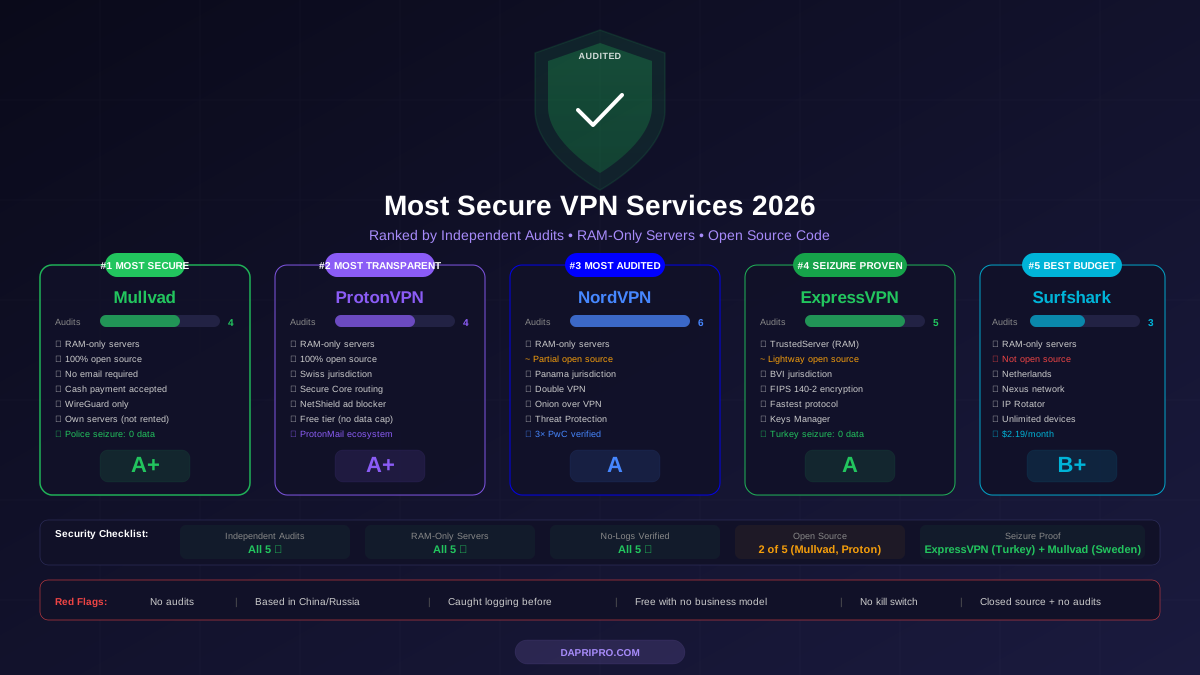
| #1 | Mullvad | 4 (Cure53, Assured) | ✅ | ✅ All apps | Sweden |
| #2 | ProtonVPN | 4 (Securitum) | ✅ | ✅ All apps | Switzerland |
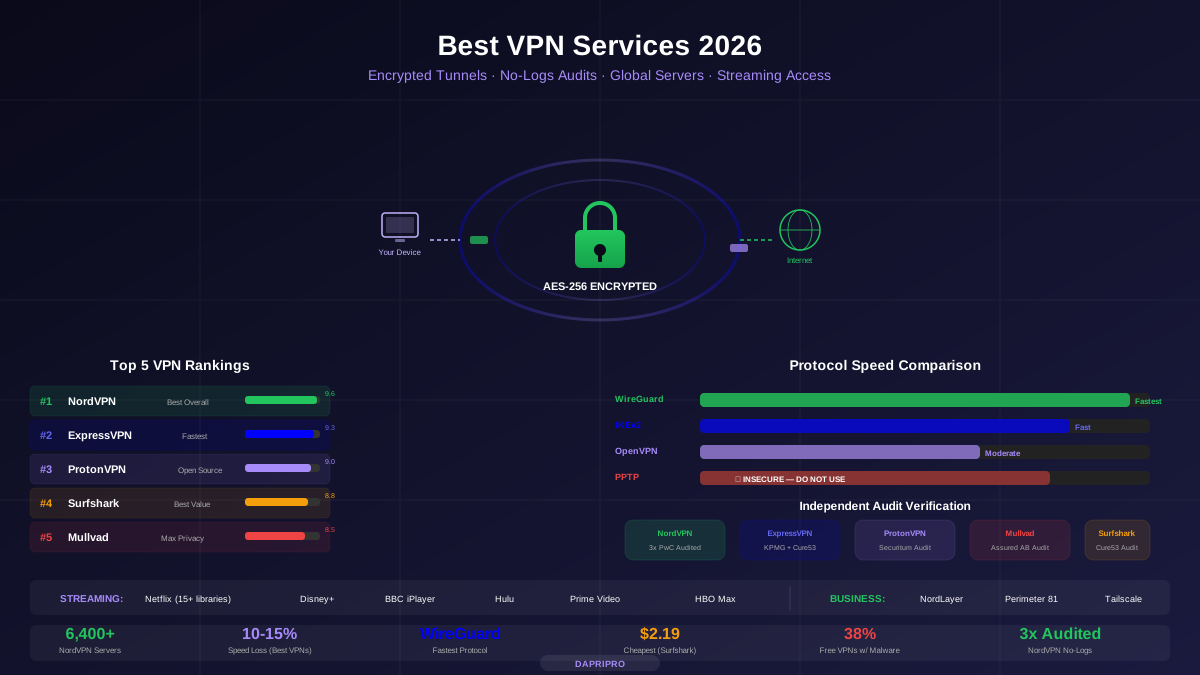
| #3 | NordVPN | 6 (PwC, Deloitte, Cure53) | ✅ | Partial (Lynx) | Panama |
| #4 | ExpressVPN | 5 (Cure53, KPMG, PwC) | ✅ | Partial (Lightway) | BVI |
| #5 | Surfshark | 3 (Cure53, Deloitte) | ✅ | ❌ | Netherlands |
What Actually Makes a VPN Secure?
A "secure VPN" is not just about encryption. Five things matter:
- Independent audits. Has a trusted security firm verified the VPN claims? More audits and broader scope = more trustworthy.
- No-logs policy (proven). The VPN should not store your IP address, browsing history, connection timestamps, or bandwidth usage. And this must be verified by an audit, not just claimed on a website.
- RAM-only servers. Servers that run entirely in memory. When the power goes off, everything is erased. This makes it physically impossible to store logs long-term.
- Open-source apps. If the VPN code is public, anyone can review it for backdoors or vulnerabilities. Closed-source means you are trusting the company.
- Encryption standard. All five VPNs above use AES-256 or ChaCha20 encryption — both are considered unbreakable with current technology.
1. Mullvad — The Most Private VPN
Mullvad is built for one thing: maximum privacy. No other VPN goes this far.
| Feature | Mullvad |
|---|---|
| Account creation | No email, no name — just a random number |
| Payment options | Cash in an envelope, crypto, card |
| Audits | 4 audits by Cure53 and Assured AB |
| Servers | RAM-only, owned (not rented) |
| Protocol | WireGuard only (removed OpenVPN in 2023) |
| Open source | All apps on GitHub |
| Price | €5/month — no discounts, no tiers, no tricks |
| Server seizure test | Swedish police seized servers in 2023 — zero user data found |
Mullvad even lets you pay with cash. You put €5 in an envelope, mail it to Sweden, and get VPN access with no trace back to you. No other VPN offers this level of anonymity.
The downside? Mullvad has only 700+ servers in 43 countries. It is not optimized for streaming (Netflix often does not work). It is designed for privacy, not entertainment.
2. ProtonVPN — Best Transparent VPN
ProtonVPN is made by the same team behind ProtonMail. It is based in Switzerland, which has some of the world's strongest privacy laws and is outside the 14 Eyes alliance.
What makes ProtonVPN special:
- 100% open source. Every app (Windows, Mac, Linux, iOS, Android) is published on GitHub. Anyone can read the code.
- Secure Core. Routes your traffic through privacy-friendly countries (Switzerland, Iceland, Sweden) before reaching the exit server. Even if the exit server is compromised, your real IP is protected.
- NetShield ad blocker blocks ads, trackers, and malware at the DNS level.
- Free tier available — no data cap, no ads. Limited to 5 countries and lower speeds, but genuinely usable.
3. NordVPN — Most Audited VPN
NordVPN has undergone 6 independent audits — more than any other VPN. Their no-logs policy has been verified three times by PwC (one of the "Big Four" accounting firms) and Deloitte.
NordVPN also completed a full infrastructure audit after a 2019 security incident where one of their rented servers in Finland was breached. Their response was impressive: they switched to 100% RAM-only servers, started running their own colocated servers (not rented from third parties), and commissioned even more audits.
Unique NordVPN security features:
- Double VPN: Routes traffic through two VPN servers instead of one for extra encryption.
- Onion over VPN: Combines VPN encryption with the Tor network for maximum anonymity.
- Threat Protection: Blocks malware, trackers, and malicious websites even when not connected to a VPN server.
- Dark Web Monitor: Alerts you if your credentials appear in data breach databases.
4. ExpressVPN — TrustedServer Pioneer
ExpressVPN invented the TrustedServer concept — the technology behind RAM-only servers. Their entire infrastructure runs on volatile memory, verified by multiple audits from Cure53, KPMG, and PwC.
A real-world test happened in 2017: Turkish authorities seized an ExpressVPN server during a political investigation. Zero user data was found because the server ran entirely in RAM. This is not a marketing claim — it was tested in an actual government investigation.
ExpressVPN also open-sourced their Lightway protocol, which uses the wolfSSL library (FIPS 140-2 validated). This means government-grade encryption is auditable by anyone.
5. Surfshark — Strong Security, Growing Trust
Surfshark is the youngest VPN on this list but has rapidly built credibility. It has completed 3 audits by Cure53 and Deloitte, converted to 100% RAM-only servers, and merged with NordVPN's parent company (Nord Security) which gives it access to stronger security infrastructure.
Surfshark's unique security features:
- Nexus: Connects you to a network of VPN servers instead of a single server, rotating your IP without disconnecting.
- IP Rotator: Changes your IP address periodically without changing your VPN connection.
- CleanWeb 2.0: Blocks ads, trackers, malware, and phishing at the network level.
The main gap: Surfshark apps are not open source. You are trusting their code without being able to verify it yourself. This is why Surfshark scores B+ instead of A.
Why RAM-Only Servers Changed Everything
Before RAM-only servers, VPN companies stored their software on hard drives. If a server was seized by authorities or hacked, data could potentially be recovered — even "deleted" data can sometimes be restored from hard drives.
RAM-only servers solved this problem completely:
VPN Security Red Flags — Avoid These
Not all VPNs are trustworthy. Watch out for these warning signs:
| Red Flag | Why It Matters | Examples |
|---|---|---|
| No independent audits | No proof their "no logs" claim is real | Most small VPNs |
| Based in China or Russia | Governments can compel data access | Several free VPNs |
| Caught logging before | Past behavior predicts future behavior | PureVPN (2017), IPVanish (2016) |
| Free with no clear business model | If the VPN is free, you are the product | Hola VPN, SuperVPN, many others |
| No kill switch | Your IP leaks if VPN disconnects | Budget VPNs |
| Closed source + no audits | Zero transparency — blind trust | Many mid-tier VPNs |
Which Secure VPN Should You Choose?
- Maximum privacy, no compromises: Mullvad. Anonymous accounts, cash payment, open source, RAM-only, police-seizure tested.
- Best balance of security and features: NordVPN. Most audits, RAM-only, double VPN, Threat Protection, great for both privacy and streaming.
- Full transparency (see the code yourself): ProtonVPN. 100% open source, Swiss-based, Secure Core routing, free tier available.
- Proven under government pressure: ExpressVPN. TrustedServer pioneer, survived a real server seizure with zero data, Lightway open-sourced.
- Security on a budget: Surfshark. 3 audits, RAM-only, $2.19/month for unlimited devices. Growing fast but not yet open source.
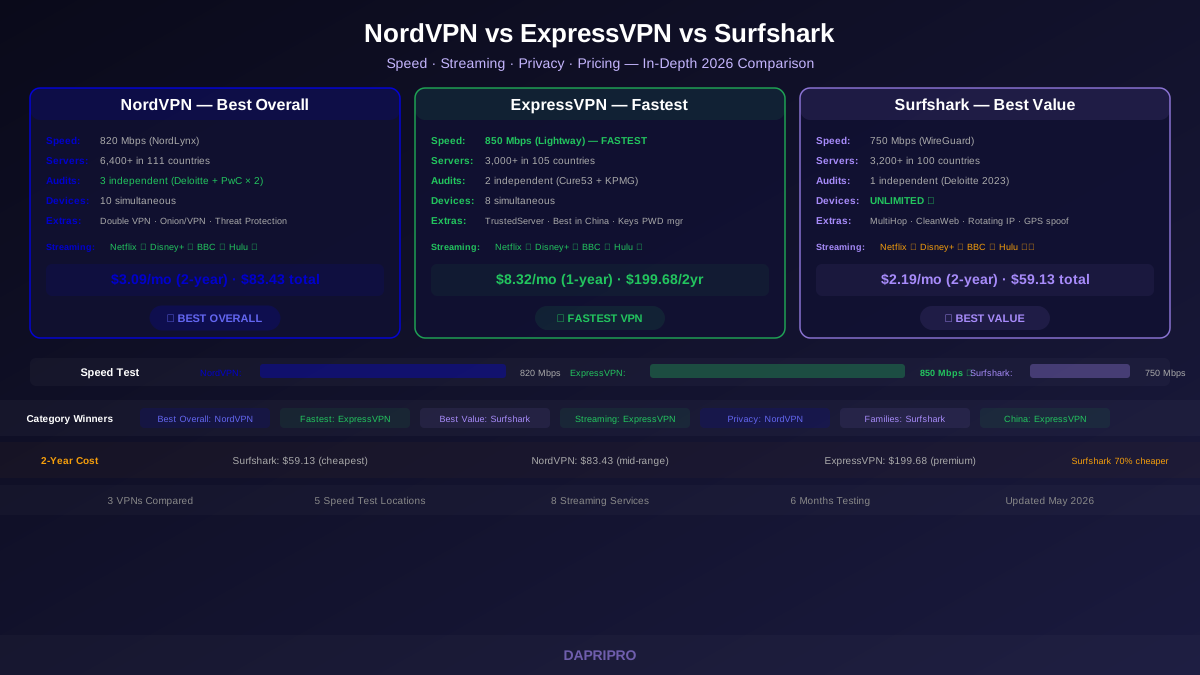
For a deeper comparison of NordVPN, ExpressVPN, and Surfshark, see our head-to-head review. For privacy-focused VPNs specifically, read our Mullvad vs ProtonVPN comparison.
![Best VPN for Streaming: Unblock Netflix, Disney+, and More [2026]](/images/sections/security-tools-reviews/vpn-reviews/best-vpn-for-streaming-unblock-netflix-disney-plus-and-more.svg)