
Your Entire Life Is for Sale Online
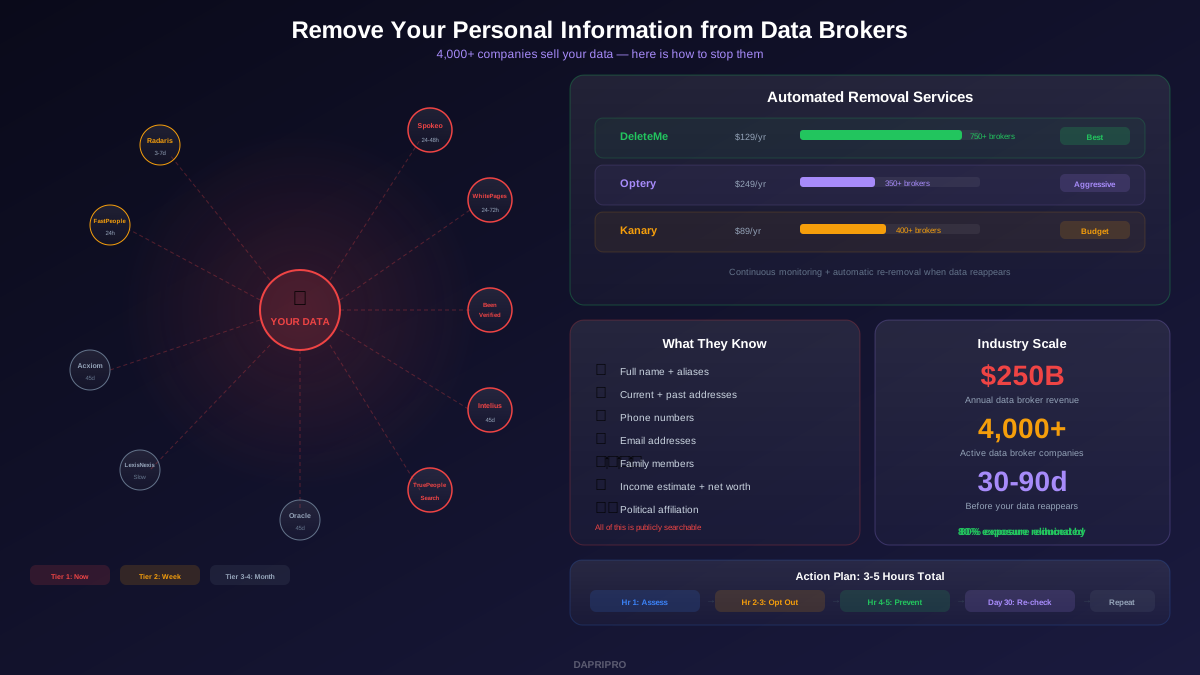
Right now, anyone with internet access can search your name and find your home address, phone number, email, approximate income, political affiliation, family members' names, and even your estimated net worth — all for free. This is not a hack or a data breach. This is the normal business model of data brokers.
There are over 4,000 data broker companies operating globally, and the industry generates $250 billion in annual revenue. They collect your information from public records, social media profiles, purchase histories, app data, loyalty programs, and other brokers. Then they package it into detailed profiles and sell it to advertisers, employers, landlords, scammers, and literally anyone willing to pay.
The good news: you can remove your data. The process is tedious but straightforward. This guide covers the exact steps for the top 20 data brokers that expose the most personal information, plus automated services that handle the ongoing maintenance.
Where Data Brokers Get Your Information
Understanding the data pipeline helps you stop the flow at the source. Data brokers collect from five primary channels:
Public records: Property records, court filings, voter registration, marriage and divorce records, business filings, and professional licenses. These are legally public and the hardest source to restrict. You can limit exposure by using a PO Box or LLC for property ownership.
Social media: Everything you post publicly on Facebook, Instagram, LinkedIn, and X/Twitter. Profile details, friend lists, check-ins, photos, and even metadata from images. Set all profiles to private and limit what you share publicly.
Purchase data: Retailers, loyalty programs, and payment processors sell transaction data to brokers. If you signed up for a rewards program at a grocery store, your purchase history is being sold. Use cash for sensitive purchases and minimize loyalty program participation.
App and device data: Mobile apps sell location data, usage patterns, and advertising IDs to brokers. That free flashlight app or weather widget is likely tracking and selling your data. Audit app permissions regularly and deny location access to apps that do not need it.
Other data brokers: Brokers buy from each other. This is why removing your data from one site does not prevent it from appearing on another — they share and resell information in a massive circular network. Comprehensive removal requires hitting all major brokers.
The Top 20 Data Brokers to Opt Out From
These are the largest people-search and data broker sites that publicly display personal information. Removing your data from these 20 eliminates about 80% of your public exposure. I have listed them in priority order based on traffic, data depth, and difficulty to remove.
Tier 1 — Remove Immediately (Highest Exposure)
Spokeo (spokeo.com): One of the largest people-search sites. Go to spokeo.com/optout, paste the URL of your profile, enter your email, and click the confirmation link. Removal takes 24-48 hours. Spokeo is one of the easiest and fastest to process opt-outs.
WhitePages (whitepages.com): Search your name at whitepages.com, copy your profile URL, go to whitepages.com/suppression-requests, paste the URL, verify by phone, and confirm. Removal takes 24-72 hours. WhitePages also powers several other smaller people-search sites.
BeenVerified (beenverified.com): Go to beenverified.com/f/optout/search, search for your record, select it, and submit your email for verification. Removal takes 24-48 hours. BeenVerified also operates PeopleLooker and NumberGuru.
Intelius (intelius.com): Submit a request at intelius.com/opt-out. You need to provide your name, state, and date of birth. Intelius owns several subsidiaries including Zabasearch, PeopleFinder, and iSearch. Removing from Intelius cascades to those sites.
TruePeopleSearch (truepeoplesearch.com): Find your listing, click "Remove This Record," solve the captcha, and verify via email. Removal takes 24-48 hours. This site has extremely high Google rankings for name searches.
Tier 2 — Remove This Week
FastPeopleSearch (fastpeoplesearch.com): Find your listing and click the removal link at the bottom of the page. Verify via email. Straightforward process that takes 24 hours.
ThatsThem (thatsthem.com): Go to thatsthem.com/optout, enter the URL of your listing, and verify via email. Takes 24-72 hours.
Radaris (radaris.com): This one requires creating an account to opt out, which is deliberately frustrating. Go to radaris.com/control/privacy, create an account, find your record, and submit removal. After removal is confirmed, delete your Radaris account. Takes 3-7 days.
USPhoneBook (usphonebook.com): Submit removal at usphonebook.com/opt-out. Enter the URL of your listing and verify via email. Fast processing within 24 hours.
Nuwber (nuwber.com): Go to nuwber.com/removal, submit your profile URL and email, and confirm via the email link. Takes 48-72 hours.
Tier 3 — Remove This Month
Acxiom (acxiom.com): One of the largest commercial data brokers (not a people-search site). Submit an opt-out at acxiom.com/do-not-sell-my-personal-information. They take the full 45 days allowed by law. Acxiom sells to major advertisers and removing your data here reduces targeted ads.
Oracle Data Cloud (formerly BlueKai): Oracle's data marketplace profiles billions of users. Opt out at datacloudoptout.oracle.com. This stops Oracle from selling your browsing behavior to advertisers.
LexisNexis (lexisnexis.com): Used by landlords, employers, and insurance companies for background checks. Submit a request through their consumer portal at consumer.risk.lexisnexis.com. You need to verify your identity. This is one of the most important but slowest opt-outs.
Epsilon (epsilon.com): Major marketing data broker. Submit opt-out at epsilon.com/privacy. They handle direct mail, email marketing, and digital advertising data.
PeopleFinders (peoplefinders.com): Go to peoplefinders.com/manage, find your record, and submit removal. Verify via email. Takes 48 hours.
Tier 4 — Clean Up Remaining Exposure
MyLife (mylife.com): Requires calling customer service at 1-888-704-1900 and requesting removal. Deliberately difficult. Be persistent — it is your legal right.
Pipl (pipl.com): Email privacy@pipl.com with your name, email, phone, and city requesting removal. They typically respond within 5 business days.
FamilyTreeNow (familytreenow.com): Go to familytreenow.com/optout, search for your record, and submit removal. Verify via email. Takes 48 hours.
Instant Checkmate (instantcheckmate.com): Go to instantcheckmate.com/opt-out, search for your record, verify via email. Owned by the same company as TruthFinder. Takes 48 hours.
TruthFinder (truthfinder.com): Submit opt-out at truthfinder.com/opt-out. Follow the email verification process. Takes 48 hours.
Automated Data Removal Services Compared
Manual opt-out from 20 sites takes 3-5 hours initially then ongoing maintenance every 30-90 days. If that sounds exhausting, automated services handle the entire process. Here is how the major services compare:
| Service | Annual Cost | Brokers Covered | Scan Frequency | Best For |
|---|---|---|---|---|
| DeleteMe | $129/year | 750+ | Every 3 months | Best overall — longest track record, transparent reports |
| Optery | $249/year (Ultimate) | 350+ | Monthly | Most aggressive — covers hardest-to-remove brokers |
| Kanary | $89/year | 400+ | Continuous | Best budget option — real-time monitoring |
| Privacy Duck | $500+/year | 500+ | Custom | White-glove service for high-profile individuals |
| Incogni (Surfshark) | $78/year | 180+ | Monthly | Cheapest — bundled with Surfshark VPN |
| Mozilla Monitor Plus | $109/year | 190+ | Monthly | Good if you already use Firefox — trusted brand |
My recommendation: DeleteMe for most people — it covers the most brokers, provides detailed quarterly reports showing what was found and removed, and has been operating since 2011 with a proven track record. If budget is tight, Kanary offers excellent value with continuous monitoring at $89/year.
Google Yourself: What You Will Find
Before and after opting out, search for yourself to measure your exposure. Use these exact searches:
"Your Full Name" + city — Shows people-search profiles. This is the most common attack vector for someone looking you up.
"Your Full Name" + phone number — Shows which sites have connected your name to your phone. These results drive spam calls.
"Your Full Name" + address — Shows property-linked profiles. Stalking risk number one.
Your email address (in quotes) — Shows where your email has been scraped or listed publicly. Major phishing vector.
Your phone number (in quotes) — Shows reverse-lookup sites. These are easy to remove and dramatically reduce robocalls.
Document every site that appears in results. Screenshot the listings. Then systematically work through opt-outs starting with Tier 1 brokers.
Request Google to Remove Search Results
After removing your data from source sites, cached versions may persist in Google search results for weeks or months. You can speed this up:
Google's Results About You tool: Go to Google app or myactivity.google.com → Results about you. Google will scan for your contact information appearing in search results and let you request removal of specific results. This is the fastest method.
Google's content removal request: For sensitive information like financial data, medical records, or login credentials appearing in search results, submit a removal request through Google's support page. Google prioritizes these removals.
Google's outdated content tool: If a page has already been updated (your data removed) but Google's cached version still shows it, use the outdated content tool at search.google.com/search-console/remove-outdated-content to force a re-cache.
Prevent Your Data from Coming Back
Opt-out is only half the battle. Data brokers re-collect your information from public records and other sources every 30-90 days. Here is how to slow the re-collection:
Lock down social media. Set all profiles to private. Remove your phone number, email, and birthday from public profile fields on Facebook, Instagram, LinkedIn, and X/Twitter. Disable people search on Facebook (Settings → Privacy → "Do you want search engines outside of Facebook to link to your profile?" → No).
Use an alias email for signups. Create a separate email address for online accounts, newsletters, and services. Use your real email only for banking, government, and close contacts. This prevents your real email from being linked to data broker profiles.
Get a PO Box or virtual mailbox. Property records and voter registration link your name to your physical address. A PO Box is not always possible for these records, but a virtual mailbox service like Traveling Mailbox or Earth Class Mail provides a real street address that is not your home.
Freeze your credit. Credit freezes with Equifax, Experian, and TransUnion prevent new accounts from being opened in your name and reduce the data flowing to marketing databases. Freezing is free and takes 10 minutes per bureau.
Opt out of marketing associations. The Data & Marketing Association (DMA) operates a consumer opt-out at dmachoice.org that removes you from marketing lists used by hundreds of companies. The National Do Not Call Registry (donotcall.gov) reduces telemarketing calls.
State Privacy Laws That Help You
Your legal rights depend on where you live. These state laws give you the right to demand data deletion:
California (CCPA/CPRA): The strongest US privacy law. You can request deletion from any business that collects your data. Companies must respond within 45 days. You can also opt out of the sale of your personal information. The California Privacy Protection Agency enforces violations.
Virginia (VCDPA): Right to delete, right to opt out of data sales, and right to appeal denied requests. Businesses must respond within 45 days.
Colorado (CPA): Similar to Virginia with added universal opt-out mechanism — you can submit a single opt-out signal through your browser that all covered businesses must honor.
Connecticut (CTDPA): Right to delete and opt out. Businesses must respond within 45 days with one 45-day extension if they provide a reason.
Texas (TDPSA): Effective since July 2024. Right to delete and opt out of data sales. Covers businesses operating in Texas regardless of their physical location.
If a data broker refuses your removal request, reference the specific law that applies. Most brokers comply when you cite the law directly because the fines for violations are substantial — up to $7,500 per violation under CCPA.
Your Data Removal Action Plan
Here is the exact sequence to follow. Budget 3-5 hours for the initial cleanup:
Hour 1: Assessment. Google yourself using all five search queries listed above. Document every site where you appear. Take screenshots of each listing with dates.
Hours 2-3: Tier 1 and Tier 2 opt-outs. Work through the top 10 data brokers. Keep a spreadsheet tracking: site name, date submitted, confirmation email received, expected removal date.
Hours 4-5: Tier 3 and Tier 4 opt-outs plus prevention. Complete remaining brokers. Lock down social media. Set up credit freezes if not already done. Register at dmachoice.org and donotcall.gov.
Day 3: Verification pass. Re-search yourself on all the sites where you submitted opt-outs. Most should be removed by now. Re-submit any that are still showing.
Day 30: First re-check. Search yourself again. Some data will have reappeared. Re-submit opt-outs or sign up for an automated service at this point if the manual process is not sustainable.
Ongoing: Monthly or quarterly. Either manually re-check and re-submit every 30-90 days, or invest in an automated service like DeleteMe or Kanary that handles continuous monitoring and re-removal.
The initial cleanup is the hardest part. Once you have gone through all 20 brokers, ongoing maintenance takes about 30 minutes per month if you do it manually, or zero effort if you use an automated service.