
Your company spent $15,000 on a security awareness training platform. You assigned the mandatory annual training. And 3 months later, 68% of employees have not completed it. The ones who did? They clicked through the slides as fast as possible while doing something else on their phone.
This is the reality of traditional security training. It is boring, forgettable, and employees treat it as a compliance checkbox rather than a learning experience. The result: companies keep spending money on training that does not actually change behavior.
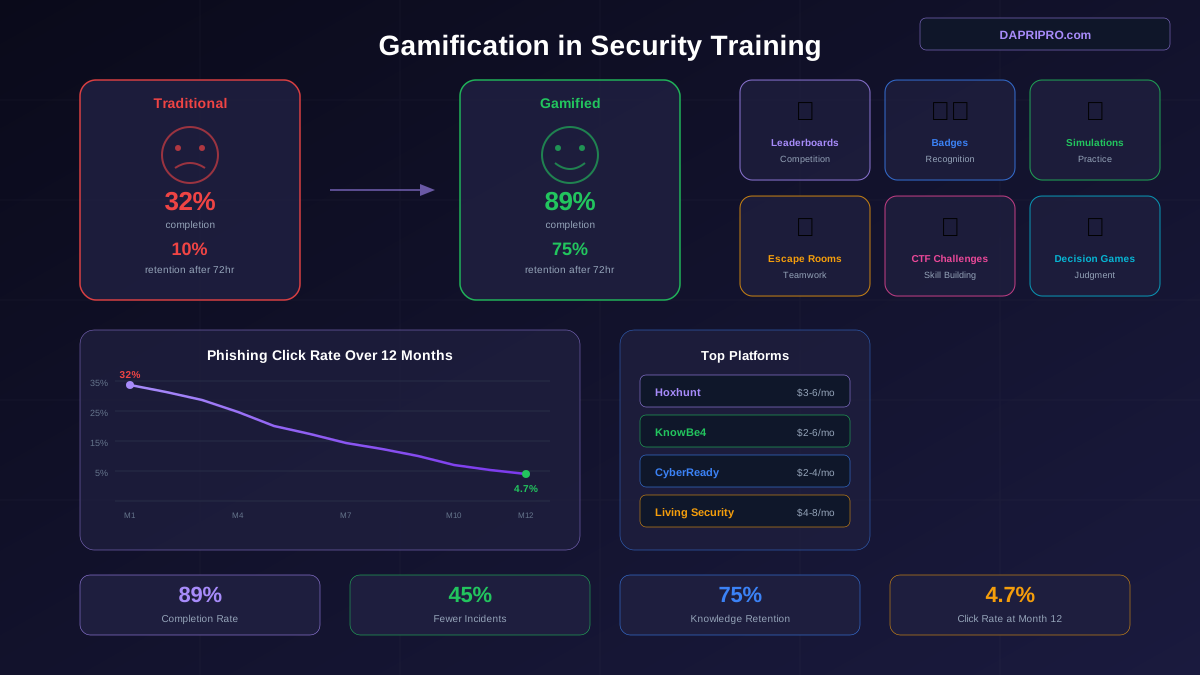
Gamification fixes this by tapping into the same psychology that makes video games addictive: competition, achievement, progress, and social recognition. Companies that gamify their security training see 89% completion rates (vs 32% traditional) and 45% fewer security incidents within the first year.
Why Gamification Works for Security Training
Traditional training fails because it relies on passive learning — watching videos, reading slides, clicking "Next." The brain retains only 10% of passively consumed information after 72 hours.
Gamification uses active learning — making decisions, solving problems, competing with peers. Active learning pushes retention to 75% after the same 72 hours. Here is why each game element works:
Competition activates the brain's reward system. When employees see their name on a leaderboard, dopamine kicks in. They want to maintain their position. They pay more attention to training because the outcome matters socially.
Immediate feedback accelerates learning. In a phishing simulation, the moment you click a fake link, you see what you missed. This instant correction is 4x more effective than delayed feedback from a quarterly training review.
Progressive difficulty maintains engagement. Easy challenges build confidence; harder challenges build skill. Players do not quit a game because it gets harder — they quit because it is boring. Same principle applies to security training.
Social recognition creates peer accountability. When your department is competing for the lowest phishing click rate, everyone holds each other accountable. "Did you check that link before clicking?" becomes a normal team conversation.
The 6 Most Effective Gamification Elements
1. Phishing Simulations with Instant Feedback
This is the single most effective gamification element. Send realistic phishing emails monthly. When someone clicks, they immediately see a training page explaining what they missed. Track individual and team progress over time. This is not really "gamification" in the traditional sense — it is practice with feedback, which is the foundation of all skill development.
2. Department Leaderboards
Display a live dashboard showing phishing click rates by department. Finance vs HR vs Engineering vs Sales. Update monthly. The department with the lowest click rate gets public recognition in the company newsletter or all-hands meeting. This creates healthy competition and makes security a team effort.
3. Badge and Achievement Systems
Award digital badges for completing training milestones:
- Phish Spotter: Reported 5 phishing simulations correctly
- Security Champion: Completed all quarterly training modules
- First Defender: First person to report a real phishing attempt
- Perfect Score: Zero clicks on simulations for 6 consecutive months
- Team Leader: Department achieved lowest click rate
Badges work because they provide visible recognition. Display them in email signatures, Slack profiles, or on a company security wall of fame.
4. Security Escape Rooms
Create a physical or virtual escape room where teams solve security-themed puzzles. Examples: decode a simulated ransomware message, identify the phishing email in a set of 10 messages, figure out which USB drive is safe to plug in, crack a social engineering scenario. Teams of 4-6 people compete on time. This builds collaboration and makes security training a memorable team event rather than solo drudgery.
5. Capture the Flag (CTF) Competitions
For technical teams, CTF competitions are the gold standard of gamified security training. Participants solve security challenges across categories: cryptography, network analysis, web security, forensics. Platforms like PicoCTF, TryHackMe, and Hack The Box offer beginner-friendly challenges. Even non-technical employees can participate in simplified CTF events focused on password cracking demonstrations and social engineering scenarios.
6. Scenario-Based Decision Games
Present employees with realistic scenarios and ask them to make decisions: "You receive an email from your CEO asking you to buy gift cards. What do you do?" Each choice leads to a different outcome, like a choose-your-own-adventure book. Right choices earn points; wrong choices show the consequences. This builds decision-making skills in a safe environment.
Platforms with Built-in Gamification
| Platform | Price/User/Mo | Gamification Features | Best For |
|---|---|---|---|
| Hoxhunt | $3-6 | Stars, levels, personal storyline | Best gamification UX |
| KnowBe4 | $2-6 | Leaderboards, badges, games | Largest content library |
| CyberReady | $2-4 | Auto-adaptive difficulty | Hands-off administration |
| Proofpoint SAT | $3-8 | Interactive modules, scoring | Gateway integration |
| Living Security | $4-8 | Escape rooms, team challenges | Team-based exercises |
Building Your Gamification Program
Month 1: Foundation
- Launch monthly phishing simulations with immediate feedback
- Create a department leaderboard (even a simple spreadsheet or Slack channel works)
- Announce the program with clear rules: no punishment, focus on improvement
Month 2-3: Add Recognition
- Introduce badges for milestones (first report, 3 months clean, team champion)
- Recognize top performers in team meetings or company newsletter
- Add progressive difficulty to simulations
Month 4-6: Add Team Events
- Run your first security escape room (virtual or in-person)
- Launch a quarterly CTF competition for technical teams
- Introduce scenario-based decision challenges
Month 7-12: Optimize
- Review metrics: click rates, report rates, completion rates, incident counts
- Adjust difficulty based on performance data
- Add new challenge types to prevent staleness
- Celebrate annual results and set next year's goals
5 Gamification Mistakes to Avoid
- Rewarding completion instead of behavior change. Points for watching a video teaches employees to watch videos, not to spot phishing. Reward reporting suspicious emails, maintaining low click rates, and helping teammates learn.
- Making it punitive. If the "game" feels like surveillance, employees will resent it. Never publicly shame people who click phishing simulations. Celebrate improvements and top reporters, not perfect scores.
- Overcomplicating the system. Do not build a complex point system with 15 tiers and 50 badges. Start with one leaderboard and one monthly challenge. Add complexity only when employees ask for more.
- Ignoring non-competitive employees. Some people are not motivated by leaderboards. Offer alternative recognition paths: self-improvement tracking (your click rate this month vs last month), team achievements, and knowledge badges.
- Letting it go stale. The same challenges every month lose their novelty. Rotate phishing templates, change competition formats quarterly, and introduce new scenario types to keep the program fresh.
Gamification is not about making security training "fun" — it is about making it effective. When employees are actively engaged, competing with peers, and receiving immediate feedback, they develop the instincts needed to spot real threats. A monthly phishing competition between departments costs nothing extra to implement. Start there, measure the results, and build from there.