
Cyber insurance has evolved from a nice-to-have add-on into a critical component of business risk management. But in 2026, getting covered is not as simple as filling out an application and writing a check. Insurers have gotten burned by massive payouts — $1.8 billion in cyber claims in 2024 alone — and they have responded by tightening underwriting requirements, narrowing coverage, and scrutinizing every detail of your security posture.
The result is a market where premiums have actually stabilized (down 15% from 2023 peaks), but qualifying for coverage requires demonstrating real security maturity. This guide breaks down exactly what cyber insurance covers in 2026, what the fine print excludes, how to navigate the application process, and how to position your organization to get the best coverage at the lowest cost.
How Cyber Insurance Works in 2026
Cyber insurance operates on two fundamental coverage types that every buyer needs to understand before shopping for policies.
First-Party Coverage: Your Direct Losses
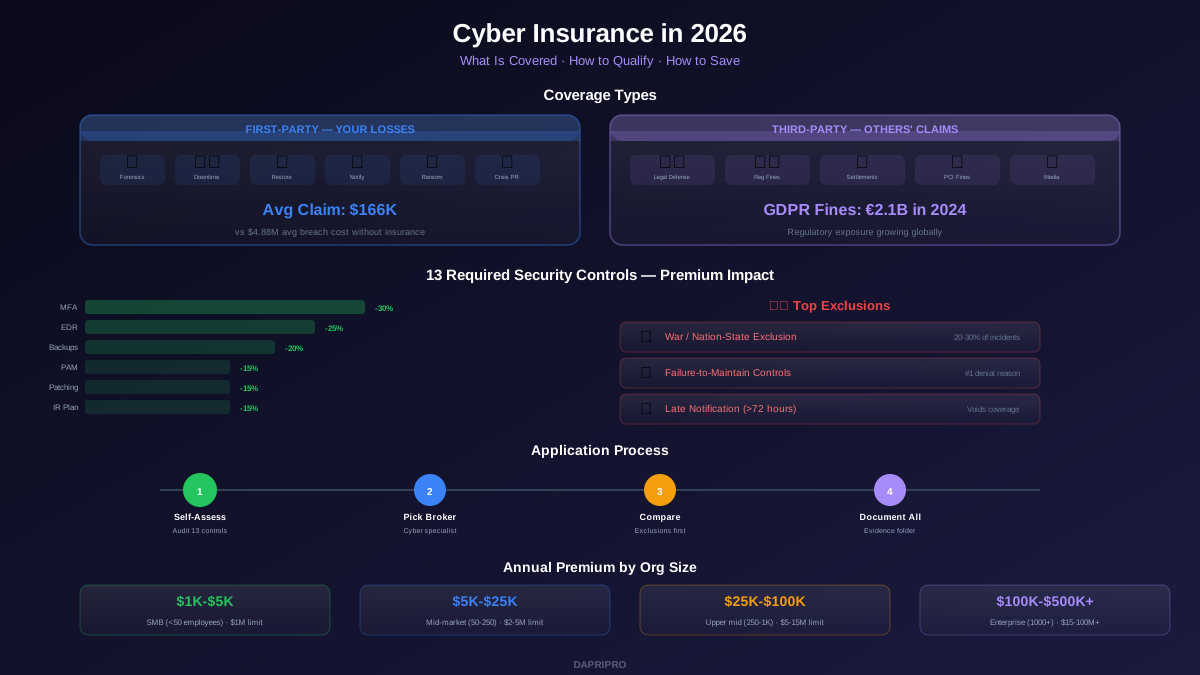
First-party coverage pays for the costs your organization incurs directly from a cyber incident. Think of it as covering your own damage:
- Incident response and forensics — hiring investigators to determine what happened, what data was accessed, and how to stop it (average cost: $50,000-$300,000)
- Business interruption — lost revenue and extra expenses while systems are down (the average downtime after a ransomware attack is 24 days)
- Data restoration — rebuilding corrupted databases, re-imaging endpoints, and restoring from backups when they exist
- Notification costs — legally required notifications to affected individuals at $1-$3 per person across potentially millions of records
- Credit monitoring — typically 12-24 months of identity protection services for affected individuals
- Ransomware payments — the actual ransom where legal and policy-approved, plus negotiation services
- Crisis management — PR firms, call centers, and communication specialists to manage reputation damage
Third-Party Coverage: When Others Come After You
Third-party coverage kicks in when customers, partners, regulators, or other parties file claims against you because of a cyber incident:
- Regulatory defense and fines — legal costs fighting regulatory actions plus applicable fines and penalties (GDPR fines alone reached €2.1 billion in 2024)
- Legal defense costs — attorney fees for lawsuits from affected parties, which can exceed the actual settlement amounts
- Settlement and judgment payments — court-ordered or negotiated payments to plaintiffs in data breach class actions
- Media liability — claims arising from content-related issues like defamation or copyright infringement following a cyber incident
- PCI-DSS assessment costs — fines and assessments from payment card brands if cardholder data was compromised
What Cyber Insurance Does NOT Cover
The exclusions section is where cyber insurance policies go from reassuring to terrifying. These are the scenarios where you will file a claim confident in your coverage — and get denied.
War and Nation-State Exclusions
The biggest coverage gap in 2026. After the NotPetya attack cost insurers billions when Zurich tried to deny Mondelez's $100M claim under a war exclusion, the industry rewrote these clauses entirely. Lloyd's of London now requires all cyber policies to exclude state-backed attacks, but the definition of "state-backed" remains murky. The Merck settlement in 2024 showed courts may side with policyholders, but you should not count on it.
What this means for you: if a nation-state group (APT29, Lazarus, Volt Typhoon) hits your organization — even as collateral damage in a broader campaign — your claim may be denied. This exclusion alone affects an estimated 20-30% of all significant cyber incidents.
Failure-to-Maintain Exclusions
If you told the insurer you had MFA everywhere and your breach entered through a VPN without MFA, your claim is dead. Insurers now conduct post-incident audits comparing your security posture at the time of the breach against what you attested to in your application. Common triggers include:
- Critical patches not applied within the timeframe stated in your application (usually 30 days)
- MFA not enforced on systems listed as protected
- Backup testing not performed at the frequency claimed
- Security awareness training not delivered on the stated schedule
- Endpoint protection not deployed on all endpoints as claimed
Other Common Exclusions
- Prior and pending claims — incidents you knew about before the policy started
- Infrastructure failure — outages caused by utility or cloud provider failures (not cyberattacks)
- Voluntary shutdown — systems taken offline as a precaution beyond what was reasonable
- Contractual liability — breach of contract claims that are not related to privacy or security
- Betterment — cost of upgrading systems beyond pre-incident state during recovery
- Cryptocurrency and digital assets — most policies explicitly exclude crypto theft
The 13 Security Controls Insurers Require in 2026
The cyber insurance application has become a de facto security audit. Insurers now require evidence — not just attestation — of specific controls. Here is what you need to have in place before applying:
| # | Control | What Insurers Want to See | Impact on Premium |
|---|---|---|---|
| 1 | MFA on all remote access | Phishing-resistant MFA (FIDO2, not SMS) on VPN, RDP, email, cloud admin | -20% to -30% |
| 2 | EDR on all endpoints | 24/7 monitored EDR (CrowdStrike, SentinelOne, Defender for Endpoint) | -15% to -25% |
| 3 | Patch management | Critical CVEs patched within 14 days, high within 30 days | -10% to -15% |
| 4 | Encrypted, tested backups | 3-2-1-1-0 backup rule with quarterly restore testing documentation | -10% to -20% |
| 5 | Incident response plan | Written IR plan tested with tabletop exercises at least annually | -10% to -15% |
| 6 | Security awareness training | Quarterly training with phishing simulations, completion records | -5% to -10% |
| 7 | Privileged access management | PAM solution with session recording, just-in-time access, vault rotation | -10% to -15% |
| 8 | Email security | Advanced email filtering with DMARC enforcement (p=reject) | -5% to -10% |
| 9 | Network segmentation | Critical systems isolated, lateral movement restricted | -5% to -10% |
| 10 | Vulnerability scanning | Regular external and internal vulnerability scans with remediation SLAs | -5% |
| 11 | Log monitoring (SIEM) | Centralized logging with 90+ day retention and alerting | -5% to -10% |
| 12 | Encryption | Data encrypted at rest and in transit, full-disk encryption on endpoints | -5% |
| 13 | Business continuity plan | Documented BCP with RTOs, tested annually, executive sponsorship | -5% to -10% |
Organizations that implement all 13 controls can see premium reductions of 40-60% compared to baseline rates. More importantly, they are far less likely to have a claim denied due to a failure-to-maintain exclusion.
Navigating the Application Process
The cyber insurance application process in 2026 involves far more than checking boxes. Here is how to approach it strategically.
Step 1: Pre-Application Security Assessment
Before you start any application, run an honest internal assessment against the 13 controls above. Insurers will verify what you claim — some send their own scanning tools (Coalition Control, At-Bay's security assessment) that check your external attack surface in real time. Misrepresenting your security posture does not just risk denial — it can void your entire policy retroactively.
Step 2: Choose the Right Broker
A specialized cyber insurance broker is not optional in 2026. General business insurance agents typically lack the technical knowledge to match your risk profile to the right policy. Specialist brokers know which insurers are lenient on specific controls, which have the best claims-paying history, and which policies have the tightest exclusions. Top cyber insurance brokers include Marsh, Aon, Willis Towers Watson, Coalition, and Corvus.
Step 3: Compare Policies — Not Just Premiums
The cheapest policy is often the most expensive when you file a claim. Key comparison points beyond premium cost:
- Retention (deductible) — the amount you pay before coverage kicks in. Typical range: $10,000-$100,000 for SMBs
- Sub-limits — caps on specific coverage categories. A $5M policy might only cover $500K in ransomware payments
- Waiting period — hours of downtime before business interruption coverage starts (typically 8-12 hours)
- Retroactive date — how far back the policy covers incidents that were not discovered until later
- Panel requirements — whether you must use the insurer's pre-approved vendors for forensics and legal services
- Hammer clause — whether the insurer can force you to accept a settlement you disagree with
Step 4: Document Everything
Create a "cyber insurance readiness folder" containing evidence of every control you claim on the application. If you say you do quarterly phishing simulations, have the reports ready. If you claim MFA everywhere, have screenshots of your identity provider policies. This documentation serves triple duty: it supports your application, speeds up claims processing, and protects you from failure-to-maintain denials.
Cost Analysis: What You Will Pay in 2026
Cyber insurance pricing varies dramatically based on organization size, industry, revenue, and security posture. Here is what to expect:
| Org Size | Revenue | Coverage Limit | Annual Premium | Retention |
|---|---|---|---|---|
| 1-50 employees | Under $10M | $1M | $1,000-$5,000 | $5K-$25K |
| 50-250 employees | $10M-$100M | $2M-$5M | $5,000-$25,000 | $25K-$100K |
| 250-1000 employees | $100M-$500M | $5M-$15M | $25,000-$100,000 | $50K-$250K |
| 1000+ employees | $500M+ | $15M-$100M+ | $100,000-$500,000+ | $250K-$1M+ |
Industry Multipliers
Your industry dramatically affects pricing. Healthcare and financial services organizations pay 2-3x the base rate due to regulatory requirements and high-value data. Technology companies pay 1.5-2x. Retail and manufacturing fall closer to baseline. Education and nonprofits often qualify for discounts through specialty programs.
The ROI of Cyber Insurance
The math is straightforward. The average cyber insurance claim in 2025 was $166,000. The average cost of a data breach without insurance was $4.88 million. Even at the high end of SMB premiums ($25,000/year), a single covered incident pays for decades of premiums. The real question is not whether you can afford cyber insurance — it is whether you can afford to go without it.
Making a Claim: What Happens When You Get Breached
Filing a cyber insurance claim is nothing like filing a car insurance claim. Speed, documentation, and following the policy's exact procedures determine whether your claim gets paid.
The First 72 Hours Are Critical
Most policies require notification within 72 hours of discovering an incident. Some require notification "as soon as practicable." Missing this window is one of the top reasons claims get denied. Here is the process:
- Call the claims hotline immediately — not your broker, not your agent, the insurer's 24/7 claims number on your policy declarations page
- Engage only approved vendors — if your policy has a panel requirement, using unapproved forensic or legal firms can void coverage
- Document everything from minute one — screenshots, logs, decisions, communications. This becomes evidence for your claim
- Preserve evidence — do not wipe systems or restore from backups before forensics. This can be treated as spoliation of evidence
- Coordinate with the insurer's breach coach — they manage the legal, forensic, notification, and crisis management workstreams
Common Claim Pitfalls
- Engaging vendors before notifying the insurer — costs incurred before formal claim notification are typically not covered
- Overstating losses — insurers hire forensic accountants who will catch inflated business interruption claims
- Failing to mitigate — you have a duty to take reasonable steps to limit damage. Ignoring containment to maximize the claim backfires
- Delayed notification of affected parties — notification costs pile up but delaying can trigger regulatory penalties that may not be covered
Top Cyber Insurance Providers Compared
| Provider | Best For | Key Differentiator | Coverage Range |
|---|---|---|---|
| Coalition | SMBs | Free continuous security monitoring with policy | $1M-$15M |
| At-Bay | Tech companies | Active risk monitoring + managed security services | $1M-$10M |
| Corvus | Mid-market | AI-driven risk assessment, proactive threat alerts | $1M-$15M |
| Chubb | Enterprise | Broadest coverage terms, best claims-paying record | $5M-$100M+ |
| AIG | Large enterprises | CyberEdge product with flexible modular coverage | $5M-$100M+ |
| Beazley | Healthcare, professional services | Industry-specific forms, excellent breach response team | $1M-$25M |
| Cowbell | Small businesses | AI underwriting, fast quotes, low minimum premiums | $250K-$5M |
Strategies to Lower Your Premiums
Beyond implementing the 13 required controls, these strategies can meaningfully reduce what you pay:
- Increase your retention — moving from a $10K to a $50K deductible can cut premiums 15-25%. Only do this if you can absorb a $50K out-of-pocket cost
- Bundle with other coverage — some insurers offer discounts when cyber is packaged with general liability, D&O, or E&O
- Get a security certification — SOC 2 Type II or ISO 27001 certification demonstrates mature security practices and typically earns 10-15% discounts
- Use insurer-provided security tools — Coalition Control, At-Bay's monitoring, and Corvus's scanning are free with the policy and demonstrate engagement
- Remove unnecessary coverage — if you do not handle payment cards, drop PCI coverage. If you have no cryptocurrency, exclude it. Tailor coverage to actual risk
- Start a multi-year policy — 2 or 3 year policies often lock in rates 5-10% below annual renewal pricing
- Demonstrate incident readiness — provide evidence of recent tabletop exercises, red team assessments, or third-party penetration tests
The Future of Cyber Insurance: 2026 and Beyond
The cyber insurance market is undergoing fundamental changes that will reshape coverage over the next few years:
- Parametric cyber insurance — trigger-based policies that pay a fixed amount when specific observable events occur, eliminating lengthy claims processes. If a cloud provider goes down for more than 4 hours, you get paid automatically
- Continuous underwriting — insurers are moving from annual assessments to continuous monitoring of your security posture. Premiums adjust monthly based on real-time risk scores
- AI-specific coverage — new policy types covering AI model poisoning, adversarial attacks on ML systems, and liability from AI-generated content
- Systemic risk pools — industry-funded pools to cover catastrophic events (like a major cloud provider breach) that would exceed any single insurer's capacity
- Regulatory alignment — policies increasingly designed to map directly to frameworks like NIST CSF 2.0, making compliance and insurability complementary rather than competing priorities
Your Cyber Insurance Action Plan
Whether you are buying cyber insurance for the first time or renewing an existing policy, follow this sequence:
- Audit your 13 controls — use the table above as a checklist. Fix gaps before applying or renewing
- Build your evidence folder — collect proof of every control: MFA policies, EDR deployment reports, backup test results, training completion records
- Engage a specialist broker — get quotes from at least three insurers through a broker who specializes in cyber
- Read the exclusions first — before comparing premiums, compare what each policy does NOT cover
- Negotiate sub-limits — ensure ransomware, regulatory, and business interruption sub-limits match your actual risk exposure
- Test your claims process — save the claims hotline number, know your panel vendors, practice the 72-hour notification procedure
- Review quarterly — your security posture and the threat landscape change constantly. Ensure your coverage keeps pace
Cyber insurance is not a replacement for security — it is a financial backstop for when security fails. The organizations that get the most value from their policies are the ones that invest in security first and treat insurance as the last line of defense, not the first.