
Every vulnerability management program faces the same fundamental challenge: too many vulnerabilities, not enough time to fix them all. The National Vulnerability Database published over 28,000 CVEs in 2024, and the pace accelerated through 2025 into 2026. No organization has the engineering bandwidth to patch every single one. You need a system for deciding which vulnerabilities matter most.
The Common Vulnerability Scoring System (CVSS) is that system, or at least it is supposed to be. Maintained by the Forum of Incident Response and Security Teams (FIRST), CVSS assigns numerical severity scores from 0 to 10 to every cataloged vulnerability. A score of 9.8 sounds terrifying. A score of 3.1 sounds ignorable. But anyone who has operated a vulnerability management program for more than a few months knows that CVSS scores alone create more confusion than clarity.
This guide breaks down exactly how CVSS scoring works across versions 3.1 and 4.0, explains why raw scores mislead teams into wasting remediation cycles on theoretical risks, and shows you how to build a prioritization framework that combines CVSS with exploit intelligence, asset criticality, and business context to focus your team on the vulnerabilities that actually threaten your organization.
Anatomy of a CVSS Score: The Three Metric Groups
CVSS is not a single number. It is a structured framework built from multiple metric groups, each capturing a different dimension of vulnerability risk. Understanding the anatomy of a CVSS score is essential before you can use it effectively or recognize its limitations.
Base Metrics: The Foundation
Base metrics capture the intrinsic characteristics of a vulnerability that remain constant regardless of deployment context. They are divided into two sub-scores that combine to produce the overall Base score.
Exploitability Sub-score measures how easy it is for an attacker to exploit the vulnerability:
- Attack Vector (AV) — How the attacker reaches the vulnerable component. Network (N) means remotely exploitable with no interaction, Adjacent (A) requires the same network segment, Local (L) requires local access or social engineering to deliver a payload, and Physical (P) requires physical touch. Network-vector vulnerabilities receive the highest sub-scores because they have the largest potential attacker population.
- Attack Complexity (AC) — Whether exploitation requires conditions beyond the attacker's control. Low (L) means the attacker can exploit at will. High (H) means they need a race condition, specific memory layout, or non-default configuration. Most scored vulnerabilities are rated AC:L because vendors and researchers typically demonstrate exploitation under best-case attacker conditions.
- Privileges Required (PR) — The level of access needed before exploitation. None (N) means unauthenticated, Low (L) means basic-user privileges, and High (H) means administrative-level access. The Scope metric modifies how PR affects the final score.
- User Interaction (UI) — Whether exploitation requires a human to perform an action. None (N) means fully automated exploitation. Required (R) means someone must click a link, open a file, or take a deliberate action.
Impact Sub-score measures the consequences of successful exploitation across the CIA triad:
- Confidentiality Impact (C) — Whether data exposure occurs. None (N), Low (L) for partial data exposure, or High (H) for complete information disclosure.
- Integrity Impact (I) — Whether the attacker can modify data. Ranges from None through Low (limited modification) to High (complete control of data integrity).
- Availability Impact (A) — Whether service disruption occurs. None through Low (degraded performance) to High (complete denial of service).
One additional metric modifies both sub-scores: Scope (S). When Scope is Changed (C), exploitation of one component impacts resources beyond its security authority, such as a VM escape affecting the host, or an XSS in a sandboxed component accessing the parent origin. Changed Scope significantly increases the computed score.
The CVSS Scoring Formula
The actual mathematical formula behind CVSS is more complex than most practitioners realize. The Base score is not a simple average of metric values. Instead, it uses a lookup-based system where each metric value maps to a specific coefficient, and these coefficients combine through a defined algorithm.
For CVSS v3.1, the Base score calculation follows this process:
- Impact Sub-Score (ISS) is calculated first: ISS = 1 - [(1 - C) x (1 - I) x (1 - A)], where C, I, and A are the numerical values of the Confidentiality, Integrity, and Availability impacts
- Impact is then calculated differently depending on Scope:
- Unchanged Scope: Impact = 6.42 x ISS
- Changed Scope: Impact = 7.52 x [ISS - 0.029] - 3.25 x [ISS - 0.02]^15
- Exploitability = 8.22 x AV x AC x PR x UI
- Base Score (Scope Unchanged) = min[(Impact + Exploitability), 10], rounded up
- Base Score (Scope Changed) = min[1.08 x (Impact + Exploitability), 10], rounded up
If Impact is 0 (all three CIA impacts are None), the Base score is automatically 0 regardless of exploitability. This is an important edge case: a vulnerability that is trivially exploitable but has no measurable impact scores 0.
CVSS Severity Ratings and What They Actually Mean
CVSS maps numerical scores to qualitative severity ratings. Understanding what each band actually represents in practice matters more than memorizing the boundaries:
- None (0.0) — Either the vulnerability has no measurable impact (all CIA metrics are None), or the evaluator determined the issue does not warrant a score. Informational findings from scanners often fall here.
- Low (0.1-3.9) — Exploitation requires significant effort (physical access, high complexity, or high privileges) and produces limited impact. These rarely justify emergency patching but should enter standard maintenance cycles.
- Medium (4.0-6.9) — The largest band, containing everything from locally exploitable privilege escalations to network-reachable issues with partial impact. This band requires the most individual triage because the range of actual risk is enormous.
- High (7.0-8.9) — Exploitation is feasible and impact is significant. These vulnerabilities can enable lateral movement, data exfiltration, or service disruption. Most should be remediated within 30 days on externally-facing systems.
- Critical (9.0-10.0) — Network-exploitable with no or low privileges required, minimal complexity, and high impact across multiple CIA dimensions. The canonical example is a remote code execution with no authentication required. These demand priority attention, but as we will see, not all Critical vulnerabilities are equally dangerous.
Here is the distribution reality that trips up most teams: roughly 15-17% of all published CVEs score Critical, and another 40-45% score High. That means over half of all vulnerabilities in the NVD are rated High or Critical. If you treat CVSS severity ratings as your sole prioritization mechanism, you are telling your team that over half of all discovered vulnerabilities are urgent. That is not prioritization. That is an everything-is-on-fire strategy that burns out engineering teams and paradoxically increases risk because genuinely dangerous issues get lost in the noise.
Why CVSS Base Scores Alone Fail at Prioritization
CVSS Base scores were never designed to serve as standalone prioritization mechanisms. FIRST explicitly states this in the specification. Yet the overwhelming majority of vulnerability management programs use Base scores as their primary or only prioritization criterion. Here is why that fails:
The Exploitation Gap
Research from multiple sources consistently shows that only 2-5% of published CVEs are ever exploited in the wild. The Kenna Security (now Cisco) Prioritization to Prediction series analyzed millions of vulnerability observations and found that exploitation probability has almost no correlation with CVSS Base score. A CVSS 6.5 vulnerability with a public exploit module in Metasploit and active scanning by botnets is vastly more dangerous than a CVSS 9.8 vulnerability that requires specific hardware, a non-default configuration, and has no known exploit code.
Missing Context
Base scores deliberately exclude environmental context. They do not know whether your vulnerable system is internet-facing or air-gapped, whether it processes sensitive data or serves a static marketing page, whether compensating controls like WAFs or EDR would detect and block exploitation, or whether the affected software is even in a code path that is reachable. Two organizations running the same vulnerable Apache version can face radically different risk levels based on deployment context.
Scoring Inconsistencies
Multiple studies have demonstrated significant disagreement among CVSS scorers. Different analysts assessing the same vulnerability frequently produce scores that differ by 1-2 points, enough to shift a vulnerability between severity bands. The Scope metric in v3.1 is particularly problematic because it is often applied inconsistently, and vendors score their own products' vulnerabilities, creating potential conflicts of interest.
The Volume Problem
Consider an enterprise with 50,000 managed assets running a typical software stack. A quarterly vulnerability scan might surface 500,000 to 1,000,000 individual vulnerability instances. If 15% are Critical and 40% are High, you are looking at 75,000 to 150,000 Critical findings and 200,000 to 400,000 High findings. No remediation team on earth can investigate each one individually. You need a system that cuts through this volume with precision.
CVSS 4.0: What Changed and What Still Falls Short
FIRST released CVSS v4.0 in November 2023 to address several known limitations of v3.1. The changes are meaningful but do not transform CVSS into a complete prioritization solution.
Key Structural Changes
Attack Requirements (AT) replaces Attack Complexity (AC) — In v3.1, Attack Complexity tried to capture both prerequisites outside the attacker's control and conditions the attacker needed to prepare. V4.0 splits this: AT captures only the deployment-specific conditions that must exist (like race conditions or non-default configurations), while the attack's intellectual complexity is assumed to be manageable for a motivated attacker.
Scope is eliminated — The notoriously inconsistent Scope metric is replaced by splitting Impact into two explicit categories: Vulnerable System Impact (VC/VI/VA) and Subsequent System Impact (SC/SI/SA). A VM escape now shows as Low impact to the vulnerable system but High impact to the subsequent system (the host), making the scoring more transparent.
Temporal becomes Threat — The three Temporal metrics (Exploit Code Maturity, Remediation Level, Report Confidence) are reduced to a single metric: Exploit Maturity (E). The rationale is that Remediation Level and Report Confidence were almost never populated by vendors and added little practical value.
Supplemental Metrics — A new metric group includes Automatable (can exploitation be fully automated at scale), Recovery (can the affected system auto-recover), Value Density (is the target resource-rich), and Provider Urgency (what does the vendor recommend). These provide valuable context but deliberately do not affect the numerical score.
Scoring Nomenclature
CVSS 4.0 introduces explicit naming conventions:
- CVSS-B — Base metrics only
- CVSS-BT — Base + Threat metrics
- CVSS-BE — Base + Environmental metrics
- CVSS-BTE — All metric groups
This forces clarity about what a given score represents, reducing the common v3.1 problem where a Base-only score was presented as if it captured complete risk.
What v4.0 Still Does Not Solve
Even with these improvements, CVSS 4.0 remains a severity framework, not a risk framework. It tells you how bad exploitation would be under specified conditions but still does not incorporate exploitation likelihood, your specific asset exposure, compensating controls beyond what Environmental metrics capture, or business impact in financial or operational terms. You still need external data sources and your own organizational context to build an effective prioritization strategy.
Building an Effective Prioritization Framework
An effective vulnerability prioritization framework layers multiple data sources on top of CVSS to produce actionable remediation queues. Here is the architecture that consistently works in practice:
Layer 1: CVSS Environmental Scores
Start by actually using the Environmental metric group that most organizations ignore. Define asset groups with appropriate Security Requirements (CR/IR/AR) based on data classification and business function. Adjust Modified metrics for systems where architecture limits the Attack Vector or where specific CIA dimensions are irrelevant. A CVSS 9.8 RCE against a development server running test data should score materially differently than the same vulnerability on your production payment processing system.
Layer 2: Exploit Intelligence
Incorporate real-world exploitation data from multiple sources:
- CISA KEV (Known Exploited Vulnerabilities) — Any CVE on this list has confirmed active exploitation. Treat KEV entries as automatic Critical priority regardless of CVSS score. Federal mandate requires remediation within specified timeframes (typically 14-21 days for new entries).
- EPSS (Exploit Prediction Scoring System) — Machine learning model that predicts the probability of exploitation within 30 days. EPSS scores range from 0 to 1. CVEs with EPSS above 0.36 (the 90th percentile) deserve elevated attention because they are in the top 10% of exploitation likelihood.
- Exploit Database Availability — Check whether public exploit code exists in Metasploit, ExploitDB, GitHub, or nuclei templates. Available exploit code dramatically increases the attacker population capable of exploitation.
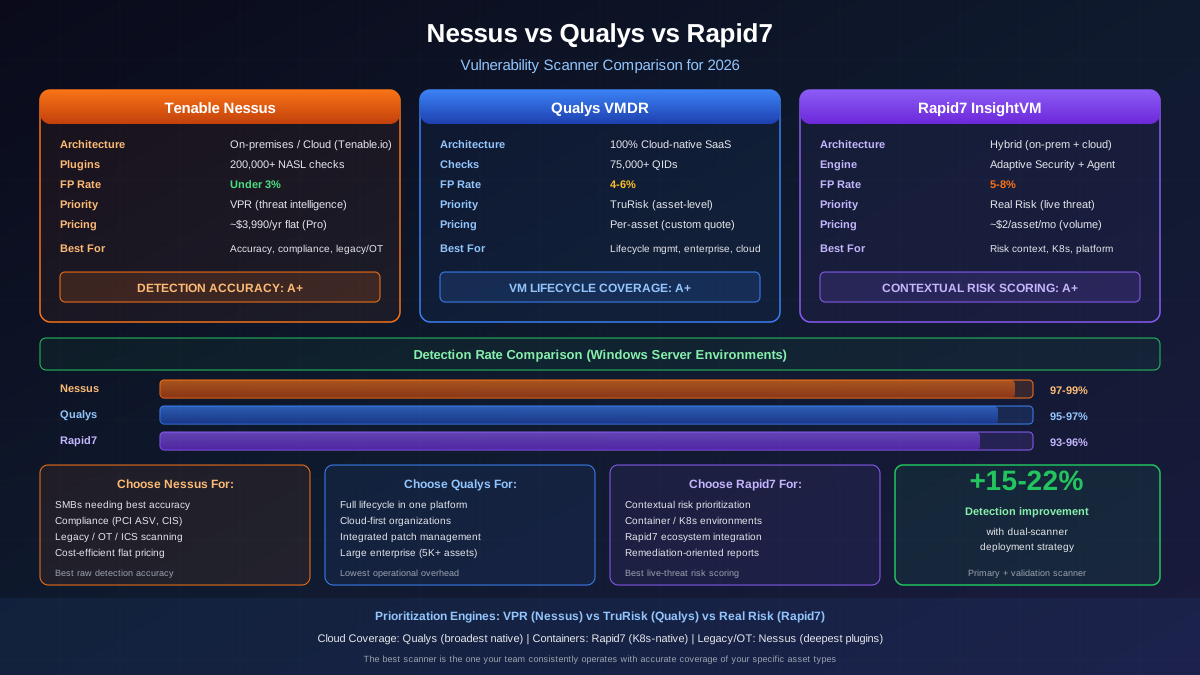
- Vendor Threat Intelligence — Tenable's VPR, Qualys TruRisk, and Rapid7 Real Risk all incorporate proprietary threat intelligence feeds that track dark web activity, exploit kit integration, and observed scanning activity.
Layer 3: Asset Criticality and Exposure
Not all assets matter equally. Build an asset criticality tier system:
- Tier 1 (Crown Jewels) — Domain controllers, authentication infrastructure, payment systems, databases holding PII/PHI, CI/CD pipelines, key management systems. Any exploitable vulnerability on Tier 1 assets is high priority by definition.
- Tier 2 (Business Critical) — Customer-facing web applications, email infrastructure, ERP systems, internal applications with sensitive data access. These require aggressive patching cadences for High and Critical vulnerabilities.
- Tier 3 (Standard Business) — Corporate workstations, internal tools, subsidiary systems. Standard patching cycles (30-day for Critical, 90-day for High) are appropriate here.
- Tier 4 (Low Impact) — Development environments, pre-production systems, standalone research tools. These can follow extended patching cycles unless they share network segments with higher tiers.
Overlay network exposure: internet-facing assets always receive elevated priority compared to assets only reachable from internal networks. A Medium-severity vulnerability on an internet-facing server may warrant faster remediation than a Critical vulnerability on an internal system behind multiple network boundaries.
Layer 4: Compensating Controls Assessment
Before escalating a vulnerability to emergency patching, verify whether existing controls mitigate the risk:
- Does the WAF have a virtual patch rule for this CVE?
- Does the EDR platform detect the exploitation technique?
- Does network segmentation prevent the attacker from reaching the vulnerable service?
- Is the vulnerable feature disabled in your configuration?
- Does the IPS/IDS have a signature for this attack pattern?
If compensating controls reduce exploitation likelihood or block it entirely, the effective priority can be adjusted downward. Document these decisions explicitly so they can be audited and re-evaluated when control configurations change.
The CVSS + EPSS Prioritization Matrix in Practice
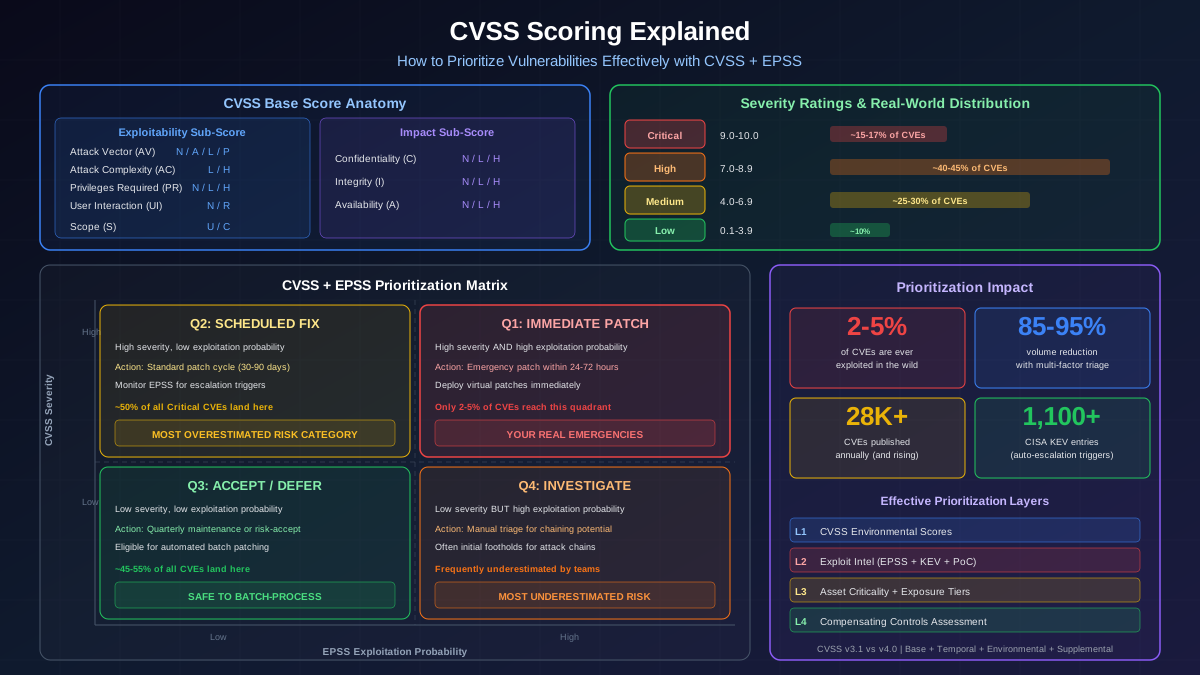
The four-quadrant CVSS + EPSS matrix shown above is the most impactful single improvement you can make to vulnerability prioritization. Here is how to operationalize each quadrant:
Q1: High CVSS, High EPSS (Immediate Patch)
These are your genuine emergencies. A vulnerability scoring CVSS 9.0+ with an EPSS above 0.36 means it is both extremely impactful and actively being weaponized. These deserve 24-72 hour remediation SLAs on internet-facing systems and 7-14 day SLAs on internal systems. Deploy WAF virtual patches and IPS signatures as immediate mitigations while planning deployment windows for permanent fixes.
Crucially, this quadrant typically contains only 2-5% of all published CVEs. That is a manageable number even for resource-constrained teams. Examples include Log4Shell (CVE-2021-44228), ProxyShell (CVE-2021-34473), and MOVEit (CVE-2023-34362) — each scored Critical and saw immediate mass exploitation.
Q2: High CVSS, Low EPSS (Scheduled Fix)
This is where most CVSS-only prioritization goes wrong. These vulnerabilities look terrifying on paper (9.0+ scores) but have low exploitation probability, often because exploitation requires unusual conditions, the affected software has a tiny install base, or no weaponized exploit code exists. Roughly 50% of all Critical CVEs fall into this quadrant.
Place these in standard patching cycles (30-90 days depending on asset tier). Monitor their EPSS scores weekly: a sudden spike from 0.02 to 0.40 indicates someone has released exploit code and the vulnerability should be re-evaluated. Set up automated EPSS threshold alerts through your vulnerability management platform.
Q3: Low CVSS, Low EPSS (Accept or Defer)
The largest volume category, containing 45-55% of all CVEs. These are low-severity issues that nobody is exploiting. Include them in quarterly maintenance windows, apply them as part of OS and application upgrade cycles, and risk-accept the oldest ones if remediation would require significant effort. Document acceptance decisions with justification for audit purposes.
Q4: Low CVSS, High EPSS (Investigate)
The most interesting and most underestimated quadrant. These vulnerabilities score lower on CVSS because their individual impact appears limited (information disclosure, SSRF without direct data access, path traversal with restricted scope), but they are actively and heavily exploited. Why? Because they are typically easy to automate at scale, work against broad target populations, and serve as initial footholds that attackers chain with other vulnerabilities.
Each Q4 vulnerability requires manual triage: can an attacker chain this with a privilege escalation to achieve Critical-equivalent impact? Is the disclosed information (credentials, internal IPs, source code) useful for follow-on attacks? The answer is often yes, making these far more dangerous than their CVSS score suggests.
Implementing CVSS-Based Prioritization in Scanning Platforms
All major vulnerability management platforms support CVSS-enhanced prioritization, but their implementations differ significantly:
Tenable (Nessus / Tenable.io)
Tenable's Vulnerability Priority Rating (VPR) combines CVSS with over 150 additional features including exploit availability, threat recency, exploit code maturity, and dark web intelligence. VPR rescores every vulnerability daily, so a CVE that was low-priority yesterday can spike when a Metasploit module drops. VPR is proprietary and only available in Tenable.io and Tenable.sc, not in standalone Nessus Professional.
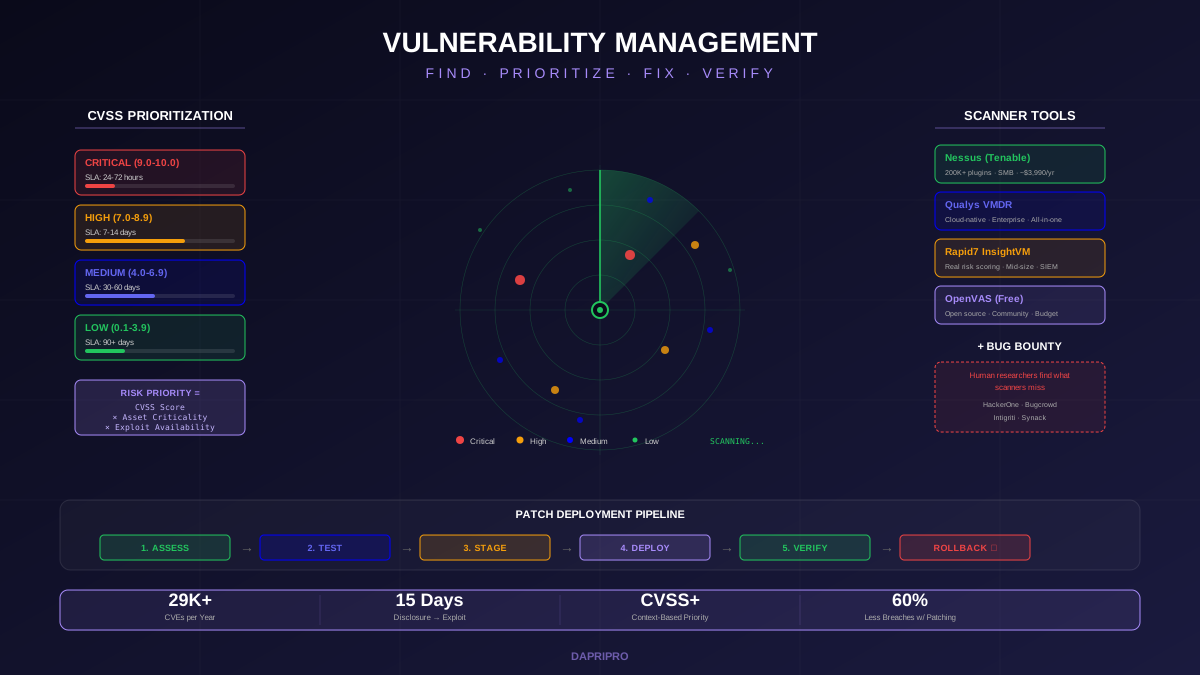
To implement: create asset groups with business criticality tags, configure VPR-based dashboards instead of CVSS-sorted lists, and set SLA policies tied to VPR bands (Critical VPR 9.0+: 7 days, High VPR 7.0-8.9: 30 days, Medium VPR 4.0-6.9: 90 days).
Qualys VMDR
Qualys TruRisk scoring integrates CVSS, real-time threat intelligence, asset exposure, and remediation complexity into a single risk score. TruRisk is also available at the asset and organizational aggregate level, allowing CISOs to track overall risk reduction over time. The platform additionally integrates EPSS data natively and cross-references against the CISA KEV catalog.
Rapid7 InsightVM
Rapid7's Real Risk scoring overlays CVSS with exploit availability, malware exposure, and active threat context. InsightVM also introduces Remediation Projects that group related vulnerabilities by solution (a single OS patch may address dozens of CVEs), making it easier to maximize risk reduction per change window.
Open-Source Approach
If you are using OpenVAS or other open-source scanners, you can build CVSS + EPSS prioritization manually. FIRST publishes EPSS data as a free daily CSV download. CISA KEV is available as a free JSON feed. Parse both feeds, cross-reference with your scan results by CVE ID, and build a scoring formula: Effective Priority = (CVSS Environmental Score x 0.4) + (EPSS x 100 x 0.3) + (KEV Boolean x 30) + (Asset Tier x 0.3). The specific weights should be tuned based on your organization's risk tolerance and adjusted quarterly based on outcome data.
CVSS in Compliance and Regulatory Frameworks
Multiple compliance frameworks reference CVSS explicitly, and understanding how they use it prevents both under-remediation and over-remediation:
PCI DSS 4.0
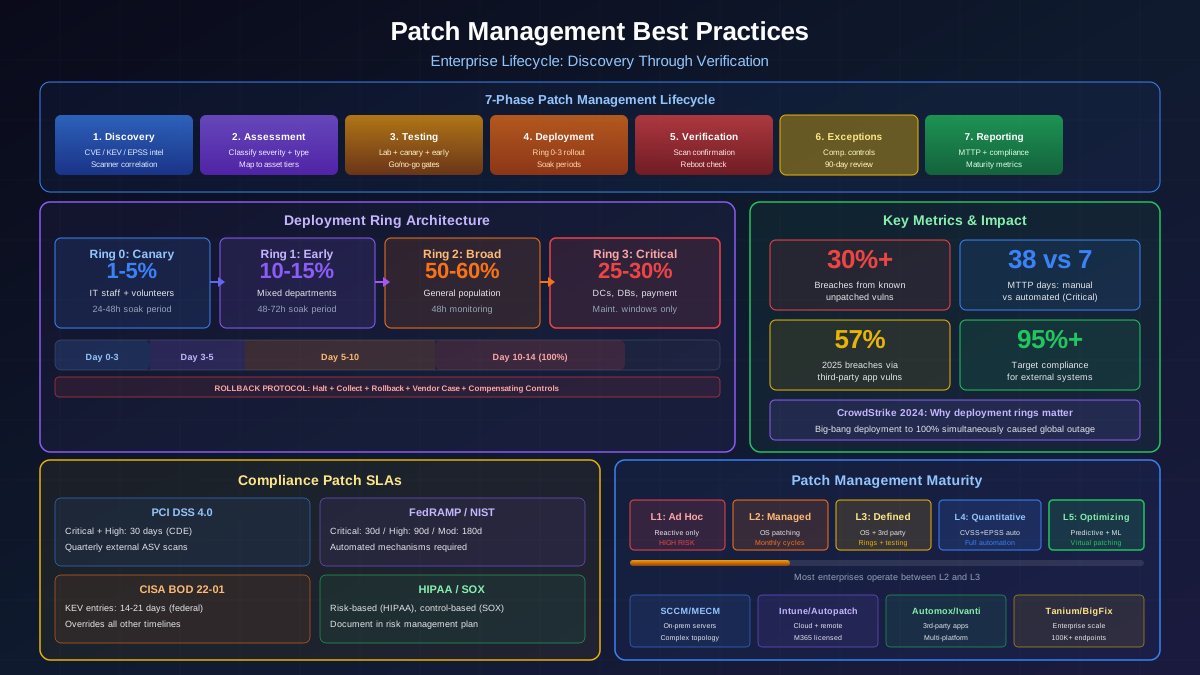
Requirement 6.3.3 mandates that all applicable Critical and High vulnerabilities (CVSS 7.0+) identified in external-facing systems be addressed within 30 days. Internal vulnerabilities follow risk-based prioritization. PCI DSS explicitly allows organizations to use risk-ranking methods beyond raw CVSS, but you must document your methodology and demonstrate that it produces equivalent or better coverage. If your internal QSA pushes back on EPSS-adjusted prioritization, the standard supports your approach.
NIST SP 800-53 / FedRAMP
RA-5 (Vulnerability Monitoring and Scanning) requires timely remediation of vulnerabilities based on risk assessment. FedRAMP Authorization requires Critical vulnerabilities remediated within 30 days and High within 90 days. FedRAMP uses CVSS as the default severity classification but permits organizations to document justification for adjusting individual vulnerability priorities based on environmental factors.
CISA BOD 22-01
Binding Operational Directive 22-01 established the Known Exploited Vulnerabilities catalog and mandated federal agencies remediate listed CVEs within specified timeframes, typically 14 days for newly added entries. This directive effectively creates a CVSS-independent prioritization override: if a CVE is on the KEV list, it is priority one regardless of its CVSS score. Non-federal organizations should adopt the same philosophy.
ISO 27001:2022
Control A.8.8 (Management of Technical Vulnerabilities) requires organizations to establish processes for identifying and evaluating vulnerabilities. ISO 27001 does not prescribe CVSS specifically but expects documented risk assessment methods. Using CVSS Environmental scores combined with EPSS and asset criticality demonstrably meets the control's intent and provides auditable evidence of a systematic approach.
Common CVSS Scoring and Prioritization Mistakes
After reviewing vulnerability management programs across hundreds of organizations, these are the most frequent mistakes in CVSS-based prioritization:
Mistake 1: Treating All Criticals as Emergencies
When everything is an emergency, nothing is. Organizations that treat every CVSS 9.0+ finding as a drop-everything event burn out their engineering teams and actually achieve slower mean-time-to-remediate on genuinely dangerous vulnerabilities because they are buried in false-priority escalations. Reserve emergency processes for Q1 (high CVSS + high EPSS + internet-facing or KEV-listed).
Mistake 2: Ignoring Medium-Severity Vulnerabilities on Critical Assets
A CVSS 5.5 local privilege escalation on a domain controller is more dangerous than a CVSS 9.8 RCE on a standalone test machine. Asset context must override raw severity. Teams that rigidly follow CVSS severity bands without asset weighting systematically neglect dangerous attack chain components on their most important systems.
Mistake 3: Never Updating Environmental Modifiers
Organizations that invest the effort to configure Environmental scores often set them once and forget them. Network architectures change. New compensating controls are deployed. Assets get moved between segments. Schedule quarterly reviews of Environmental modifier configurations to ensure they reflect current reality.
Mistake 4: Using CVSS for Application Security Findings
CVSS was designed for infrastructure and software vulnerabilities, not for custom application security findings. An XSS vulnerability in your application has context (what data is accessible, what actions the user can take, whether HttpOnly cookies prevent session theft) that CVSS metrics cannot adequately capture. Use application-specific risk rating methodologies like the OWASP Risk Rating Methodology for custom code findings.
Mistake 5: Not Tracking Prioritization Accuracy
If you implement CVSS + EPSS prioritization, measure its effectiveness. Track which vulnerabilities you deferred (Q2/Q3) and cross-reference against breach reports, exploit releases, and CISA KEV additions. If deferred vulnerabilities keep appearing in real-world incidents, your framework needs calibration. Conversely, if your emergency queue consistently contains vulnerabilities that are never exploited, your thresholds are too aggressive.
Operationalizing CVSS Prioritization: SLA Framework
Transform your prioritization framework into enforceable SLAs that map directly to the CVSS + EPSS quadrants:
Recommended SLA Matrix
For internet-facing assets:
- Q1 (Critical CVSS + High EPSS) — 24-72 hours, with virtual patching deployed within 4 hours of discovery
- Q2 (Critical CVSS + Low EPSS) — 14-30 days, with EPSS monitoring for escalation triggers
- Q4 (Moderate CVSS + High EPSS) — 7-14 days, with mandatory chaining analysis before deferral
- Q3 (Low-Moderate CVSS + Low EPSS) — 60-90 days, eligible for automated patching
For internal-only assets, multiply each SLA by 2x. For air-gapped systems, use risk-acceptance with quarterly review.
Exception Management
CISA KEV entries override all SLA tiers. Any vulnerability added to KEV automatically escalates to the Q1 remediation timeline regardless of its CVSS score or EPSS probability. Similarly, if your threat intelligence team identifies a vulnerability being actively used against your industry sector, it should be escalated regardless of generic scoring.
Document all SLA exceptions with business justification, compensating controls in place, and a re-evaluation date. Never let exceptions become permanent without periodic review.
Measuring Program Effectiveness
Key metrics for tracking whether your CVSS-enhanced prioritization is working:
- Mean Time to Remediate (MTTR) by quadrant — Q1 MTTR should be under 7 days. If it is consistently above 14 days, your emergency process has friction that needs elimination.
- Coverage ratio — Percentage of KEV-listed CVEs remediated within their assigned SLA. Target 95%+.
- False escalation rate — Percentage of Q1-classified vulnerabilities that were never observed exploited within 90 days. If this exceeds 30%, your escalation thresholds need tightening.
- Risk reduction efficiency — Aggregate CVSS score reduction divided by engineering hours spent. This measures how effectively you are allocating remediation effort.
- Escape rate — Vulnerabilities you classified as Q3 or Q2 that later appeared on KEV or in breach reports. This should be under 1%.
The Future: Beyond CVSS
CVSS will remain a foundational component of vulnerability management, but the industry is moving toward composite risk scoring that integrates multiple frameworks:
SSVC (Stakeholder-Specific Vulnerability Categorization) — Developed by Carnegie Mellon's CERT/CC and adopted by CISA for its own prioritization, SSVC uses decision trees rather than numerical scores. It categorizes vulnerabilities into four response actions: Track, Track*, Attend, and Act. SSVC explicitly considers exploitation status, technical impact, automatability, and mission impact. Organizations frustrated with CVSS numerical ambiguity often find SSVC's decision-tree approach more intuitive for operational teams.
VEX (Vulnerability Exploitability eXchange) — A machine-readable format that lets software vendors communicate whether specific CVEs are actually exploitable in their products. VEX status values include Not Affected (the product uses the library but the vulnerable function is never called), Affected, Fixed, and Under Investigation. As VEX adoption grows, it will dramatically reduce the volume of false positives from SCA tools that flag every dependency CVE regardless of reachability.
SBOM-Integrated Prioritization — Combining Software Bill of Materials data with CVSS, EPSS, and VEX creates a pipeline where vulnerability scanners report CVEs, SBOMs identify which components are present, VEX statements filter out non-exploitable instances, and the remaining genuine risks are prioritized by CVSS Environmental score + EPSS + asset tier. This is the emerging best practice for supply chain vulnerability management.
The trajectory is clear: raw CVSS scores will become one input among many in automated prioritization engines. Organizations that build flexible, multi-factor prioritization frameworks today will adapt most easily as these complementary standards mature.
Practical Implementation Checklist
If you are starting from CVSS-only prioritization and want to upgrade to a multi-factor framework, here is your implementation sequence:
- Week 1-2: Asset inventory and tiering — Classify all managed assets into Tier 1 through Tier 4 based on business criticality, data sensitivity, and exposure. Tag them in your CMDB and vulnerability management platform.
- Week 3-4: EPSS integration — Configure your scanner to ingest EPSS data (native integration or daily CSV feed). Build the four-quadrant dashboard (CVSS Y-axis, EPSS X-axis) and compare the output against your current remediation queue.
- Week 5-6: KEV automation — Set up automated ingestion of the CISA KEV JSON feed. Create triggers that automatically escalate any matching CVE to Q1 priority with alerts to the remediation team.
- Week 7-8: Environmental scoring — Configure Environmental modifiers for at least your Tier 1 and Tier 2 assets. This is the most labor-intensive step but provides the highest accuracy improvement.
- Week 9-10: SLA policy deployment — Implement quadrant-based SLAs, configure automated reporting, and set up escalation workflows for SLA breaches.
- Week 11-12: Baseline measurement — Run the new framework in parallel with your old approach for two weeks. Compare remediation queue sizes, MTTR, and alignment with KEV/exploitation data. Present results to leadership and formalize the transition.
This twelve-week implementation converts a CVSS-only program into a risk-informed prioritization framework that typically reduces actionable vulnerability volume by 85-95% while improving coverage of genuinely exploited vulnerabilities. The return on investment comes from both reduced remediation effort (fewer fire drills for never-exploited Criticals) and improved security outcomes (faster response to actually exploited vulnerabilities regardless of their CVSS score).