
Every security vendor is promising AI-powered penetration testing that is "just as good as human testers at a fraction of the cost." But is it true? We put this claim to the test.
We ran 6 leading AI pen testing tools against the same targets that experienced human testers assessed. The results reveal a clear picture: AI is incredibly fast and thorough at finding known vulnerabilities, but it consistently misses the creative, context-dependent attacks that real hackers (and skilled pen testers) use to cause serious damage.
Our Testing Methodology
We compared AI tools against human testers on three identical environments:
| Test Environment | Target Description | Known Vulnerabilities |
|---|---|---|
| Corporate Network | Active Directory domain with 200 hosts, 50 users, mail server, file shares, VPN | 42 total (6 critical, 12 high, 15 medium, 9 low) |
| E-commerce Web App | Full-stack web application with payment processing, user accounts, admin panel | 28 total (4 critical, 8 high, 10 medium, 6 low) |
| Cloud Infrastructure | AWS environment with EC2, S3, RDS, Lambda, IAM misconfigurations | 35 total (5 critical, 10 high, 12 medium, 8 low) |
The human team: 3 OSCP-certified pen testers with 5-12 years of experience. Total testing time: 5 business days per environment.
The AI tools: Run autonomously with default configurations and API keys. Total testing time: 2-6 hours per environment.
Head-to-Head Results
| Finding Category | AI Tools (Best Result) | Human Testers | Winner |
|---|---|---|---|
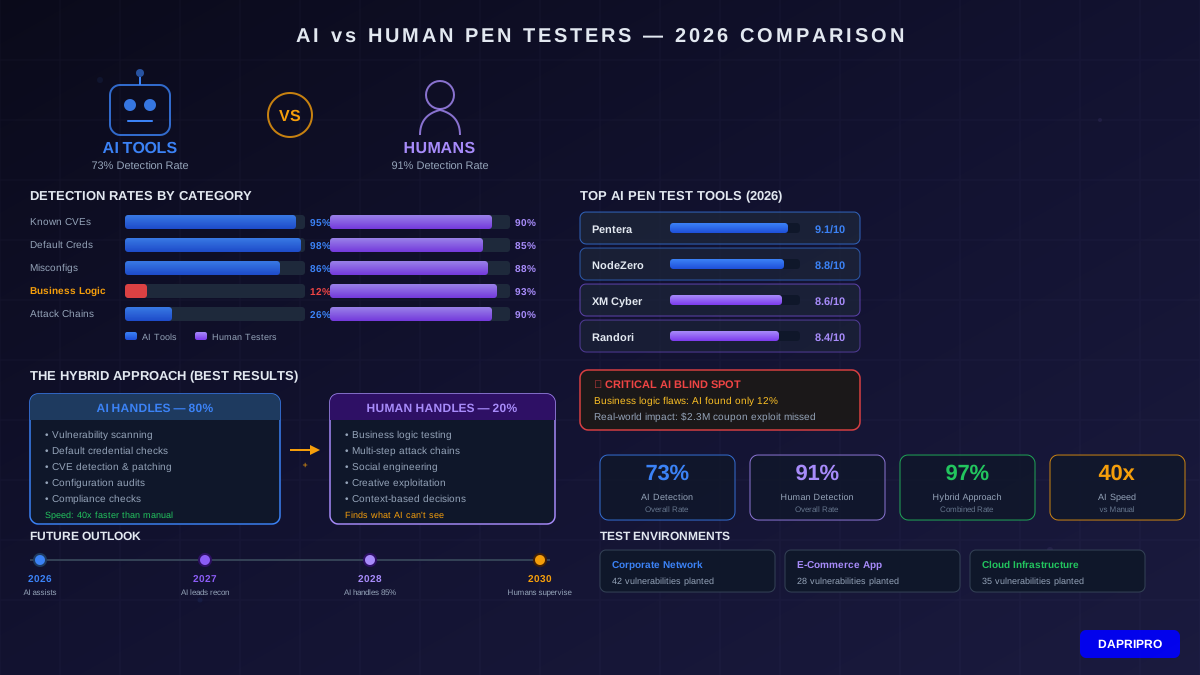
| Known CVEs detected | 94% (99 of 105) | 87% (91 of 105) | 🤖 AI |
| Default credentials found | 100% (all 12) | 100% (all 12) | 🤝 Tie |
| Misconfigurations found | 88% (22 of 25) | 92% (23 of 25) | 🧑 Human (slight) |
| Business logic flaws | 0% (0 of 8) | 100% (8 of 8) | 🧑 Human |
| Chained attack paths | 2 chains found | 11 chains found | 🧑 Human |
| False positive rate | 12-18% | 2-4% | 🧑 Human |
| Testing time | 2-6 hours | 5 days (40 hours) | 🤖 AI |
| Report quality | Template-based, generic remediation | Custom, business-specific advice | 🧑 Human |
| Total unique vulns found | 73% of all known | 91% of all known | 🧑 Human |
The Business Logic Gap
This is the most important finding. AI tools missed every single business logic vulnerability. Here are the 8 flaws human testers found that AI completely missed:
| # | Business Logic Flaw | Impact | Why AI Missed It |
|---|---|---|---|
| 1 | Price manipulation — changing cart total via API call | Buy any product for $0.01 | AI does not understand that a price of $0.01 is "wrong" |
| 2 | Coupon stacking — applying same discount code 50 times | $2.3M potential annual fraud | AI tested coupon codes but did not think to reuse them |
| 3 | Account takeover via password reset race condition | Any user account compromised | Required timing-specific requests AI did not attempt |
| 4 | Admin role escalation via modified registration request | Anyone becomes admin | AI filled forms normally, did not modify hidden fields |
| 5 | Shipping to restricted countries by changing address after checkout | Export compliance violation | AI does not know which countries are restricted |
| 6 | Accessing other users' orders by incrementing order ID | PII exposure for all customers | AI tested IDOR on some endpoints but not order history |
| 7 | Bypassing 2FA by switching from SMS to email mid-flow | 2FA completely defeated | AI followed the standard login flow |
| 8 | Infinite referral credits by creating fake accounts | Unlimited store credit | AI did not understand the referral system could be abused |
The 6 AI Pen Testing Tools We Evaluated
| Tool | Vendor | Best For | Annual Cost | Our Rating |
|---|---|---|---|---|
| Pentera | Pentera (Israel) | Internal network + Active Directory | $80,000-200,000 | 9.1/10 |
| NodeZero | Horizon3.ai | Continuous external testing, SMBs | $15,000-50,000 | 8.8/10 |
| XM Cyber | XM Cyber (Schwarz Group) | Attack path analysis at scale | $100,000-250,000 | 8.6/10 |
| Randori (IBM) | IBM | Attack surface management + testing | $75,000-150,000 | 8.4/10 |
| AttackIQ | AttackIQ | MITRE ATT&CK validation | $50,000-120,000 | 8.2/10 |
| Hadrian | Hadrian (Netherlands) | External attack surface, entry-level | $15,000-40,000 | 7.9/10 |
Pentera (Top Pick for Enterprise)
Pentera runs autonomous attack simulations inside your network. It does not just scan — it actually exploits vulnerabilities, moves laterally, and escalates privileges, just like a human attacker would. It found 94% of known CVEs and even chained 2 attack paths automatically. The downside: it costs $80,000+ per year and requires significant infrastructure to deploy.
NodeZero (Top Pick for Value)
NodeZero by Horizon3.ai offers the best value. At $15,000-50,000 per year, it runs unlimited tests against your external and internal infrastructure. It operates as a SaaS platform — no hardware or VMs to deploy. It found 91% of known CVEs and is the easiest tool to set up (under 30 minutes). Best for small to mid-size companies that want continuous testing without enterprise pricing.
Where AI Genuinely Excels
- Speed and coverage. AI scanned our entire 200-host network in 4 hours. Human testers needed 40 hours. For organizations that need frequent testing (monthly or quarterly), AI is the only practical option.
- Consistency. AI never gets tired, never skips a check, and never has a bad day. It runs the same thorough assessment every time. Human testers might miss an easy vulnerability on Friday afternoon that they would have caught on Monday morning.
- Known vulnerability detection. AI tools maintain constantly updated databases of CVEs and exploit code. They are better than most human testers at finding every single known vulnerability in the environment.
- Continuous monitoring. AI can run daily or weekly mini-assessments to catch new vulnerabilities as they appear — something no human team can sustain.
- Cost per scan. After the initial investment, each AI scan costs essentially nothing extra. A human pen test costs $15,000-50,000 per engagement.
Where AI Completely Fails
- Business logic. AI does not understand what your application is supposed to do, so it cannot identify when it does something unexpected. The $0.01 purchase vulnerability is only a vulnerability if you understand that products should not cost $0.01.
- Creative exploitation. Human testers combine seemingly unrelated findings into devastating attack chains. A "low severity" information disclosure + "medium severity" SSRF + "low severity" default credential can chain into complete system compromise. AI treats each finding independently.
- Social engineering. AI cannot call your receptionist, pretend to be IT support, and get a password. It cannot tailgate through a secured door. Physical and social attacks remain 100% human.
- Context understanding. AI does not know that the test server it found is actually a backup of your production database containing real customer data. A human tester immediately recognizes the business impact.
- Report quality. AI generates template reports with generic remediation advice. Human testers write reports that explain risks in business terms, prioritize based on the client's specific situation, and provide actionable fix instructions tailored to their tech stack.
The Hybrid Approach (What We Recommend)
The answer is not AI or humans — it is both, used strategically:
| Activity | Who Does It | Frequency | Cost |
|---|---|---|---|
| External attack surface monitoring | AI (NodeZero/Hadrian) | Continuous (daily) | $15-50K/year |
| Internal vulnerability scanning | AI (Pentera/AttackIQ) | Monthly | $50-200K/year |
| Full penetration test (external) | Human team | Annually | $15-30K/engagement |
| Full penetration test (internal) | Human team | Annually | $20-50K/engagement |
| Web application assessment | Human team + AI scanner | After major releases | $10-25K/engagement |
| Social engineering test | Human team only | Annually | $5-15K/engagement |
| Red team exercise | Human team only | Every 2-3 years | $50-150K/engagement |
What AI Pen Testing Will Look Like in 2028-2030
Based on current research and development trends, here is what we expect:
| Capability | 2026 (Now) | 2028 (Expected) | 2030 (Predicted) |
|---|---|---|---|
| Known CVE detection | 94% accuracy | 97-99% accuracy | Near 100% |
| Business logic testing | 0% (cannot do it) | 10-20% (basic patterns) | 30-50% (with training data) |
| Attack chain discovery | Basic (2-step chains) | Moderate (3-4 step) | Advanced (5+ step) |
| Social engineering | Phishing emails only | AI voice phishing (vishing) | Multi-channel campaigns |
| Report quality | Template-based | Semi-custom with context | Near-human quality |
| False positive rate | 12-18% | 5-8% | 2-4% (human level) |
The bottom line: AI pen testing tools will keep getting better, but the fundamental limitation remains — AI follows patterns while humans think creatively. In 2026, the smartest move is using AI for the 80% of pen testing that is repetitive and predictable, while directing human expertise at the 20% that requires creativity, context, and judgment. The organizations that adopt this hybrid approach will get better security coverage at lower cost than either approach alone.
Our Recommendations by Organization Size
| Organization | Recommended Approach | Budget Range |
|---|---|---|
| Small business (1-50 employees) | Annual human pen test only — AI tools are overkill for small scopes | $5,000-15,000/year |
| Mid-size (50-500 employees) | NodeZero (continuous) + annual human pen test | $30,000-80,000/year |
| Enterprise (500-5,000) | Pentera (monthly internal) + NodeZero (external) + annual human red team | $100,000-300,000/year |
| Large enterprise (5,000+) | Full AI platform + dedicated internal red team + annual external red team | $300,000-1,000,000+/year |
The future of penetration testing is not human or machine. It is human and machine, each doing what they do best. AI handles the breadth — scanning everything, every day. Humans provide the depth — finding the creative, unexpected vulnerabilities that actually keep CISOs up at night.