
Privacy policy generators are one of the most widely used shortcuts on the internet — and one of the most dangerous. Millions of websites and apps display privacy policies that were generated in under five minutes by free tools like TermsFeed, GetTerms, FreePrivacyPolicy, or Shopify's built-in generator. The result is a document that looks professional but fails to describe the site's actual data practices, creating a ticking time bomb of regulatory, legal, and reputational risk.
This is not a theoretical problem. The FTC has explicitly stated that an inaccurate privacy policy is worse than having no privacy policy at all. A missing policy is an omission. A misleading one is deception — and deception carries steeper penalties, consent order requirements, and years of regulatory oversight. In this guide, we break down exactly why template policies fail, the specific disclosures they miss, and how to build a privacy policy that actually protects your business.
How Privacy Policy Generators Actually Work
Most free privacy policy generators follow the same basic pattern. You answer a handful of questions — your company name, whether you use cookies, whether you collect email addresses, and maybe which country you operate in. The generator then inserts your answers into a pre-written template and produces a seemingly complete privacy policy in a few seconds.
The problem is structural. These generators cannot know:
- What your technology stack actually collects — every analytics SDK, advertising pixel, crash reporting tool, and third-party widget on your site collects data, often including data you did not explicitly choose to collect. A generator asking "do you collect personal information?" cannot account for what Firebase, Hotjar, Meta Pixel, or Google Tag Manager are doing behind the scenes
- How data flows through your systems — generators do not map your data pipeline. They do not know if data gets sent to a CRM, forwarded to an email marketing platform, stored in a cloud database, backed up to a different region, or shared with business partners
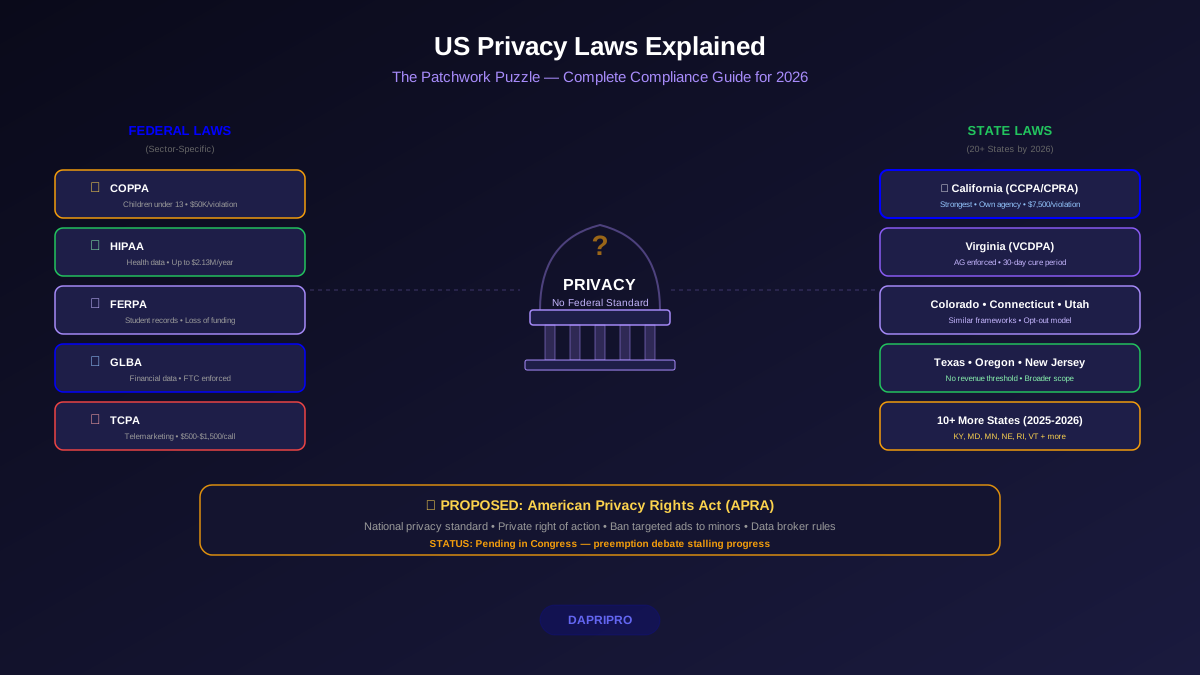
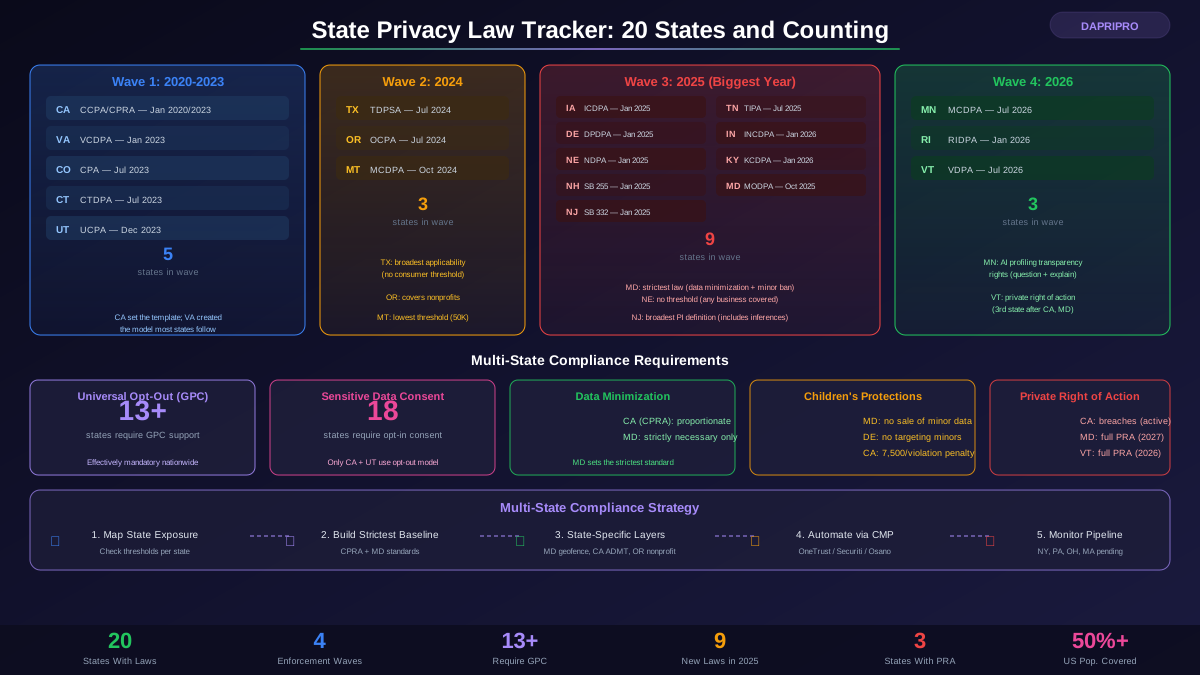
- Which jurisdictions apply to your users — having users in California triggers CCPA/CPRA requirements. Users in the EU trigger GDPR. Users in Virginia, Colorado, Connecticut, or any of the other 20+ states with privacy laws trigger state-specific disclosures. A generator cannot dynamically determine which laws apply to your user base
- Your actual data retention practices — generators typically insert vague language like "we retain data as long as necessary for the purposes described." Modern privacy laws require specific retention periods for specific categories of data
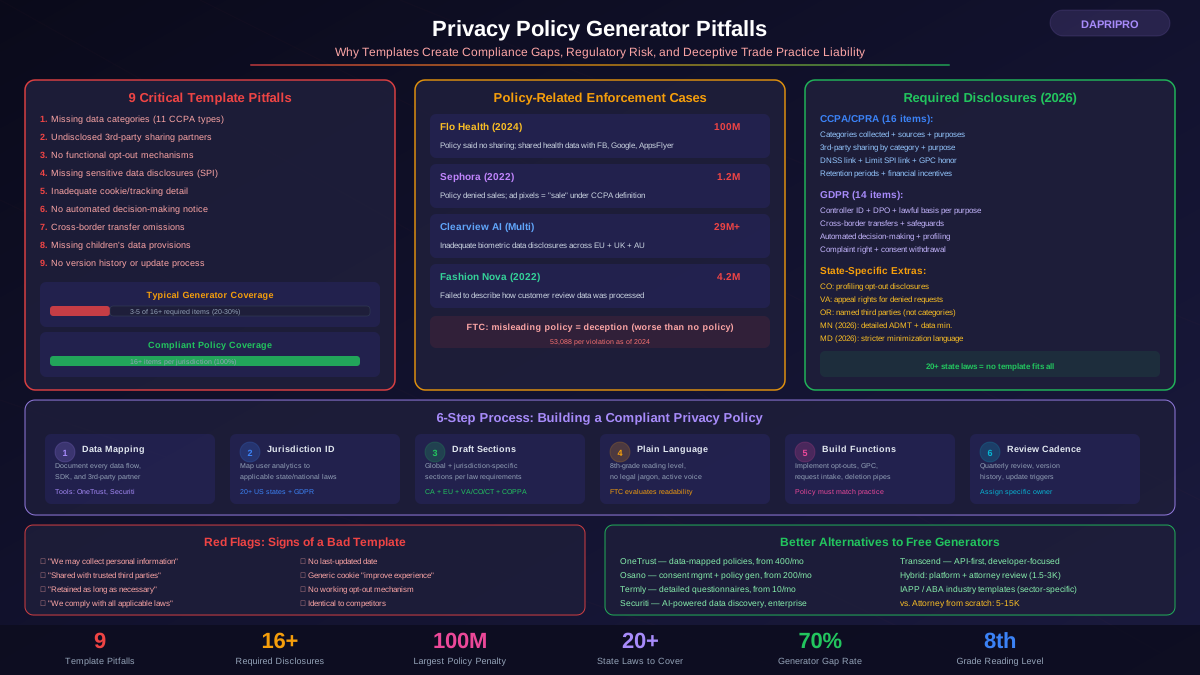
The 9 Critical Pitfalls of Template Privacy Policies
Pitfall 1: Missing Data Categories
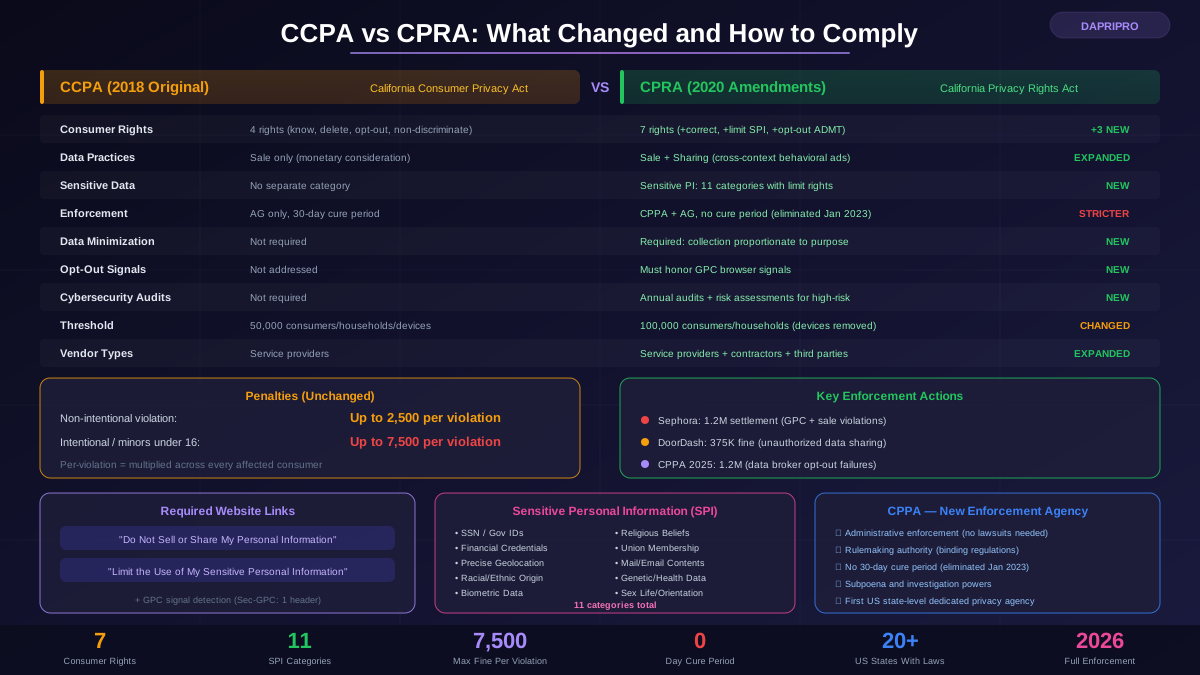
CCPA/CPRA requires you to disclose the specific categories of personal information you collect, using the law's own category definitions. There are 11 categories under CCPA (identifiers, commercial information, biometric data, internet activity, geolocation, audio/visual data, professional information, education information, inferences, and sensitive personal information). A template policy that says "we collect personal information you provide to us" fails this requirement entirely.
The CPPA (California Privacy Protection Agency) specifically cited inadequate category disclosures in multiple enforcement actions in 2024 and 2025. Data brokers that used template policies were penalized for not disclosing that they collected "inferences drawn from other personal information" — a category most generators do not even mention.
Pitfall 2: Undisclosed Third-Party Sharing
Template policies typically include generic language about sharing data with "trusted third parties" or "service providers." Under modern privacy laws, this is insufficient. CCPA/CPRA requires disclosure of the specific categories of personal information shared with each category of third party, whether data is "sold" or "shared" (which includes cross-context behavioral advertising), and the business or commercial purpose for each sharing arrangement.
If your website runs Google Ads, Meta Pixel, TikTok Pixel, and LinkedIn Insight Tag, each of those represents a separate data sharing arrangement that must be disclosed. A typical template policy mentions none of them by name or category.
Pitfall 3: No Opt-Out Mechanisms
Multiple state laws now require specific opt-out mechanisms — and simply stating that users can "opt out by contacting us" is not compliant. California requires a "Do Not Sell or Share My Personal Information" link. Colorado, Connecticut, Montana, and other states require recognition of universal opt-out mechanisms like the Global Privacy Control (GPC) browser signal. Virginia and other states require specific opt-out disclosures for targeted advertising, sale of personal data, and profiling.
Privacy policy generators do not implement opt-out mechanisms — they just generate text. You still need to actually build the opt-out functionality, connect it to your advertising and analytics stack, and honor GPC signals. A template policy that says "you can opt out" without functional opt-out technology is both non-compliant and deceptive.
Pitfall 4: Missing Sensitive Data Disclosures
CPRA created a separate category for "sensitive personal information" (SPI) with its own disclosure requirements. Sensitive PI includes Social Security numbers, driver's license numbers, financial account details, precise geolocation, racial or ethnic origin, religious beliefs, union membership, private communications content, genetic data, biometric data, and health information. If you collect any of these — even through third-party plugins — your privacy policy must separately disclose each category, the purpose for collecting it, and the consumer's right to limit its use.
Most privacy policy generators do not even have a sensitive data section. They lump everything under "personal information," which violates CPRA's separate disclosure requirement for sensitive PI.
Pitfall 5: Inadequate Cookie and Tracking Disclosures
A privacy policy that says "we use cookies to improve your experience" is the 2026 equivalent of saying nothing at all. Modern enforcement requires disclosure of every category of cookie and tracking technology (strictly necessary, functional, analytics, advertising), the specific purposes of each category, duration of each cookie type, which third parties set cookies on your site and for what purpose, and how users can manage or reject non-essential cookies.
Under GDPR and ePrivacy, you need separate cookie consent — a banner that blocks non-essential cookies until the user opts in. Under CCPA/CPRA, advertising cookies constitute "sharing" personal information and trigger "Do Not Sell or Share" obligations. A template policy addresses none of this specifically.
Pitfall 6: No Automated Decision-Making Disclosure
If your site or app uses algorithms to make decisions that affect users — ad targeting, content recommendations, credit decisions, insurance pricing, hiring screening, or content moderation — modern privacy laws require disclosure of the existence of automated decision-making, the logic involved (at least a general explanation), the significance and consequences of the processing, and the user's right to opt out or request human review.
GDPR Article 22 requires this disclosure. CCPA/CPRA's ADMT regulations (finalized by the CPPA) require it. Colorado's profiling provisions require it. Template generators do not ask whether you use automated decision-making, so they cannot disclose it.
Pitfall 7: Cross-Border Transfer Omissions
If you use AWS (US-East or US-West regions), Google Cloud, or Azure, your data is stored in specific physical locations. If your users include Europeans, your privacy policy must disclose that data is transferred to the United States, identify the legal mechanism for the transfer (Standard Contractual Clauses, EU-US Data Privacy Framework certification, or binding corporate rules), and inform users of the risks of the transfer. Most generators assume your data stays in one country and include no cross-border transfer disclosures.
Pitfall 8: Missing Children's Data Provisions
Even if your site is not directed at children, your privacy policy should address what happens if you discover a child under 13 has provided personal information. COPPA requires specific disclosures about children's data practices. If your app or site could attract users under 13 — even incidentally — a template policy that says "we do not knowingly collect data from children" without implementing actual age-gating or deletion procedures is inadequate.
Pitfall 9: No Version History or Update Procedures
Privacy policies are living documents. When your data practices change, the policy must change. Multiple state laws require that you identify when the policy was last updated, describe how you notify users of changes, and maintain records of prior versions. A generated policy is a snapshot of a moment in time. Without a process for regular review and updates, it becomes inaccurate the first time you add a new analytics tool, change a hosting provider, or expand into a new market.
Real-World Enforcement: When Template Policies Caused Real Penalties
These are not hypothetical risks. Regulators worldwide have penalized organizations specifically for inadequate privacy policies:
Flo Health (2024) — 100 Million Dollars
The period-tracking app Flo Health settled with the FTC for 100 million dollars. A core allegation was that Flo's privacy policy stated the app would not share health data with third parties — but the app actually shared sensitive health information with Facebook, Google, AppsFlyer, and Flurry for advertising purposes. The privacy policy was generated from a template and never updated to reflect actual data sharing practices. The FTC's consent order requires Flo to implement a comprehensive privacy program, obtain independent assessments for 20 years, and obtain user consent before sharing health data.
Fashion Nova (2022) — 4.2 Million Dollars
The FTC fined Fashion Nova 4.2 million dollars for suppressing negative customer reviews. While the core violation was review manipulation, the FTC also cited Fashion Nova's privacy policy for failing to accurately describe how customer data (including reviews) was collected, processed, and selectively published. The case illustrated that privacy policy accuracy extends to all data practices — not just the data categories generators typically address.
Clearview AI (Multiple Jurisdictions) — Tens of Millions
Clearview AI faced enforcement across multiple jurisdictions — 20 million euros from France's CNIL, 9 million pounds from the UK's ICO, and penalties from Italy, Greece, and Australia. In each case, regulators cited Clearview's inadequate privacy policy alongside the underlying violations. The privacy policy failed to explain how facial recognition data was collected from public sources, how it was processed, and users' rights regarding their biometric information.
Sephora (2022) — 1.2 Million Dollars
California's first CCPA enforcement action targeted Sephora for failing to disclose that it "sold" personal information to third parties through advertising technologies. Sephora's privacy policy — likely generated or drafted from a template — stated the company did not sell personal information. But under CCPA's broad definition of "sale" (which includes sharing data for valuable consideration like analytics access), Sephora's advertising pixel integrations constituted sales. The privacy policy's denial of data sales made the violation deceptive rather than merely non-compliant.
What Laws Actually Require in Privacy Policies (2026)
Here is a summary of the specific disclosures required by major privacy laws. Any compliant privacy policy must address all of these for every jurisdiction where you have users:
CCPA/CPRA Requirements
- Categories of personal information collected in the preceding 12 months
- Sources of each category of personal information
- Business or commercial purpose for collecting or selling each category
- Categories of third parties with whom each category is shared
- Consumer rights: access, deletion, correction, portability, opt-out of sale/sharing, limit use of sensitive PI
- Specific pieces of personal information collected about a consumer (upon request)
- "Do Not Sell or Share My Personal Information" link
- "Limit the Use of My Sensitive Personal Information" link (if applicable)
- Disclosure of financial incentives for data collection (loyalty programs, discounts for data)
- Annual CCPA metrics for businesses receiving 10 million+ consumer requests
- Data retention periods for each category of personal information
GDPR Requirements
- Identity and contact details of the data controller
- Contact details of the Data Protection Officer (if applicable)
- Lawful basis for each processing purpose (consent, contract, legitimate interest, etc.)
- Categories of personal data processed
- Recipients or categories of recipients of personal data
- Cross-border transfer details and safeguards
- Retention periods or criteria for determining retention
- Data subject rights: access, rectification, erasure, restriction, portability, objection
- Right to withdraw consent at any time
- Right to lodge a complaint with a supervisory authority
- Whether data provision is a contractual requirement and consequences of not providing it
- Existence of automated decision-making, including profiling
State-Specific Additional Requirements
- Colorado — specific disclosure of profiling activities and opt-out rights for profiling
- Connecticut — disclosure of whether data is sold and consumer's right to opt out
- Virginia — explicit notice of appeal rights if a consumer request is denied
- Oregon — disclosure of the specific third parties (not just categories) that receive personal data
- Minnesota (2026) — detailed profiling disclosures and data minimization commitments
- Maryland (2026) — stricter data minimization language required in the policy
How to Build a Privacy Policy That Actually Works
Instead of starting with a template, start with a data map. A privacy policy should be a disclosure document that reflects your actual practices — not aspirational language pasted from a generator. Here is the correct process:
Step 1: Complete Data Mapping
Before writing a single word, document every data flow in your organization. For each piece of personal information, record what it is and its category under applicable law, how it is collected (directly from the user, from third parties, through cookies/tracking), why it is collected (the specific business purpose), where it is stored and for how long, who has access to it internally, which third parties receive it and why, whether it crosses national borders, and how it is deleted when no longer needed.
Tools like OneTrust Data Mapping, Securiti's PrivacyOps, Transcend Data Inventory, or even a detailed spreadsheet can help. The data map forms the factual foundation of your privacy policy.
Step 2: Identify Applicable Laws
Determine which privacy laws apply based on your user base, not just your company location. If you have website visitors from California (you almost certainly do), CCPA/CPRA applies. If European residents visit your site, GDPR likely applies. Map your user analytics to jurisdictions and note which state-specific requirements apply.
Step 3: Draft Jurisdiction-Specific Sections
Structure your privacy policy with a general section covering universal disclosures, followed by jurisdiction-specific sections. Common structures include:
- A global section covering data categories, purposes, and retention
- A "Your California Privacy Rights" section with CCPA/CPRA-specific disclosures
- A "Your European Privacy Rights" section with GDPR-specific disclosures
- A "Your Virginia/Colorado/Connecticut Privacy Rights" section for applicable state laws
- A "Children's Privacy" section addressing COPPA compliance
- A "Cookie Policy" section (or separate page) with tracking technology details
Step 4: Write in Plain Language
The FTC explicitly evaluates whether privacy policies are understandable by ordinary consumers. Target an 8th-grade reading level. Avoid legal jargon. Use short sentences and active voice. Replace "we may utilize personal information for the purpose of" with "we use your personal information to." The CPPA in California has specifically called out "legalese" privacy policies as potentially deceptive because consumers cannot understand what they are consenting to.
Step 5: Implement Supporting Functionality
A privacy policy is only compliant if the rights and mechanisms it describes actually work. This means building functional opt-out mechanisms (not just a "contact us" email), implementing GPC signal detection, creating consumer request intake and fulfillment workflows, setting up data deletion pipelines that actually purge data from all systems, and maintaining consent records for audit purposes. The policy and the technology must match.
Step 6: Establish Review Cadence
Set a quarterly review calendar. Assign a specific person or team responsible for privacy policy maintenance. Create a checklist of triggers that require immediate policy updates. Maintain a version history log that records what changed, when, and why. Many compliance platforms automate change tracking and notification.
Better Alternatives to Free Generators
If you cannot afford a privacy attorney, there are middle-ground options that produce significantly better results than free generators:
Compliance Platforms with Policy Features
- OneTrust — enterprise privacy management platform with privacy policy generation based on actual data mapping. Policies are tied to your data inventory and update when your practices change. Starting around 400 dollars per month
- Osano — consent management platform that includes policy generation, cookie scanning, and regulatory monitoring. Offers small business plans and a compliance monitoring dashboard. Plans from 200 dollars per month
- Termly — positioned between free generators and enterprise platforms. Offers more detailed questionnaires, jurisdiction-specific sections, and cookie consent integration. Plans from 10 to 50 dollars per month
- Securiti — AI-powered privacy management with automated data discovery, risk assessment, and policy generation tied to your actual data flows. Enterprise pricing
- Transcend — privacy infrastructure platform that connects your privacy policy disclosures to actual data systems, ensuring policy-practice alignment. Developer-focused with API-first approach
Hybrid Approach: Platform + Legal Review
The most cost-effective approach for small to mid-size businesses is to use a compliance platform to generate a data-mapped privacy policy, then have a privacy attorney review and customize it. This typically costs 1,500 to 3,000 dollars for the initial review (compared to 5,000 to 15,000 dollars for drafting from scratch) and ensures the policy accurately reflects your practices while meeting legal requirements.
Industry-Specific Templates
Some industry organizations provide sector-specific privacy policy guidance that is significantly more detailed than generic generators. The IAPP (International Association of Privacy Professionals) offers model privacy notices. The ABA (American Bar Association) provides legal-service specific templates. Healthcare organizations can use HIPAA-specific policy frameworks from HHS. The key difference is that industry templates address sector-specific data practices rather than trying to be universal.
Privacy Policy Red Flags: Signs You Are Using a Bad Template
Review your current privacy policy for these warning signs that indicate template-derived content:
- "We may collect personal information" — the word "may" signals that the drafter did not know what the organization actually collects. A compliant policy says "we collect" and lists specific categories
- "Trusted third parties" — this phrase appears in virtually every generated policy and tells the user nothing. Name the categories of third parties or the specific companies
- "As long as necessary" — CCPA/CPRA and GDPR require specific retention periods. This phrase is a compliance gap
- "We comply with all applicable laws" — this is not a disclosure. It is an aspiration. Regulators want to see specific rights listed for specific jurisdictions
- No last-updated date — a policy without a date stamp raises immediate red flags for regulators
- Generic cookie disclosure — "we use cookies to improve your experience" without listing cookie categories, purposes, and third-party cookies
- No consumer request process — the policy describes rights but provides no working mechanism to exercise them
- Identical to competitors — if your privacy policy reads like every other template policy, it is almost certainly not describing your unique data practices
Privacy Policy Compliance Checklist for 2026
Use this checklist to evaluate and improve your privacy policy:
Content Completeness
- All categories of personal information collected are specifically listed
- Sources of personal information are disclosed
- Business purposes for each category are stated
- Third-party data sharing is disclosed by recipient category and purpose
- Data retention periods are specific and stated per category
- Cookie and tracking technology disclosures are detailed
- Automated decision-making practices are disclosed
- Cross-border data transfer mechanisms are identified
- Children's data handling practices are addressed
- Sensitive personal information is separately disclosed (CPRA)
Consumer Rights
- All applicable rights are listed per jurisdiction
- Opt-out mechanisms are functional (not just text)
- "Do Not Sell or Share" link is present and working (CCPA/CPRA)
- GPC/universal opt-out signals are disclosed and honored
- Consumer request process includes at least two intake methods
- Response timeframes are stated and meet legal requirements
- Appeal process is disclosed (Virginia and other states)
Format and Accessibility
- Written at 8th-grade reading level or below
- Last-updated date is prominently displayed
- Version history is maintained
- Policy is accessible (screen reader compatible, adequate contrast)
- Available in languages matching your user base
- Linked from every page of the site (footer) and in app settings
Operational Integration
- Privacy policy matches actual data practices (policy-practice alignment)
- Supporting technology is implemented (consent management, request fulfillment)
- Quarterly review schedule is established and assigned
- Update triggers are documented and monitored
- Staff is trained on privacy policy commitments and procedures
A privacy policy is not a checkbox — it is a binding commitment to your users about how you handle their data. Template generators create the illusion of compliance while exposing you to enforcement risk, consumer lawsuits, and reputational damage. The investment in getting it right is minimal compared to the cost of getting it wrong.