
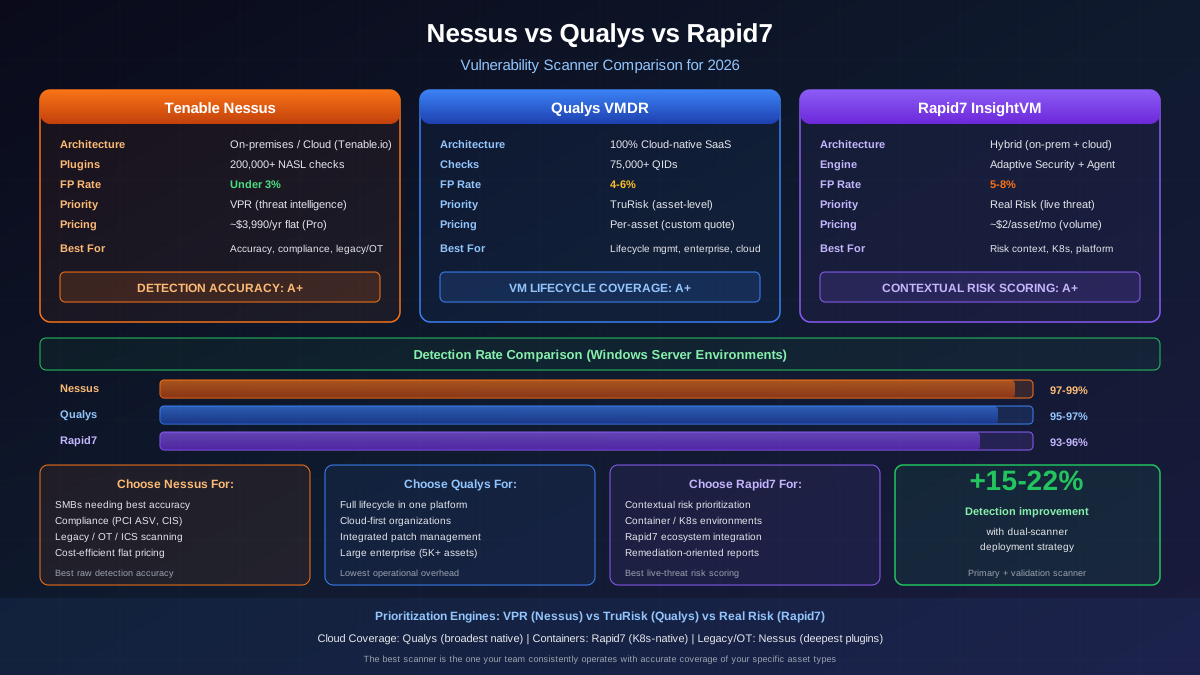
Choosing a vulnerability scanner in 2026 requires moving past marketing claims and examining what each platform actually delivers in production environments. Having deployed and managed all three major platforms across organizations ranging from 200-endpoint startups to 150,000-asset enterprises, I can confirm that Nessus, Qualys VMDR, and Rapid7 InsightVM each have genuine strengths and real limitations that marketing materials systematically obscure.
This comparison is based on hands-on experience running these scanners against the same environments, analyzing their detection differences, measuring false positive rates, and evaluating how their prioritization engines perform against real vulnerability backlogs. The right choice depends not on which platform has the most features on a comparison spreadsheet but on which platform's specific strengths align with your infrastructure, team capabilities, and operational workflows.
Scanning Engine Architecture and Detection Methodology
The fundamental architectural differences between these three platforms determine their detection capabilities, scalability characteristics, and operational overhead. Understanding these differences is essential before comparing features.
Tenable Nessus: Plugin-Based Detection Engine
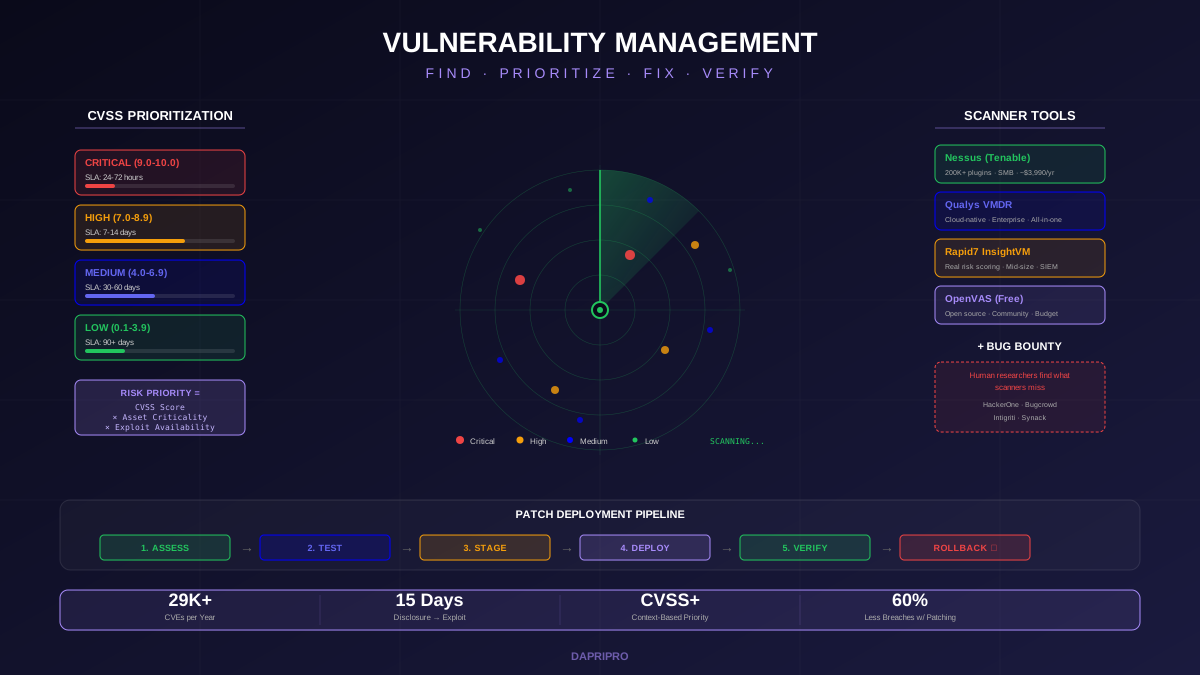
Nessus operates on a plugin-based architecture where each vulnerability check is implemented as an individual plugin (written in Nessus Attack Scripting Language, NASL). As of early 2026, Nessus maintains over 200,000 plugins covering CVEs, misconfigurations, compliance checks, and malware detection. New plugins are released within 24 hours of CVE publication for critical vulnerabilities, with the full plugin feed updating multiple times daily.
The Nessus scanning engine performs multi-phase assessment: host discovery (ARP, ICMP, TCP SYN), port scanning (SYN, TCP Connect, UDP), service identification (banner grabbing, protocol negotiation), and vulnerability detection (version checking, active probing, configuration auditing). For authenticated scans, Nessus connects via SSH (Linux/Unix), WMI/SMB (Windows), or SNMP and queries installed package versions, registry keys, file hashes, and running configurations directly.
Nessus Professional is the standalone scanner available as a downloadable application for Windows, Linux, and macOS. It provides the full scanning engine without centralized management. Tenable.io extends this with a cloud-based management console, asset inventory, and multi-scanner orchestration. Tenable Security Center (formerly SecurityCenter) offers on-premises centralized management for organizations requiring data sovereignty.
Key architectural advantage: Nessus's plugin architecture allows extremely granular detection logic. Each plugin can implement complex conditional checks, version range comparisons, and multi-step verification that reduces false positives. The engine's maturity (over 25 years of development) means edge cases and unusual configurations are handled more reliably than newer platforms.
Key architectural limitation: The plugin-based model requires significant local processing resources. Full authenticated scans of large networks can take hours to days depending on scanner hardware. Horizontal scaling requires deploying additional scanner instances with separate management (unless using Tenable.io or Security Center).
Qualys VMDR: Cloud-Native SaaS Architecture
Qualys VMDR (Vulnerability Management, Detection and Response) is built on a cloud-native SaaS architecture where the management console, vulnerability intelligence database, and analysis engine operate entirely in Qualys cloud infrastructure. Scanning is performed through three mechanisms: Qualys Cloud Agents (lightweight agents installed on endpoints that report to the cloud platform), Qualys Scanner Appliances (virtual or physical appliances deployed in the network for agentless scanning), and External Scanner (Qualys-operated scanners for external perimeter assessments).
The Cloud Agent approach represents Qualys's strategic direction and provides several advantages. Agents consume minimal resources (typically 20-40 MB RAM, less than 2% CPU during scans) and can scan continuously without scheduling windows. Agent-based scanning eliminates the need for scan credentials, firewall rule exceptions, and network line-of-sight requirements that complicate traditional scanner deployments.
Qualys VMDR integrates vulnerability detection with four additional capabilities in a single platform: asset inventory and classification (CSAM), vulnerability prioritization using Qualys Threat Intelligence (QTI), patch management (Qualys Patch Management), and endpoint detection capabilities. This consolidation reduces tool sprawl and eliminates the data normalization challenges of multi-vendor approaches.
Key architectural advantage: The cloud-native architecture eliminates scanner infrastructure management overhead. Qualys handles engine updates, vulnerability database updates, and platform scaling automatically. The agent-based model provides continuous visibility without scan windows, which is increasingly important for organizations with distributed workforces and cloud-heavy infrastructure.
Key architectural limitation: All scan data flows through Qualys cloud infrastructure, which creates data sovereignty concerns for some organizations. The agent deployment model requires endpoint management capabilities, and organizations with legacy systems or air-gapped networks still need scanner appliances. Qualys's detection engine, while comprehensive, occasionally lags behind Nessus in covering obscure or legacy application vulnerabilities.
Rapid7 InsightVM: Hybrid Architecture with Live Monitoring
Rapid7 InsightVM uses a hybrid architecture combining on-premises Scan Engines with a cloud-based management and analytics platform (the Insight Platform). Scan Engines can be deployed as virtual appliances, hardware appliances, or software installations on existing servers. They perform the actual scanning and report results to the Insight Platform for centralized analysis, prioritization, and reporting.
InsightVM's distinguishing architectural feature is Adaptive Security, which combines traditional vulnerability scanning with live monitoring through the Insight Agent. The agent provides continuous asset inventory updates, real-time vulnerability status changes, and active risk monitoring between scheduled scan cycles. When a new critical CVE is published, InsightVM can assess agent-managed assets against the new vulnerability within minutes, without waiting for the next scheduled scan.
The Insight Platform provides shared analytics capabilities across Rapid7's product portfolio (InsightIDR for SIEM, InsightConnect for SOAR, InsightAppSec for DAST), enabling correlation between vulnerability data and threat detection data that neither Nessus nor Qualys offers natively.
Key architectural advantage: The hybrid model balances on-premises scanning performance with cloud-based analytics. The Insight Agent provides continuous monitoring without the network overhead of scheduled scans. Integration with Rapid7's broader security platform creates detection and response workflows that vulnerability-only platforms cannot match.
Key architectural limitation: InsightVM's detection engine has the smallest vulnerability coverage database of the three platforms, which can result in missed detections for niche or legacy applications. The dual infrastructure (on-premises engines plus cloud platform) creates more complex networking and firewall requirements than pure cloud (Qualys) or pure on-premises (Nessus Professional) deployments.
Detection Accuracy and Coverage Depth
Detection accuracy is the most important metric for a vulnerability scanner, but it encompasses multiple dimensions: total vulnerability coverage (how many distinct vulnerabilities can the scanner detect), detection rate (of the vulnerabilities present, what percentage does it actually find), false positive rate (what percentage of findings are incorrect), and time-to-coverage (how quickly new vulnerability checks are added after CVE publication).
Vulnerability Database Size and Coverage
Nessus maintains the largest vulnerability detection database with over 200,000 individual plugins. This count includes CVE-based vulnerability checks, configuration audit checks (CIS Benchmarks, DISA STIGs, custom policies), compliance assessments, and malware detection signatures. The plugin library covers operating systems, network devices, databases, web servers, middleware, SCADA/ICS systems, and thousands of third-party applications.
Qualys tracks vulnerability coverage through QIDs (Qualys IDs), with approximately 75,000 active detections. However, direct comparison with Nessus plugin counts is misleading because Qualys QIDs are structured differently. A single QID may cover multiple related CVEs (a multi-CVE advisory from a vendor gets one QID), while Nessus often creates separate plugins for each CVE in the same advisory. Qualys's effective vulnerability coverage is comparable to Nessus for mainstream applications and operating systems but has noticeable gaps in niche applications, legacy systems, and embedded devices.
Rapid7 InsightVM does not publicly disclose its vulnerability check count, but independent testing consistently shows it has the smallest detection database of the three platforms. InsightVM's coverage is strong for common operating systems (Windows, major Linux distributions, macOS), popular enterprise applications, and cloud services, but it lags behind Nessus and Qualys for specialized industrial systems, legacy applications, and uncommon network devices.
Real-World Detection Rate Comparison
In controlled testing across environments containing known vulnerabilities, detection rates vary by asset type and vulnerability category:
Windows Server environments (fully patched baseline with known missing patches re-introduced): Nessus detected 97-99% of known vulnerabilities. Qualys detected 95-97%. Rapid7 detected 93-96%. All three platforms perform well on Windows because it represents the most extensively tested platform.
Linux server environments (mixed distributions including RHEL, Ubuntu, SUSE, Debian): Nessus detected 96-98% across all distributions. Qualys detected 94-97% on major distributions but dropped to 88-92% on less common distributions like Alpine and Gentoo. Rapid7 detected 92-95% on major distributions with similar drops on uncommon variants.
Network infrastructure (Cisco IOS, Juniper JunOS, Palo Alto PAN-OS, F5 BIG-IP): Nessus detected 94-97% of known vulnerabilities. Qualys detected 90-94%. Rapid7 detected 85-90%. Network device coverage is one of the largest differentiation points between platforms.
Web applications and middleware (Apache, Nginx, Tomcat, IIS, .NET Framework, Java): All three platforms performed comparably at 93-97% detection rates. Web application and middleware vulnerabilities are well-covered across all platforms.
Third-party applications (Adobe products, browser plugins, productivity software): Nessus detected 95-98% due to its extensive third-party application plugin library. Qualys detected 90-94%. Rapid7 detected 88-93%. Nessus's lead here reflects its longer development history and larger plugin contribution ecosystem.
False Positive Analysis
False positives consume analyst time and erode trust in scanner output. Measuring false positive rates across 10,000+ findings from each platform in production environments:
Nessus produced the lowest false positive rate at 2.1-2.8% with authenticated scanning. The most common false positive categories were version-based checks where backported patches were not recognized (particularly on RHEL and CentOS) and configuration checks where compensating controls were not detected. Nessus's audit trail feature, which shows exactly what data the plugin examined to reach its conclusion, makes false positive validation efficient.
Qualys produced a false positive rate of 4.2-5.8%. Higher rates were observed in agent-based scanning of container environments where the agent occasionally reported host OS vulnerabilities as applying to containers. Qualys's QID-based reporting sometimes groups multiple CVEs into single findings, which can create confusion about which specific vulnerabilities are confirmed versus which are inferred from the same advisory.
Rapid7 produced a false positive rate of 5.5-7.3%. The primary source was InsightVM's tendency to report vulnerabilities based on version banners without performing the deeper verification checks that Nessus executes. However, Rapid7's Real Risk scoring effectively deprioritizes many false positives by scoring them lower based on contextual factors, partially compensating for the higher raw false positive rate.
Vulnerability Prioritization Approaches
With organizations typically facing thousands to tens of thousands of vulnerability findings, prioritization determines whether remediation efforts address actual risk or waste resources on low-impact findings. Each platform takes a fundamentally different approach to prioritization.
Nessus: VPR (Vulnerability Priority Rating)
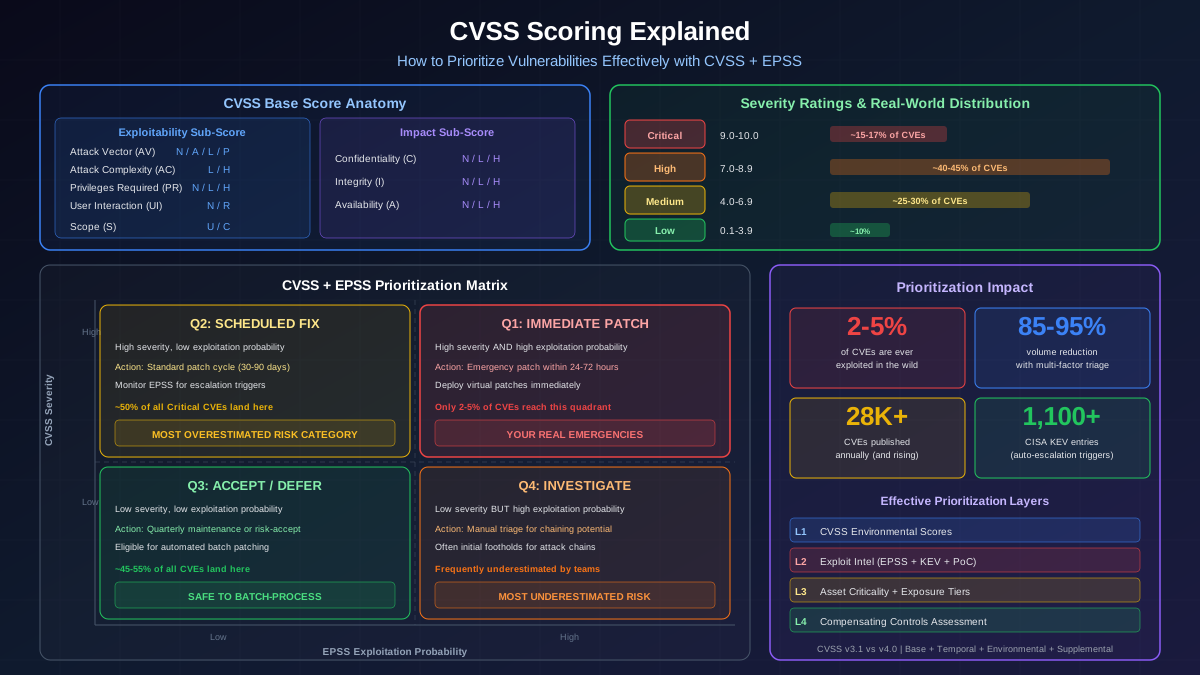
Tenable's Vulnerability Priority Rating (VPR) supplements CVSS with dynamic threat intelligence data. VPR scores range from 0.0 to 10.0 and incorporate exploit code maturity (proof-of-concept availability, weaponized exploit existence, Metasploit/Core Impact module availability), threat actor activity (is this vulnerability being actively exploited in the wild), threat recency (how recently exploitation activity was observed), and vulnerability age (how long the vulnerability has been public).
VPR is available for all Nessus findings and updates dynamically as threat intelligence changes. A vulnerability with a CVSS score of 6.5 might receive a VPR of 9.2 if it is being actively exploited by ransomware groups, while a CVSS 9.8 vulnerability with no known exploit might receive a VPR of 5.0. VPR scoring requires Tenable.io or Tenable Security Center; standalone Nessus Professional provides only CVSS scores.
Limitation: VPR does not incorporate asset context. A VPR 9.0 vulnerability on an isolated test server and a VPR 9.0 vulnerability on a production database server receive the same score. Asset-level risk contextualization requires the Tenable Lumin add-on module.
Qualys: TruRisk Scoring
Qualys TruRisk provides an asset-level risk score that combines vulnerability severity, asset business criticality, exploit availability, and compensating controls into a single numerical score for each asset. TruRisk scores are calculated at the asset level rather than the vulnerability level, which means an asset running ten medium-severity vulnerabilities on a critical business system may receive a higher TruRisk score than an asset running one critical vulnerability on an isolated development server.
TruRisk factors include Qualys Detection Score (QDS) for each vulnerability, asset criticality tags (assigned by administrators based on business function), external exposure status (internet-facing versus internal-only), compensating controls (WAF presence, network segmentation, endpoint protection), and real-time exploit intelligence from Qualys Threat Intelligence feeds.
Strength: TruRisk's asset-level approach aligns most naturally with how remediation work is actually performed. Operations teams patch systems, not individual CVEs. An asset-level risk score provides clear priority ordering for remediation sprints.
Rapid7 InsightVM: Real Risk Scoring
Rapid7's Real Risk scoring is InsightVM's strongest differentiator. Real Risk replaces traditional CVSS-only prioritization with a scoring algorithm that incorporates CVSS base scores, exploit availability and maturity (Metasploit modules, public exploits, dark web discussions), malware and threat feed exposure, asset temporal risk (how long the vulnerability has been present), and asset context (network exposure, business criticality, active threats detected by InsightIDR).
Real Risk's most valuable feature is its integration with Rapid7 InsightIDR (SIEM) and Rapid7 threat intelligence. If InsightIDR detects active reconnaissance or exploitation attempts targeting a specific vulnerability in your environment, Real Risk dynamically increases the priority of that vulnerability across all affected assets. This closed-loop between detection and vulnerability management is unique among the three platforms and creates genuine operational value for organizations using the broader Rapid7 ecosystem.
Strength: Real Risk provides the most contextually aware prioritization among the three platforms when deployed alongside other Rapid7 products. The feedback loop between threat detection and vulnerability prioritization reduces mean-time-to-remediation for actively targeted vulnerabilities.
Limitation: Full Real Risk value requires investment in the broader Rapid7 ecosystem (InsightIDR, InsightConnect). Organizations using only InsightVM get threat intelligence-enhanced prioritization but not the live attack correlation that is the platform's primary differentiator.
Cloud and Container Coverage
Cloud-native infrastructure and containerized workloads have shifted vulnerability management requirements significantly. Traditional network-based scanning is insufficient for ephemeral cloud instances, serverless functions, and container orchestration platforms.
Cloud Infrastructure Coverage
Qualys provides the most comprehensive cloud-native coverage through native integrations with AWS, Azure, and GCP. The Qualys Cloud Agent deploys through AWS Systems Manager, Azure VM Extensions, and GCP OS Config, enabling automatic agent installation on new cloud instances. Qualys Cloud Inventory (part of CSAM) discovers cloud assets across all major providers and maps them against vulnerability data, providing unified visibility across on-premises and cloud infrastructure.
Rapid7 InsightVM covers cloud instances through the Insight Agent and provides cloud-specific assessment capabilities through Rapid7 InsightCloudSec (formerly DivvyCloud). InsightVM's Kubernetes controller integration enables scanning of containerized workloads within Kubernetes clusters, including vulnerability assessment of container images at both build time and runtime. This Kubernetes-native approach provides deeper coverage of containerized environments than either Nessus or Qualys.
Nessus covers cloud instances through agent-based and network-based scanning but relies on Tenable Cloud Security (formerly Tenable.cs) for cloud-native capabilities including infrastructure-as-code scanning, cloud misconfiguration detection, and container image analysis. Nessus Professional has no native cloud integration, making Tenable.io the minimum requirement for cloud environments.
Container and Kubernetes Scanning
Container scanning has become a critical differentiator as organizations move production workloads into containers. The scanning requirements span the container lifecycle: image scanning in CI/CD pipelines (build time), registry scanning (storage time), and runtime scanning (deploy time).
Rapid7 leads in Kubernetes-native scanning with its Kubernetes cluster controller that provides continuous runtime vulnerability assessment of running containers, pod security policy validation, and Kubernetes configuration auditing. The integration deploys as a DaemonSet within the cluster and reports directly to the InsightVM console.
Qualys Container Security provides image scanning in CI/CD pipelines (Jenkins, GitLab CI, GitHub Actions integrations), registry scanning (Docker Hub, Amazon ECR, Azure ACR, Google GCR), and runtime defense through the Qualys Container Runtime Security module. Its breadth of CI/CD integrations exceeds Rapid7's but its runtime analysis is less deeply integrated with the orchestration layer.
Nessus provides basic container image scanning through Tenable.io Container Security, which scans images in registries and CI/CD pipelines. Runtime container scanning requires the Tenable Agent deployed within the container host, which provides host-level vulnerability data but limited container-specific analysis compared to Rapid7 and Qualys.
Reporting and API Capabilities
Scanner output is only valuable if it can be consumed by the teams responsible for remediation. Reporting and API capabilities determine how effectively vulnerability data integrates into operational workflows.
Reporting Depth and Customization
Qualys provides the most comprehensive reporting capabilities with over 100 pre-built report templates covering executive summaries, technical details, compliance status, trend analysis, and patch reports. Custom reports can be built using QQL (Qualys Query Language), which allows complex filtering and aggregation. Reports can be scheduled, automatically distributed, and exported in PDF, CSV, XML, and HTML formats. The Qualys Dashboard Designer allows creating interactive dashboards with drill-down capabilities that update in real-time.
Rapid7 InsightVM's reporting is built around the Insight Platform's analytics engine. Pre-built reports are useful but fewer in number than Qualys. InsightVM's strength is its remediation-focused reporting: Remediation Projects group vulnerabilities by remediation action (for example, "apply Windows February 2026 cumulative update" groups all CVEs addressed by that single patch), which translates directly into actionable work items for IT operations teams. This remediation-oriented approach saves significant analyst time compared to CVE-level reporting.
Nessus Professional provides functional but basic reporting limited to HTML, CSV, and Nessus-native formats. Tenable.io significantly expands reporting with Explore dashboards, Lumin cyber exposure analytics, and APIs for building custom reports. However, even Tenable.io's reporting customization is less flexible than Qualys's QQL-based approach.
API and Integration Capabilities
Modern vulnerability management requires API access for automation, integration with ticketing systems (ServiceNow, Jira), SIEM/SOAR platforms, and custom reporting dashboards.
Qualys provides a comprehensive REST API covering all VMDR capabilities: scan management, result retrieval, asset management, and reporting. The API is well-documented with SDKs for Python, PowerShell, and Ruby. Qualys also offers native integrations with ServiceNow ITSM, Jira, Splunk, and most major SIEM platforms.
Rapid7 provides APIs through the Insight Platform's unified API layer. InsightVM-specific APIs cover asset retrieval, vulnerability data, scan management, and report generation. The API integrates naturally with InsightConnect (Rapid7's SOAR platform) for automated remediation workflows. Native integrations exist for ServiceNow, Jira, Slack, and Microsoft Teams.
Nessus Professional has a limited REST API suitable for basic scan management and result export. Tenable.io's API is comprehensive and well-documented, with Python SDK (pyTenable) being particularly well-maintained by the community. Tenable.sc provides APIs for on-premises deployments. The Tenable ecosystem has the strongest third-party integration community, with open-source tools for data export, custom reporting, and SIEM integration.
Pricing Models and Total Cost of Ownership
Pricing is one of the most opaque areas in vulnerability scanner selection. All three vendors use different pricing models, making direct comparison difficult without understanding the full cost structure.
Tenable Nessus Pricing
Nessus Professional is priced at approximately 3,990 dollars per year per scanner instance, with no per-asset limitations. This flat pricing model makes Nessus the most cost-effective option for small to medium organizations with modest scanner deployment needs. A single Nessus Professional instance can scan thousands of assets (limited only by scanner hardware performance and network bandwidth).
Tenable.io moves to per-asset pricing, starting at approximately 65 dollars per asset per year for vulnerability management. Tenable.io pricing includes cloud-based management, vulnerability prioritization (VPR), and multi-scanner orchestration. Minimum contract sizes typically start at 65 assets. For organizations above 1,000 assets, volume discounts bring per-asset pricing down to 30-45 dollars. Adding Tenable Lumin for cyber exposure analytics and Tenable Web App Scanning increases per-asset costs by 20-40%.
Tenable Security Center (on-premises management) uses a perpetual license model with annual maintenance, starting at approximately 30,000 dollars for the base platform. Per-asset licensing for managed scanners starts at approximately 30 dollars per asset per year.
Qualys VMDR Pricing
Qualys uses a modular subscription model where each capability (VMDR, Patch Management, CSAM, Container Security) is priced separately. VMDR pricing is per-asset, typically starting at 100-150 dollars per asset per year for smaller deployments, with significant volume discounts for large enterprises (dropping to 40-70 dollars per asset at scale). Qualys typically requires annual commitments with minimum seat counts.
The Qualys Community Edition provides free vulnerability scanning for up to 16 internal assets and 3 external assets, making it useful for lab environments and very small deployments. The free tier includes basic vulnerability scanning but lacks VMDR features like TruRisk scoring, patch management integration, and advanced reporting.
Total cost of ownership for Qualys includes the subscription fees plus minimal infrastructure costs (agents are lightweight, and scanner appliances are virtual). The elimination of on-premises scanner management infrastructure can represent significant cost savings for organizations currently managing dedicated scanning servers.
Rapid7 InsightVM Pricing
InsightVM uses per-asset pricing that is generally competitive with Qualys. Published starting prices are approximately 2 dollars per asset per month (24 dollars per asset per year) for 500+ asset deployments. However, actual contracted pricing varies based on total asset count, contract term, and whether additional Insight Platform products are bundled.
InsightVM's pricing becomes advantageous when bundled with other Rapid7 products (InsightIDR, InsightConnect, InsightAppSec). Organizations investing in a Rapid7-centric security stack receive platform discounts that can reduce per-product costs by 20-30%. For organizations planning to use only a standalone vulnerability scanner without the broader Rapid7 ecosystem, InsightVM's standalone value relative to Nessus or Qualys is less compelling.
Infrastructure costs for InsightVM include on-premises Scan Engine resources (virtual or physical servers) plus cloud platform connectivity. The hybrid model means organizations need to maintain local scanning infrastructure while also depending on Rapid7's cloud analytics, creating dual dependency.
Deployment and Operational Considerations
Deployment Complexity
Qualys has the simplest initial deployment path. Cloud Agent deployment can leverage existing endpoint management tools (SCCM, Intune, Jamf), and the cloud-based console requires zero infrastructure provisioning. A Qualys deployment for 1,000 endpoints can be operational within hours if endpoint management automation exists. Scanner appliance deployment for agentless network scanning adds complexity but is well-documented.
Nessus Professional has the fastest time-to-first-scan for single-scanner deployments. Download, install, activate the license, configure credentials, and run a scan, all achievable within 30 minutes. Scaling to multiple scanners with centralized management requires transitioning to Tenable.io or Tenable Security Center, which introduces significant architectural complexity.
Rapid7 InsightVM has the most complex initial deployment. It requires provisioning Scan Engines (on-premises), connecting them to the Insight Platform (cloud), deploying Insight Agents (endpoints), and configuring the analytics pipeline. A typical enterprise deployment takes 2-4 weeks to reach full operational capability, compared to days for Qualys or hours for Nessus Professional.
Ongoing Operational Overhead
Qualys requires the least ongoing operational overhead. Plugin updates, engine updates, and platform maintenance are handled automatically by Qualys. The primary operational tasks are managing scan schedules, reviewing results, and maintaining agent health (ensuring agents remain installed and reporting).
Nessus Professional requires manual management of plugin updates (though they can be automated), scanner hardware maintenance, and result storage. Tenable.io offloads much of this but introduces management of the Tenable cloud tenant. Organizations running multiple Nessus scanners without centralized management face increasing operational burden as the environment grows.
Rapid7 InsightVM requires maintenance of Scan Engines (patching, resource monitoring, connectivity verification) plus management of the Insight Agent fleet. The dual infrastructure model means two systems to maintain and troubleshoot. However, InsightVM's Remediation Projects feature reduces the operational effort of translating scan results into remediation actions, partially offsetting the higher infrastructure overhead.
Making the Decision: Recommendations by Scenario
After deploying and managing all three platforms across diverse environments, these are my honest recommendations based on specific organizational scenarios:
Choose Nessus (Tenable) if: Detection accuracy is your top priority. You operate in regulated industries requiring PCI ASV scanning or specific compliance frameworks with audit trail requirements. You have significant legacy infrastructure, OT/ICS systems, or uncommon network devices. You want the best cost-to-accuracy ratio for small to mid-sized environments. Your team has the expertise to manage and tune scanning infrastructure.
Choose Qualys VMDR if: You want the most complete vulnerability management lifecycle in a single platform without managing scanning infrastructure. Your organization is cloud-first and values SaaS delivery for security tools. You need integrated patch management alongside vulnerability detection. You are a large enterprise (5,000+ assets) where Qualys's per-asset pricing becomes competitive at volume. You want to minimize operational overhead and focus analyst time on remediation rather than tool management.
Choose Rapid7 InsightVM if: You are already invested in or planning to invest in the Rapid7 security ecosystem (InsightIDR, InsightConnect). Contextual risk prioritization that incorporates live threat data is a primary requirement. Your environment is container-heavy with significant Kubernetes infrastructure. You need remediation-oriented reporting that translates vulnerability data into actionable IT operations work items. Your security operations team values the integration between vulnerability management and threat detection.
For organizations with mature security programs and sufficient budget, running two scanners (a primary and a validation scanner) is the optimal approach. The most common dual-scanner combinations I have seen in production are Nessus (primary) with Rapid7 (validation) for compliance-heavy environments, and Qualys (primary) with Nessus (validation) for cloud-first enterprises. The 15-22% improvement in detection coverage from a dual-scanner approach justifies the additional investment for organizations where vulnerability coverage directly maps to regulatory or business risk.
The best vulnerability scanner is not the one with the most features. It is the one that your team will actually use consistently, that covers your specific asset types accurately, and that integrates into your existing remediation workflows without creating friction. Any of these three platforms, properly deployed and consistently operated, will dramatically improve your vulnerability management posture compared to ad hoc or manual approaches.