
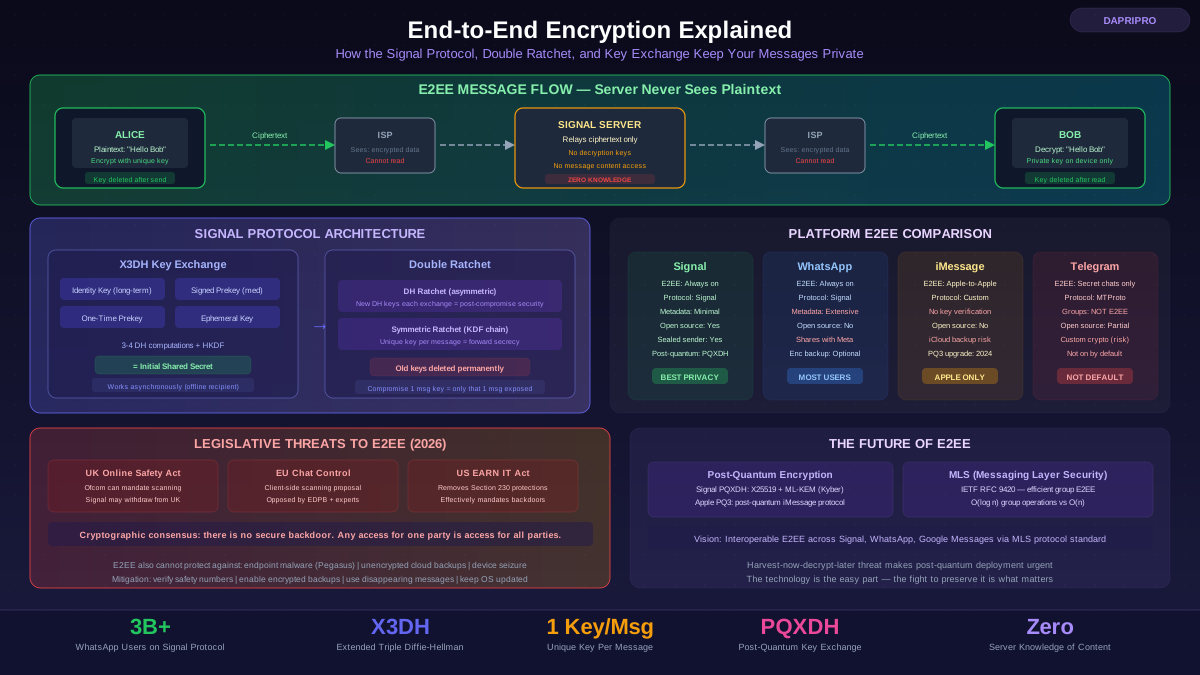
Every time you send a message on Signal, a series of cryptographic operations happens in milliseconds: your device generates a unique encryption key for that specific message, encrypts the plaintext, sends the ciphertext through Signal's server, and the server relays it to the recipient without ever being able to read it. The key used for that message is then deleted and can never be reconstructed — not by you, not by Signal, not by anyone.
That is end-to-end encryption at its core: a system where the service provider is mathematically excluded from accessing your data. In a world where data breaches expose billions of records annually and governments increasingly demand surveillance capabilities, E2EE is the last meaningful line of defense for private communication. This guide explains exactly how it works, where it succeeds, where it falls short, and why it matters more in 2026 than ever before.
What End-to-End Encryption Actually Means
End-to-end encryption is a communication system where only the communicating users can read the messages. In principle, it prevents potential eavesdroppers — including telecom providers, internet service providers, the communication service provider itself, and malicious actors — from being able to access the cryptographic keys needed to decrypt the conversation.
The critical distinction is between E2EE and transport encryption (TLS). With TLS, your message is encrypted between your device and the server, decrypted at the server for processing or storage, and then re-encrypted between the server and the recipient. The server sees the plaintext. With E2EE, your message is encrypted on your device and decrypted only on the recipient's device — the server handles only ciphertext it cannot decrypt.
This distinction matters enormously because it changes the trust model. With transport encryption, you trust the service provider not to read, sell, or leak your messages. With E2EE, you do not need to trust the service provider at all — the cryptography ensures they cannot access your messages regardless of their intentions, their security practices, or what a court order demands.
The Cryptographic Foundations of E2EE
Understanding E2EE requires understanding four cryptographic building blocks that work together.
Asymmetric encryption and key pairs
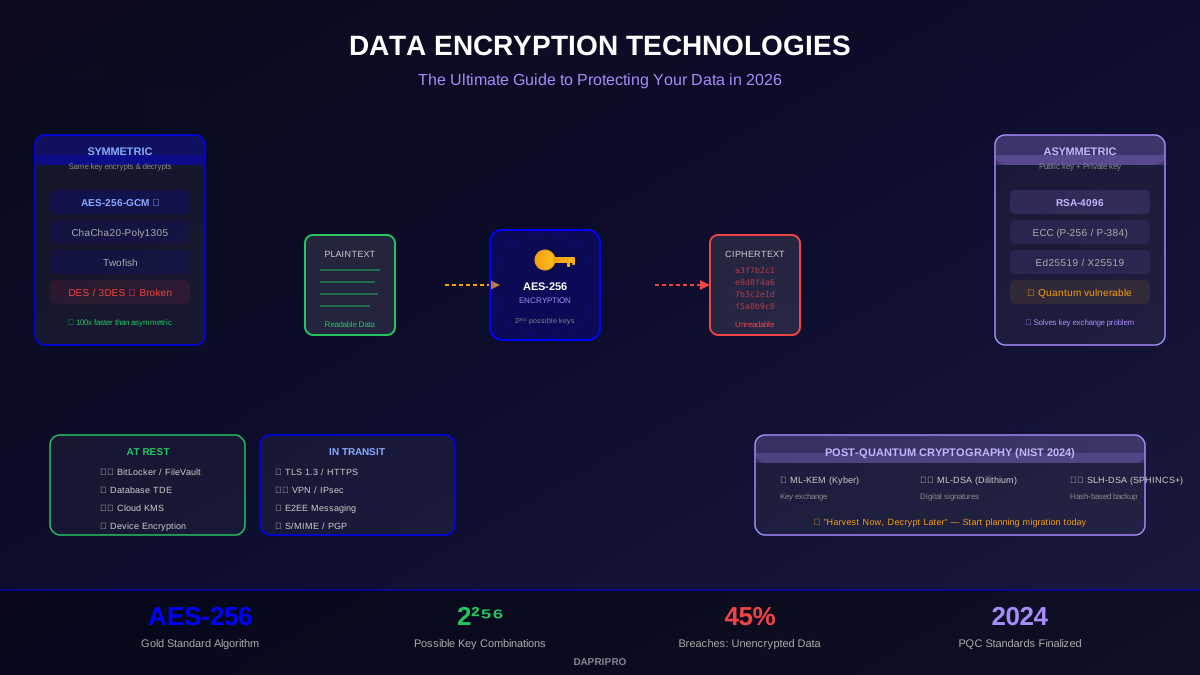
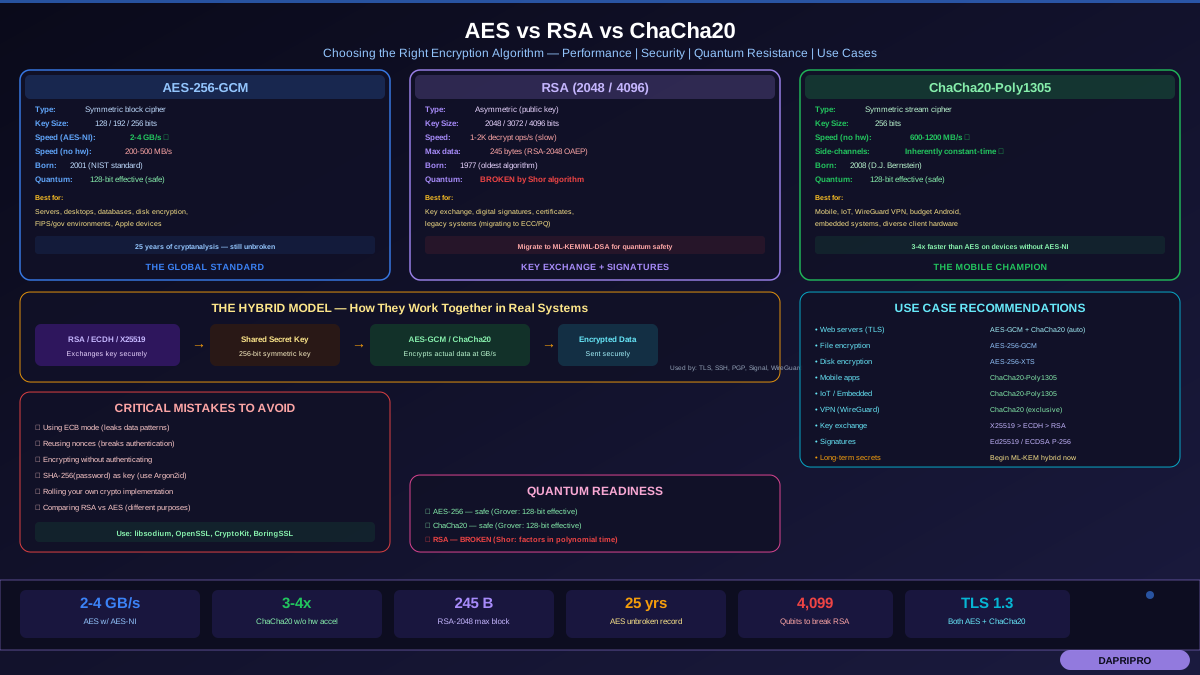
Each user generates a key pair: a public key (shared openly) and a private key (never leaves the device). Anyone can encrypt a message using your public key, but only your private key can decrypt it. This solves the fundamental problem of secure communication — you can establish a shared secret with someone you have never met before, over a completely public channel, without an eavesdropper being able to derive that secret. Modern E2EE systems use elliptic curve cryptography (specifically Curve25519) rather than RSA for key pairs, because ECC provides the same security with much smaller keys (256-bit ECC roughly equals 3072-bit RSA).
Diffie-Hellman key exchange
The Diffie-Hellman protocol allows two parties to collaboratively generate a shared secret over an insecure channel. Neither party sends the shared secret — they each contribute half the computation, and the mathematical properties of the algorithm ensure both arrive at the same secret. In E2EE messaging, Elliptic Curve Diffie-Hellman (ECDH) combines each party's private key with the other party's public key to produce a shared secret. An eavesdropper who captures both public keys cannot derive the shared secret without one of the private keys — this is the Elliptic Curve Discrete Logarithm Problem, which has no known efficient solution.
Symmetric encryption for message content
Once the shared secret is established, it is used to derive symmetric encryption keys (AES-256 or ChaCha20-Poly1305) for the actual message encryption. Symmetric encryption is orders of magnitude faster than asymmetric encryption — encrypting a message with AES-256 takes microseconds, while RSA encryption of the same data would take milliseconds and produce much larger ciphertext. This is why all practical E2EE systems use hybrid encryption: asymmetric crypto for key agreement, symmetric crypto for bulk data.
Hash-based key derivation
The raw shared secret from Diffie-Hellman is fed through a Key Derivation Function (HKDF using SHA-256) to produce the actual encryption key, authentication key, and initialization vector. KDFs add entropy mixing, ensure the output has uniform randomness (even if the input has some structure), and allow deriving multiple independent keys from one shared secret. This is particularly important in the Double Ratchet where new keys are continuously derived from previous state.
The Signal Protocol: Gold Standard of E2EE
The Signal Protocol (developed by Moxie Marlinspike and Trevor Perrin at Open Whisper Systems) is the most widely deployed E2EE protocol in the world. It is used by Signal, WhatsApp (3+ billion users), Google Messages (RCS E2EE), Facebook Messenger (default E2EE since 2023), and Skype. The protocol combines two key components: X3DH for initial key establishment and the Double Ratchet for ongoing message encryption.
X3DH: Extended Triple Diffie-Hellman
When Alice wants to start an encrypted conversation with Bob, she needs to establish a shared secret — but Bob might be offline. X3DH solves this asynchronous problem. During registration, Bob uploads a set of keys to the Signal server: his identity key (long-term), a signed prekey (medium-term, rotated periodically), and a batch of one-time prekeys (each used once). When Alice wants to message Bob, she downloads his key bundle from the server and performs three (or four) Diffie-Hellman computations using combinations of both parties identity keys, ephemeral keys, and prekeys. The results are combined through HKDF to produce the initial shared secret. The beauty of X3DH is that it provides mutual authentication (both parties' identity keys are involved), forward secrecy (the ephemeral keys ensure past sessions cannot be compromised), and works asynchronously (Bob does not need to be online).
The Double Ratchet Algorithm
After X3DH establishes the initial secret, the Double Ratchet takes over for all subsequent messages. It combines two "ratcheting" mechanisms:
Symmetric-key ratchet (sending chain): Each message key is derived from the previous one using a KDF. After encrypting a message, the previous key is deleted. This means each message uses a unique key, and compromising one key does not reveal past message keys (forward secrecy).
Diffie-Hellman ratchet: With each message exchange, new DH key pairs are generated and new DH computations are performed. This "ratchets forward" the root key, which feeds into the symmetric ratchet. This provides post-compromise security — if an attacker somehow obtains the current state of the ratchet, the next DH ratchet step generates a completely new shared secret that the attacker cannot derive, locking them out again.
The result: every single message is encrypted with a unique key, derived from an always-evolving chain of DH exchanges and KDF computations. The keys that encrypted your messages from last week do not exist on any device or server — they were deterministically derived, used once, and destroyed.
E2EE Across Messaging Platforms
Not all "encrypted" messaging platforms are created equal. The implementation details, default settings, and metadata handling vary dramatically.
Signal: the privacy benchmark
Signal is the reference implementation of the Signal Protocol, maintained by the Signal Foundation (a non-profit). E2EE is always on for all messages and calls — there is no unencrypted mode. Signal collects virtually no metadata: the only data Signal has about you is the phone number you registered with, the date you registered, and the date you last connected. When the US government served Signal with a subpoena and grand jury request in 2021, Signal could only produce those three data points — no message content, no contacts, no groups, no profile information.
Signal also implements several additional privacy features: sealed sender (hides the sender's identity from Signal's servers), disappearing messages (auto-delete after a configurable timer), screen security (prevents screenshots in the app), registration lock (prevents someone re-registering your number and receiving your messages), and relay calls through Signal servers to hide your IP address from the call recipient. Signal is open-source — both the client applications and the server code are publicly audited.
WhatsApp: signal protocol with metadata collection
WhatsApp adopted the Signal Protocol in 2016, providing E2EE for all one-on-one and group messages and calls. The encryption itself is strong — the same cryptographic guarantees as Signal. The privacy story, however, is fundamentally different. WhatsApp collects extensive metadata: your phone number, contacts, usage patterns, group memberships, status updates, profile photo, about info, device information, IP addresses, location data (if permitted), and interaction logs. This metadata is shared with Meta (Facebook's parent company) and used for targeted advertising across Meta's platforms. WhatsApp's privacy policy explicitly states that transaction data, service-related information, and interaction metadata may be shared with other Meta companies.
WhatsApp also introduced several features that create E2EE exceptions: cloud backups (iCloud/Google Drive) were historically unencrypted, meaning Google or Apple could read your message history. WhatsApp added optional encrypted backups in 2021, but it is not enabled by default. The "Report" feature sends the last 5 messages of a reported conversation to WhatsApp in plaintext. Multi-device support means messages pass through WhatsApp servers for device synchronization.
iMessage: partial E2EE with caveats
Apple's iMessage provides E2EE for messages between Apple devices. The encryption uses RSA-1280 and AES-128 in CTR mode (older than the Signal Protocol with weaker parameters — RSA-1280 is below the 2048-bit recommendation, and AES-128 provides less margin than AES-256). Apple announced a protocol upgrade called PQ3 in 2024, adding post-quantum cryptography and periodic re-keying.
iMessage has a fundamental trust problem: Apple controls the key directory. When you send an iMessage, your device fetches the recipient's public key from Apple's Identity Service (IDS). You are trusting Apple not to substitute a fake key (which would allow Apple or a government to intercept messages). Unlike Signal, iMessage has no user-accessible key verification mechanism — you cannot compare safety numbers to confirm you have the authentic key. Apple could theoretically perform a man-in-the-middle attack by distributing fake keys, and the user would have no way to detect it. Apple states it does not do this, but the system provides no cryptographic guarantee.
iCloud backups are the biggest iMessage privacy concern. If iCloud Backup is enabled (the default), your iMessage encryption keys and message history are included in the backup — and Apple has the keys to decrypt iCloud Backups. Law enforcement regularly obtains iMessage content through iCloud Backup warrants. Apple's Advanced Data Protection (ADP), launched in late 2022, finally offers E2EE for iCloud Backups including iMessage content, but it must be manually enabled and is not the default.
Telegram: not E2EE by default
Telegram is frequently described as a "secure messenger," but standard Telegram chats are not end-to-end encrypted. Regular chats use client-server encryption (TLS + MTProto), meaning Telegram's servers can read all messages in normal chats and group chats. E2EE is available only in "Secret Chats," which must be manually initiated for each conversation, only work between two users (no group support), and only work on a single device (no multi-device sync). Telegram group chats, which can have up to 200,000 members, are never end-to-end encrypted. Telegram's MTProto protocol is custom-built and has not undergone the same level of independent cryptographic review as the Signal Protocol.
The Metadata Problem: What E2EE Does Not Protect
E2EE protects message content. It does not protect metadata — and metadata can be as revealing as content. A government does not need to read your messages if it can see that you called a journalist at 2 AM, then contacted a lawyer, then called a mental health crisis line. The content of those calls is private, but the pattern tells the whole story.
Metadata that a messaging service can collect even with E2EE includes: sender and recipient identities (phone numbers, usernames), timestamps of every message, message sizes (reveals whether you sent text, photos, or videos), group membership and changes, online/typing status indicators, IP addresses (reveals location), device information and app version, frequency and duration of communications, and social graph analysis (who knows whom).
Signal addresses the metadata problem more aggressively than any other mainstream messenger. Sealed sender hides the sender's identity from Signal's servers (the server knows the recipient but not the sender). Signal does not store contact lists, group info, or communication patterns on its servers. Phone number discovery uses a privacy-preserving protocol (SGX-based private contact discovery). However, Signal still requires a phone number for registration (though this is being changed to support usernames without phone numbers), and metadata is visible at the network level to anyone monitoring your internet connection (though they cannot determine the message content or even which Signal user you are communicating with).
E2EE for Email: The Usability Failure
Email was designed in the 1970s without encryption, and bolting on E2EE has proven to be one of the hardest usability problems in security. Two standards exist: PGP/GPG (OpenPGP) and S/MIME.
PGP (Pretty Good Privacy) was created by Phil Zimmermann in 1991 and uses public key cryptography to encrypt email body content. Despite existing for over 35 years, PGP email encryption has failed catastrophically at mainstream adoption. The reasons are well-documented: key management is complex (users must generate key pairs, publish public keys to key servers or share them manually, and verify key fingerprints), there is no forward secrecy (one compromised private key decrypts all past messages encrypted with that key), key discovery is fragmented (multiple incompatible key servers, no universal directory), most email clients require plugins or extensions, encrypted emails cannot be searched on the server, and the 2018 EFAIL vulnerability demonstrated practical attacks against PGP in email contexts.
S/MIME uses X.509 certificates (the same infrastructure as TLS/HTTPS) to encrypt and sign emails. It has better email client support than PGP (built into Outlook, Apple Mail, and Thunderbird) but requires certificates from a Certificate Authority, which costs money and the CA can be compromised. S/MIME also lacks forward secrecy.
The practical alternatives are: ProtonMail (end-to-end encrypted between ProtonMail users, with password-protected messages to external recipients), Tutanota (similar model with their own encrypted format), or simply not using email for sensitive communication and using Signal instead. The security community has largely accepted that E2EE email is an unsolved problem for general use.
Threats to E2EE: Attacks and Legislation
The backdoor debate
The most significant threat to E2EE in 2026 is not cryptographic — it is legislative. Governments around the world are pushing laws that would effectively mandate weakened encryption or client-side scanning systems.
The UK Online Safety Act (passed 2023) gives Ofcom the power to require messaging platforms to implement "accredited technology" to scan for CSAM (child sexual abuse material) in E2EE messages. Signal and WhatsApp have stated they would rather withdraw from the UK than comply with such an order. As of 2026, Ofcom has not yet issued a technical notice requiring scanning, but the legal authority exists.
The EU Chat Control proposal (various iterations since 2022) would require messaging platforms to scan all messages for CSAM, including E2EE messages. The European Data Protection Board, hundreds of cryptographers, and multiple EU member states have opposed the proposal, but negotiations continue. Client-side scanning (CSS) — where scanning happens on the device before encryption — has been proposed as a "compromise," but security researchers have demonstrated that CSS fundamentally undermines E2EE by creating a scanning infrastructure that can be expanded to detect any content, not just CSAM.
The EARN IT Act (US, reintroduced in multiple Congress sessions) would remove Section 230 liability protections from platforms that do not implement "best practices" for detecting CSAM — best practices that would effectively require backdoors in E2EE. Despite bipartisan support, the bill has faced strong opposition from both civil liberties organizations and technology companies.
The cryptographic consensus on backdoors is unambiguous: there is no way to build a system that is secure against unauthorized access while providing authorized access to a third party. A backdoor that works for law enforcement also works for foreign intelligence services, criminal hackers, and anyone who discovers it. The 2020 SolarWinds attack and the 2024 Change Healthcare breach demonstrated that even well-funded organizations cannot protect encryption keys from sophisticated adversaries.
Device-level attacks
E2EE is only as strong as the devices at each end. If an attacker compromises your device with malware — particularly commercial spyware like NSO Group's Pegasus — they can read messages after decryption, before they are displayed on screen. Pegasus has been deployed against journalists, activists, and political figures worldwide and exploits zero-day vulnerabilities in iOS and Android to gain full device access. Against device-level compromise, E2EE provides no protection. Defenses include keeping your device OS updated, avoiding clicking links from unknown sources, rebooting your phone regularly (which kills many memory-resident exploits), and for high-risk individuals, using Lockdown Mode on iOS.
How to Verify E2EE Is Working
Every E2EE messaging app provides a mechanism to verify that your conversation is actually encrypted with the correct keys and not being intercepted.
Signal: Tap the contact's name in a conversation, then tap "View safety number." You will see a 60-digit number and a QR code. Compare this number with your contact by reading it aloud over a phone call, meeting in person, or using a separate messaging channel. If the numbers match, your conversation is encrypted between the correct endpoints. If the numbers change (you will see a notification in the chat), it means your contact re-registered or got a new device — verify the new safety number before continuing sensitive conversations.
WhatsApp: Tap the contact's name, then "Encryption." You will see a 60-digit security code and QR code. The verification process is the same as Signal. WhatsApp also supports Key Transparency (rolled out in 2023), which uses an auditable key directory to make server-based key substitution attacks detectable (though not impossible).
iMessage: As of 2026, Apple does not provide a user-accessible key verification mechanism for standard iMessage. Apple's Contact Key Verification (announced in 2022, rolled out in iOS 17.2) provides automatic alerts if Apple's key directory is compromised, but it does not allow manual comparison of key fingerprints the way Signal and WhatsApp do. This remains a significant gap in iMessage's security model.
The Future of E2EE: Post-Quantum and MLS
Post-quantum E2EE: Current E2EE protocols rely on ECDH for key exchange, which will be broken by sufficiently powerful quantum computers running Shor's algorithm. Signal added PQXDH (Post-Quantum Extended Diffie-Hellman) in 2023, combining X25519 with CRYSTALS-Kyber (now ML-KEM) for quantum-resistant key exchange. Apple's PQ3 protocol for iMessage adds similar protections. The "harvest now, decrypt later" threat — adversaries recording encrypted communications today to decrypt them when quantum computers become available — makes post-quantum E2EE deployment urgent, even though large-scale quantum computers may be 10-15 years away.
Messaging Layer Security (MLS): Group chats are a weak point in E2EE because the Signal Protocol does not scale efficiently to large groups (each message must be encrypted separately for each member). MLS is an IETF protocol (RFC 9420, published 2023) designed for efficient E2EE in large groups and across platforms. Instead of pairwise encryption, MLS uses a tree structure where adding/removing group members requires only O(log n) operations instead of O(n). Cisco Webex, Google, and several other providers are implementing MLS. The long-term vision is interoperable E2EE — where you could send an E2EE message from Signal to WhatsApp to Google Messages — but significant challenges remain around identity, key management, and feature parity.
The direction of E2EE in 2026 is clear: stronger cryptography (post-quantum), better group scaling (MLS), reduced metadata exposure (sealed sender, anonymous credentials), and intense political pressure to weaken it. The technology is the easy part — the fight to preserve it is what matters.