
Every piece of software ships with flaws. Most vulnerabilities follow a predictable lifecycle: the vendor discovers or is notified of the issue, develops a patch, releases an update, and organizations deploy the fix. Zero-day vulnerabilities break this model entirely. The vendor does not know the flaw exists. There is no patch. There is no advisory. The first indication of the vulnerability may be active exploitation against your infrastructure.
The term "zero-day" refers to the number of days the vendor has had to fix the problem: zero. From the defender's perspective, this creates a window of exposure that cannot be closed through conventional patching. From an attacker's perspective, zero-days represent the most valuable offensive capability available, commanding prices from tens of thousands to millions of dollars depending on the target software and exploitation impact.
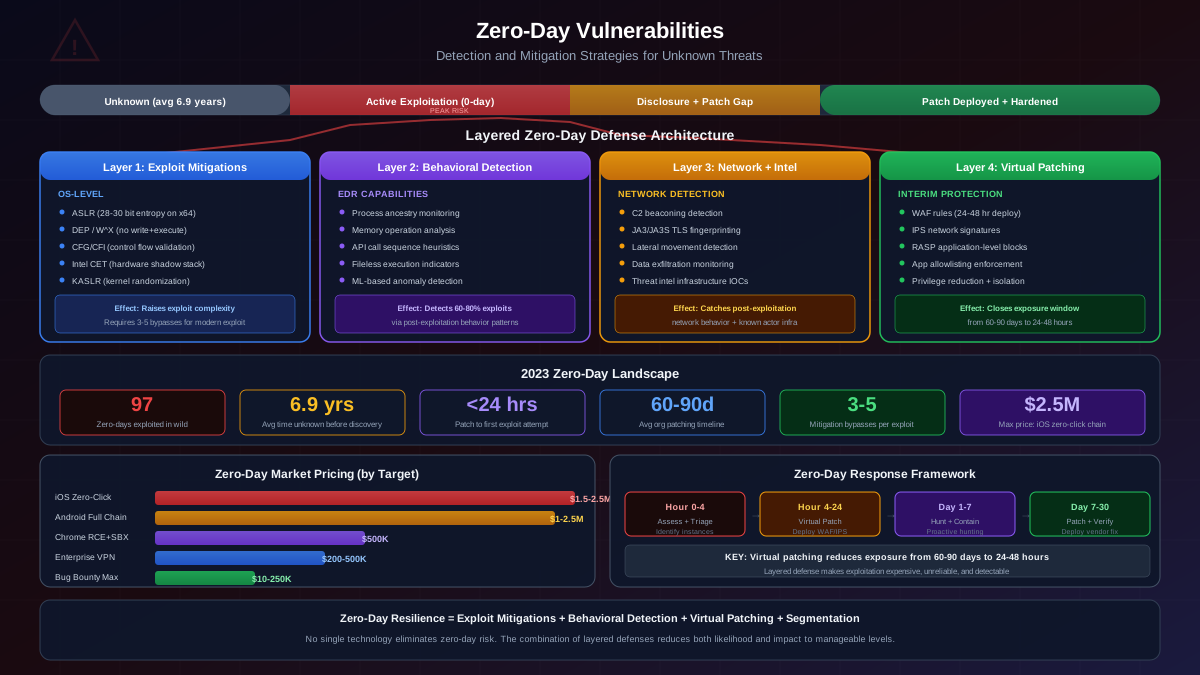
In 2023, researchers tracked 97 zero-day vulnerabilities exploited in the wild, continuing an upward trend driven by the proliferation of commercial spyware vendors, the expansion of cybercriminal zero-day capabilities, and the growing attack surface of cloud, mobile, and IoT platforms. This guide examines the complete zero-day problem: the lifecycle from vulnerability to exploit to detection, practical detection strategies that work without signatures, mitigation technologies that reduce exploitation success even against unknown vulnerabilities, and organizational response frameworks for when zero-days inevitably affect your environment.
The Zero-Day Lifecycle: From Discovery to Patch
Understanding the zero-day lifecycle reveals why these vulnerabilities are uniquely dangerous and where defensive investments provide the most value.
Phase 1: Vulnerability Existence (Unknown Period)
Every zero-day begins as an unknown vulnerability in production software. Research from the RAND Corporation found that the average zero-day vulnerability persists for 6.9 years before independent discovery. During this period, anyone who discovers the flaw holds asymmetric advantage. The vulnerability exists in potentially millions of deployed instances, completely unprotected because no one knows protection is needed.
Vulnerabilities in this phase may be discovered by:
- Security researchers who audit source code, fuzz software inputs, or reverse-engineer binaries. Responsible researchers report findings to vendors, starting the clock toward a patch.
- Government intelligence agencies that invest heavily in vulnerability research for offensive cyber operations. NSA, GCHQ, Unit 8200, and their counterparts maintain classified vulnerability stockpiles.
- Commercial exploit brokers such as NSO Group, Zerodium, and Crowdfense that purchase vulnerability research and develop exploitation capabilities for sale to government clients.
- Cybercriminal groups that increasingly fund vulnerability research internally or purchase zero-days from dark web markets. Ransomware operators have demonstrated zero-day capabilities against enterprise software like MOVEit, Accellion FTA, and Kaseya VSA.
Phase 2: Exploitation (Zero-Day Active)
Once a zero-day vulnerability has a working exploit, the exploitation phase begins. This is the most dangerous period for defenders. The attacker has a reliable attack method. The vendor has no knowledge of the vulnerability. There are no patches, no signatures, no IOCs for conventional detection tools to match.
Zero-day exploitation patterns fall into two categories:
Targeted exploitation involves nation-state actors and advanced persistent threats using zero-days against specific high-value targets. These operations are stealthy, limited in scope (often fewer than 100 targets), and designed to avoid detection that would burn the zero-day capability. The Pegasus spyware used by NSO Group clients exemplifies this pattern, deploying iOS zero-day chains against individual journalists, activists, and government officials.
Mass exploitation involves threat actors using zero-days for broad campaigns. This is increasingly common as cybercriminal groups gain zero-day capabilities. The MOVEit Transfer zero-day (CVE-2023-34362) was exploited by the Cl0p ransomware group against thousands of organizations simultaneously. Mass exploitation burns the zero-day rapidly (it gets detected and patched quickly) but extracts maximum value through volume.
Phase 3: Discovery and Disclosure
Zero-day exploitation is eventually detected through behavioral anomalies, incident response investigations, or independent researcher discovery. The window between exploitation start and detection varies dramatically: targeted operations may remain undetected for months or years, while mass exploitation campaigns typically trigger detection within days to weeks.
Once discovered, the vulnerability enters coordinated disclosure:
- The discoverer (researcher, IR team, threat intelligence vendor) reports to the software vendor
- The vendor develops and tests a patch (typically 30-90 days for complex vulnerabilities)
- A CVE identifier is assigned and an advisory is published
- The patch is released publicly
Phase 4: Patch Gap (N-Day Exploitation)
After public disclosure, the vulnerability transitions from zero-day to "n-day" (n days since disclosure). Paradoxically, this is when exploitation volume spikes. The disclosure provides all attackers with vulnerability details. Within hours of patch release, skilled attackers reverse-engineer the patch to understand the vulnerability and develop exploits. Organizations that cannot patch immediately face a surge of exploitation attempts using publicly-available exploit code.
Research shows that the median time from patch release to first exploitation attempt has compressed to under 24 hours for critical vulnerabilities. Yet the average organizational patching timeline remains 60-90 days. This gap creates a 60-90 day window where organizations know they are vulnerable, patches exist, but deployment takes weeks or months.
Detection Without Signatures: Finding Zero-Day Exploitation
Conventional signature-based detection is useless against zero-days by definition. There is no known signature to match. Detection must rely on behavioral patterns, anomaly detection, and heuristic analysis that identify exploitation indicators regardless of the specific vulnerability being exploited.
Behavioral Analysis and EDR
Modern endpoint detection and response (EDR) platforms detect zero-day exploitation through behavioral indicators that are common across exploitation techniques, regardless of the specific vulnerability:
- Process ancestry anomalies — Exploitation often creates unexpected parent-child process relationships. A browser spawning PowerShell. A PDF reader creating cmd.exe. An office application launching regsvr32. These relationships are abnormal regardless of the specific vulnerability, and behavioral rules can detect them without knowing the exploit details.
- Memory operation monitoring — Exploits manipulate memory in characteristic ways: heap spraying to control memory layout, ROP chain execution to bypass DEP, stack pivoting to hijack execution flow. EDR agents that monitor memory operations can detect these manipulation patterns even for novel exploits.
- API call sequence analysis — Exploitation typically follows recognizable API call patterns even when the exploit code is novel. Calls to VirtualAlloc followed by WriteProcessMemory followed by CreateRemoteThread indicate process injection regardless of the zero-day used to achieve code execution.
- Fileless execution indicators — Many zero-day exploits use fileless techniques to evade file-scanning antivirus. Monitoring for script interpreters loading from unusual locations, .NET assembly loading from memory, or WMI/COM object abuse catches these techniques independent of the specific vulnerability.
Network Traffic Analysis
Zero-day exploitation generates network anomalies that network detection tools can identify:
Command and control beaconing — After successful exploitation, implants communicate with attacker infrastructure. Network detection tools using JA3/JA3S fingerprinting, DNS analysis, and traffic pattern analysis can identify C2 communications even when the initial exploitation was a zero-day. The exploitation method is invisible, but the post-exploitation network behavior is detectable.
Data exfiltration patterns — Zero-day exploitation is a means to an end. When the end is data theft, network monitoring for unusual data volumes, connections to unrecognized external hosts, DNS tunneling, or HTTPS traffic to recently-registered domains can catch the exfiltration phase of an attack that began with zero-day exploitation.
Lateral movement indicators — After gaining initial access through a zero-day, attackers move laterally using standard techniques (pass-the-hash, Kerberoasting, SMB exploitation). Network monitoring for anomalous authentication patterns, unusual service account usage, and unexpected inter-segment communication catches the lateral movement phase.
Threat Intelligence Integration
While signature-based detection fails for unknown zero-days, threat intelligence provides valuable context for detection and response:
- Infrastructure indicators — Threat actors reuse infrastructure across campaigns. A zero-day exploit may be delivered from a domain or IP address previously associated with the threat actor through other operations. Threat intelligence feeds that track actor infrastructure help identify zero-day campaigns through their delivery infrastructure.
- Targeting intelligence — Understanding which threat actors target your industry and which software they have historically exploited helps focus monitoring. If a nation-state group targeting your sector has historically used browser zero-days, intense monitoring of browser process behavior on high-value endpoints is warranted.
- Zero-day advisories — When vendors issue emergency advisories for actively-exploited zero-days, threat intelligence services distribute detection guidance (behavioral indicators, network signatures, file artifacts) within hours. Rapid integration of these emergency indicators is critical during the patch gap.
Exploit Mitigation Technologies
Exploit mitigations are defensive technologies built into operating systems, compilers, and hardware that make exploitation harder even when a vulnerability exists. They do not fix vulnerabilities; they raise the cost and complexity of exploitation.
Operating System Mitigations
Address Space Layout Randomization (ASLR) randomizes the memory addresses where system libraries, the stack, and the heap are loaded. Without ASLR, attackers know exactly where code and data reside in memory, making exploitation straightforward. With ASLR, exploits must first leak a memory address to defeat the randomization before proceeding with exploitation. Modern implementations provide 28-30 bits of entropy on 64-bit systems, making brute-force infeasible for remote exploits.
Data Execution Prevention (DEP / W^X) enforces a simple policy: memory pages can be either writable or executable, but not both simultaneously. This prevents the classic exploitation technique of injecting shellcode into a data buffer and executing it. Attackers adapted with Return-Oriented Programming (ROP), which chains together small code snippets already in executable memory. DEP did not eliminate exploitation but forced attackers to develop more complex, less reliable techniques.
Control Flow Guard (CFG) and Control Flow Integrity (CFI) validate that indirect function calls transfer control to legitimate function entry points. This mitigates ROP attacks by preventing the hijacked control flow that ROP relies on. CFG (Microsoft's implementation) and CFI (Clang/LLVM's implementation) add 1-5% performance overhead but significantly constrain exploitation options.
Intel Control-flow Enforcement Technology (CET) provides hardware-level protection against ROP and Jump-Oriented Programming (JOP) through a shadow stack that validates return addresses and indirect branch tracking that validates jump targets. CET operates at the CPU level, making it much harder to bypass than software-only mitigations.
Kernel Address Space Layout Randomization (KASLR) extends ASLR to the kernel itself, randomizing where kernel code loads on each boot. This complicates kernel exploitation because attackers must first leak a kernel address before targeting kernel vulnerabilities.
Application-Level Protections
Sandboxing restricts what an exploited application can access. Chrome's multi-process sandbox isolates each tab in a restricted process that cannot access the file system, other processes, or network sockets directly. Exploiting a rendering vulnerability gives the attacker control of the sandboxed process, but escaping the sandbox requires a second vulnerability. This raises the cost of browser exploitation from one zero-day to a zero-day chain of two or more vulnerabilities.
JIT hardening protects Just-In-Time compiled code (used in JavaScript engines, .NET, and Java) from exploitation. JIT compilers create executable code at runtime, providing attackers with a writable-then-executable memory region. Mitigations include W^X policy enforcement during JIT compilation, constant blinding (XORing immediate values to prevent controlled data in JIT output), and guard pages around JIT code regions.
The Mitigation Stack Effect
Individual mitigations are bypassable. ASLR can be defeated with an information leak. DEP is bypassed with ROP. CFG has known bypass techniques. The defensive value comes from stacking multiple mitigations so that exploiting a single vulnerability requires chaining bypasses for each layer. A successful exploit against a fully-mitigated modern system might need to: defeat ASLR through an information leak, construct a ROP chain to bypass DEP, find a CFG bypass to redirect control flow, and escape a sandbox through a second vulnerability. This chain complexity makes zero-day exploitation expensive, unreliable, and fragile.
Virtual Patching and Interim Mitigation
When a zero-day is disclosed but no vendor patch exists, or when deployment of a vendor patch requires weeks of testing, virtual patching provides interim protection by blocking the exploitation vector at a layer outside the vulnerable application.
Web Application Firewall (WAF) Rules
WAFs operating at the HTTP layer can block exploitation attempts targeting web application zero-days. When a zero-day in a web framework is disclosed, WAF vendors typically release protective rules within 24-48 hours that identify and block the specific HTTP request patterns that trigger the vulnerability. This does not fix the code, but it prevents the exploitation vector from reaching the vulnerable code path.
Effective WAF-based virtual patching requires understanding the vulnerability's exploitation mechanics. A WAF rule for a SQL injection zero-day blocks different patterns than a rule for a deserialization zero-day. Rule creation based solely on the CVE description without understanding the exploit mechanics leads to bypasses.
Intrusion Prevention System (IPS) Signatures
Network-level IPS can deploy signatures for zero-days that are exploited over network protocols. Buffer overflow vulnerabilities in network services, protocol parsing flaws, and similar network-accessible vulnerabilities can be detected and blocked by IPS signatures that identify the exploitation traffic pattern. Like WAF rules, IPS signatures for zero-days are interim measures deployed within hours while waiting for vendor patches.
Runtime Application Self-Protection (RASP)
RASP agents instrumented within the application runtime can detect and block exploitation at the point of attack. Unlike WAFs that operate at the network perimeter, RASP has visibility into the application's internal execution, allowing it to detect exploitation patterns like malicious SQL query construction, command injection through dangerous API calls, or unauthorized file system access, regardless of how the malicious input bypassed perimeter controls.
Compensating Controls
When direct virtual patching is not feasible, compensating controls reduce the exploitation impact:
- Network segmentation — Isolate vulnerable systems into restricted network segments. Even if the zero-day is exploited, the attacker's lateral movement is constrained by segmentation boundaries.
- Privilege reduction — Run vulnerable applications with minimum required privileges. A zero-day exploited in a service running as Local System provides kernel-level access. The same zero-day in a service running with a restricted service account provides limited access.
- Application allowlisting — Restrict which executables can run on critical systems. Even after successful zero-day exploitation, the attacker cannot execute arbitrary binaries if application allowlisting blocks unsigned or unapproved executables.
- Enhanced monitoring — Deploy additional detection rules focused on the vulnerable system. Increase logging verbosity. Add behavioral monitoring for exploitation indicators specific to the vulnerability class. This does not prevent exploitation but accelerates detection and response.
The Zero-Day Market: Understanding the Economics
Understanding who buys and sells zero-days, and at what prices, helps defenders understand which assets face the highest risk of zero-day exploitation and calibrate defensive investment accordingly.
Market Tiers
The zero-day market operates at three distinct tiers:
Tier 1: Government and intelligence agencies (highest prices) — Direct procurement from vulnerability researchers or through commercial exploit brokers. Prices for full-chain mobile exploits (iOS zero-click, Android zero-click) reach $1.5-2.5 million. Browser exploitation chains command $500K-1M. Enterprise software zero-days (Exchange, VPN appliances) range from $200K-500K. These customers value stealth and exclusivity, paying premiums for vulnerabilities restricted to single-customer use.
Tier 2: Commercial exploit brokers (mid-tier prices) — Companies like Zerodium publicly advertise acquisition prices. Their published price list provides a useful reference for understanding which software targets are most valuable to attackers. iOS full chain: up to $2M. Android full chain: up to $2.5M. Chrome RCE + sandbox escape: up to $500K. These brokers aggregate exploits from multiple researchers and sell to multiple government clients.
Tier 3: Bug bounty programs (lowest legitimate prices) — Vendor-operated and platform-operated bug bounty programs pay $10K-250K for critical vulnerabilities. Apple Security Bounty pays up to $2M for iOS kernel zero-click exploits. Google Chrome pays up to $250K for full chain exploits. Microsoft pays up to $200K for Hyper-V guest-to-host escapes. Bug bounty pricing has increased dramatically to compete with exploit broker pricing, though a gap remains for the most valuable vulnerability classes.
Implications for Defenders
Market pricing reveals attacker priorities. The highest prices target:
- Mobile platforms (iOS, Android) — Maximum zero-day investment targets mobile devices because they contain the most valuable intelligence (communications, location, contacts, credentials) and because mobile exploitation is technically challenging (hardened kernels, mandatory sandboxing, hardware security).
- Browsers (Chrome, Safari, Firefox) — Browser zero-days provide initial access from a single click or even zero-click (via malicious ads or compromised websites). Browser exploitation is a primary vector for both targeted espionage and mass campaigns.
- Enterprise perimeter devices (VPN appliances, firewalls, email gateways) — These assets sit at the network boundary, are Internet-facing, and run with high privileges. Zero-days in these devices provide direct network access bypassing perimeter controls.
- Server software (Exchange, SharePoint, collaboration tools) — Server zero-days provide access to centralized data stores and often run with elevated privileges in trusted network zones.
Organizations whose critical assets align with the highest-priced zero-day targets should invest more heavily in behavioral detection, exploit mitigation assurance, and network segmentation than organizations whose assets are lower on the pricing hierarchy.
Organizational Response Framework for Zero-Day Events
When a zero-day affecting your environment is disclosed, the response must be faster and more coordinated than standard vulnerability management processes. The following framework provides a structured approach:
Hour 0-4: Assessment and Triage
- Determine whether the affected software exists in your environment and identify all instances
- Assess whether exploitation is occurring in the wild (check vendor advisory, CISA KEV catalog, threat intelligence feeds)
- Determine exposure: Is the vulnerable component Internet-facing? Does it process untrusted input? Is it in a protected network segment?
- Activate the zero-day response team: vulnerability management lead, SOC analysts, affected system owners, communications (if customer-facing systems are affected)
Hour 4-24: Immediate Mitigation
- Deploy virtual patches (WAF rules, IPS signatures) for Internet-facing vulnerable systems
- Implement compensating controls for systems that cannot be virtually patched: restrict network access, disable vulnerable features, increase monitoring
- Search for indicators of compromise using available IOCs from the vendor advisory or threat intelligence
- Brief executive leadership on the risk, current mitigations, and planned remediation timeline
Day 1-7: Containment and Hunting
- Conduct proactive threat hunting focused on exploitation indicators specific to the zero-day vulnerability class
- Expand monitoring scope to include assets adjacent to vulnerable systems
- Validate that virtual patches and compensating controls are functioning as expected
- Coordinate with the vendor on patch development timeline and pre-release testing opportunities
Day 7-30: Remediation
- Deploy vendor patch through emergency change management (bypassing standard change windows for Critical zero-days)
- Validate patch deployment across all affected instances
- Remove virtual patches and compensating controls after confirming vendor patch effectiveness
- Conduct post-incident review: assess detection effectiveness, response time, communication quality, and identify improvement opportunities
Building Long-Term Zero-Day Resilience
Individual zero-day events are inevitable. Organizational resilience is built through sustained investment in multiple defensive layers:
Attack Surface Reduction
Every piece of software in your environment is a potential zero-day target. Reduce the attack surface by removing software that is not business-essential, disabling features and services that are not actively used, replacing end-of-life software that no longer receives security patches, and consolidating redundant tools that expand the vulnerability footprint without adding capability.
Defense-in-Depth Architecture
Design your architecture to limit the impact of any single compromised component. Network segmentation prevents lateral movement. Application sandboxing contains exploitation. Least-privilege access limits what a compromised account can reach. Multi-factor authentication prevents credential-based pivoting even after initial exploitation. No single zero-day should give an attacker unrestricted access to your entire environment.
Detection Maturity
Invest in detection capabilities that work without prior vulnerability knowledge. Behavioral EDR on all endpoints. Network detection and response for east-west traffic. User and entity behavior analytics (UEBA) for anomalous access patterns. These capabilities detect zero-day exploitation through its effects (abnormal behavior, unusual network patterns, unexpected system changes) rather than through knowledge of the specific vulnerability.
Response Readiness
Maintain a documented zero-day response procedure that the team has practiced. Conduct tabletop exercises simulating zero-day scenarios in your critical software. Ensure virtual patching capability is operational and tested, not theoretical. Have pre-approved emergency change management procedures that allow rapid deployment without the overhead of standard change windows. The difference between a well-handled zero-day event and a catastrophic one is usually response speed, and response speed depends on preparation.
Zero-day vulnerabilities will remain a persistent challenge as software complexity grows and the economics of vulnerability research continue to attract both defensive and offensive investment. The organizations that weather zero-day events gracefully are those that built layered defenses before the event, maintained detection capabilities that work without signatures, and rehearsed response procedures until they became operational reflex. No single technology eliminates zero-day risk, but the combination of exploit mitigations, behavioral detection, virtual patching capability, and architectural resilience reduces both the likelihood and the impact of zero-day exploitation to manageable levels.