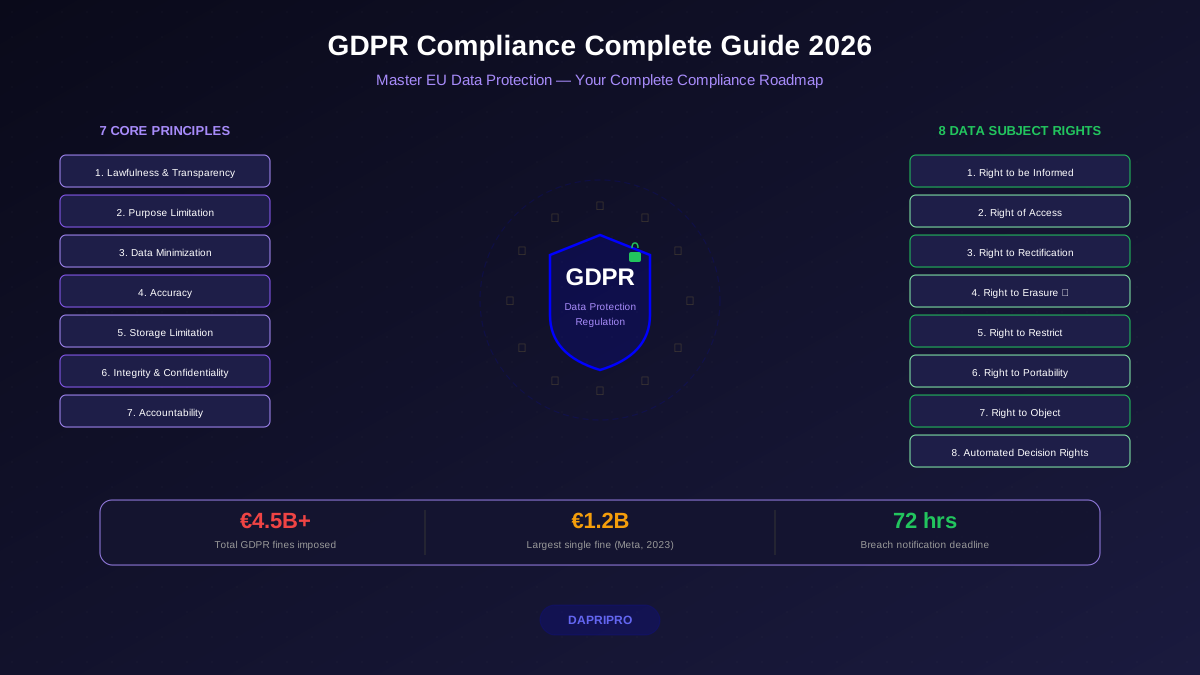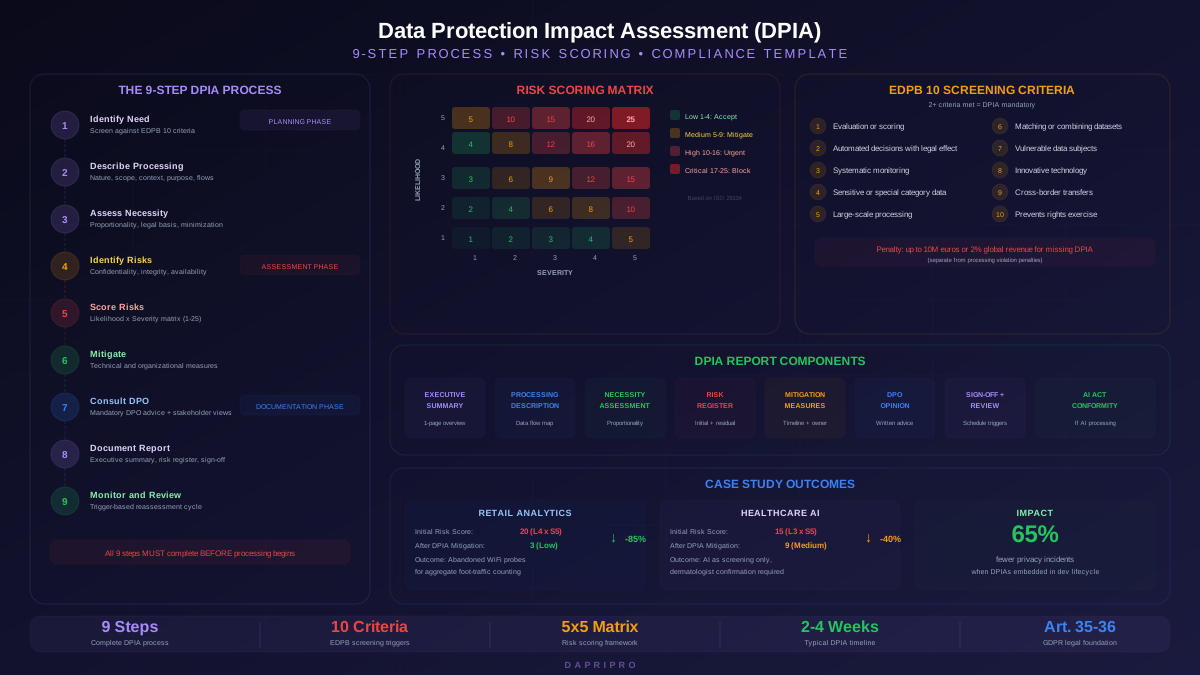

The General Data Protection Regulation has been enforceable since May 2018. In the first two years, enforcement was cautious — Data Protection Authorities (DPAs) across Europe focused on guidance, warnings, and establishing precedent. That phase is over. Since 2022, GDPR enforcement has accelerated dramatically, with fines growing in both frequency and magnitude.
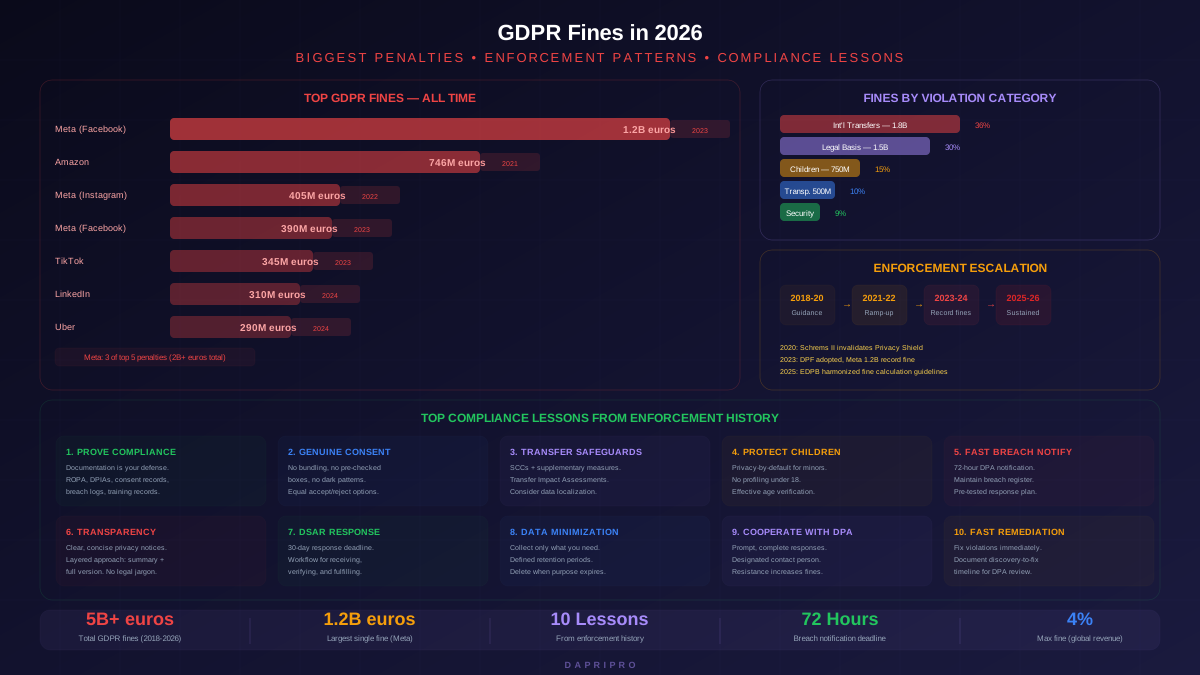
By early 2026, cumulative GDPR fines exceeded 5 billion euros. The ten largest fines alone account for over 4 billion euros of that total, with Meta receiving three of the top five penalties. But the enforcement landscape extends far beyond Big Tech — small businesses, healthcare providers, municipalities, and even individual data controllers have been fined for violations ranging from unlawful surveillance to inadequate breach notification.
This analysis covers the largest GDPR fines issued through 2026, the enforcement patterns that predict which violations trigger the biggest penalties, and the practical compliance lessons every organization should extract from these cases.
The Largest GDPR Fines Through 2026
| Rank | Organization | Amount | DPA | Year | Primary Violation |
|---|---|---|---|---|---|
| 1 | Meta (Facebook) | 1.2 billion euros | Ireland DPC | 2023 | International data transfers to the US without adequate safeguards (Schrems II) |
| 2 | Amazon | 746 million euros | Luxembourg CNPD | 2021 | Non-compliant advertising targeting system, insufficient consent mechanisms |
| 3 | Meta (Instagram) | 405 million euros | Ireland DPC | 2022 | Processing children's data, making teens' profiles and contact info public by default |
| 4 | Meta (Facebook) | 390 million euros | Ireland DPC | 2023 | Forcing consent for personalized advertising as condition of service (invalid legal basis) |
| 5 | Meta (WhatsApp) | 225 million euros | Ireland DPC | 2021 | Transparency failures — inadequate privacy notices about data sharing with Facebook |
| 6 | Clearview AI | 20 million euros | Multiple (Italy, France, Greece, UK) | 2022 | Scraping facial images without consent or legal basis, biometric data processing |
| 7 | TikTok | 345 million euros | Ireland DPC | 2023 | Processing children's data, platform design that coerced children into privacy-harmful settings |
| 8 | Criteo | 40 million euros | France CNIL | 2023 | Ad tracking without valid consent, failure to demonstrate consent was freely given |
| 9 | Uber | 290 million euros | Netherlands AP | 2024 | Transferring EU driver data to US without adequate safeguards post-Schrems II |
| 10 | 310 million euros | Ireland DPC | 2024 | Behavioral analysis and targeted advertising without valid consent |
Enforcement Patterns: What Triggers the Biggest Fines
Analyzing the full history of GDPR fines reveals clear patterns in how DPAs calculate penalties. Understanding these patterns is essential for prioritizing compliance investments.
The Three Factors That Amplify Fine Amounts
| Amplifying Factor | How It Increases the Fine | Examples |
|---|---|---|
| Scale of affected data subjects | Fines scale with the number of people affected. A violation affecting millions of users triggers a proportionally larger penalty than one affecting thousands | Meta fines involved hundreds of millions of EU users. Criteo's fine was amplified by the scale of ad tracking across millions of devices. |
| Duration of the violation | Ongoing violations that persist after warnings or regulatory guidance receive significantly higher fines than one-time incidents quickly remediated | Meta continued EU-US data transfers for years after Schrems II invalidated the legal basis, despite knowing the transfer mechanism was inadequate. |
| Failure to cooperate with the DPA | Organizations that delay responses, provide incomplete information, or challenge DPA authority during investigations face higher penalties | Several fines have been explicitly increased in DPA decisions citing lack of cooperation during the investigation process. |
The Three Factors That Reduce Fine Amounts
| Mitigating Factor | How It Reduces the Fine | Practical Application |
|---|---|---|
| Quick remediation | Organizations that fix the violation promptly after discovery (before or during the investigation) receive lower fines | Document your remediation timeline. Show the DPA exactly when you identified the issue, what you changed, and when the fix was deployed. |
| Proactive notification | Self-reporting violations and data breaches voluntarily (especially before the DPA discovers them) is viewed favorably | Report breaches within the 72-hour window. If you discover a compliance gap, consider proactively engaging with your DPA before they find it. |
| Demonstrated accountability | Organizations that can show comprehensive compliance programs (DPO, training records, DPIAs, processing records) receive lower fines even when violations occur | Maintain complete compliance documentation. The difference between a 100,000 euro fine and a 500,000 euro fine is often the existence (or absence) of documented compliance efforts. |
International Data Transfers: The Highest-Risk Category
International data transfers — particularly EU-to-US transfers — have generated the largest individual GDPR fines. The core issue stems from the 2020 Schrems II ruling by the Court of Justice of the European Union (CJEU), which invalidated the EU-US Privacy Shield framework because US surveillance laws (FISA Section 702, Executive Order 12333) do not provide adequate protection for EU citizens' data.
After Schrems II, organizations had to rely on Standard Contractual Clauses (SCCs) supplemented by additional technical safeguards (encryption, pseudonymization) to transfer data to the US. Many organizations continued transfers without implementing adequate supplementary measures — and DPAs began issuing fines.
The EU-US Data Privacy Framework (DPF), adopted in July 2023, created a new legal basis for EU-US transfers. Organizations self-certify under the DPF with the US Department of Commerce. However, privacy advocacy groups have already challenged the DPF before the CJEU (the expected "Schrems III" case), and many compliance professionals treat the DPF as a temporary solution rather than a permanent fix.
Transfer Compliance Strategies
| Strategy | Reliability | Implementation |
|---|---|---|
| EU-US Data Privacy Framework | Moderate risk — may be invalidated by CJEU in a future ruling | Self-certify with the US Department of Commerce. Implement the required privacy principles. Monitor CJEU proceedings for Schrems III developments. |
| SCCs with supplementary measures | Strong — explicitly endorsed by the EDPB | Execute updated SCCs (June 2021 version). Conduct Transfer Impact Assessments (TIAs). Implement encryption where the EU data exporter holds the keys. |
| Data localization | Strongest — eliminates transfer risk entirely | Process and store EU data within the EU/EEA. Use EU-region cloud infrastructure. More expensive but removes regulatory uncertainty. |
| Binding Corporate Rules (BCRs) | Strong — approved by DPAs, but approval takes 12-18 months | Develop comprehensive BCRs covering all intra-group transfers. Submit for DPA approval. Suitable for large multinationals with significant EU-to-non-EU data flows. |
Consent and Legal Basis Violations
The second largest category of GDPR fines relates to processing personal data without a valid legal basis — most commonly, consent failures. GDPR requires that consent be freely given, specific, informed, and unambiguous (Article 7). Many organizations fail one or more of these requirements.
Common Consent Failures That Trigger Fines
- Bundled consent — requiring users to consent to advertising tracking as a condition of using a service (Meta's 390 million euro fine). GDPR requires that consent be separable from service terms.
- Pre-checked boxes — consent checkboxes that are checked by default do not constitute valid consent. Users must take affirmative action to consent.
- Dark patterns — making it visually harder to decline consent than to accept it (larger "Accept All" buttons, hidden reject options). CNIL has specifically called out cookie consent dark patterns.
- No granularity — offering only "Accept All" without the ability to consent to specific purposes separately (analytics vs. advertising vs. functional).
- Inability to demonstrate consent — organizations that cannot produce timestamped records proving when and how each user consented. Under accountability, the burden of proof falls on the data controller.
Children's Data: A Growing Enforcement Priority
DPAs have increasingly focused on how platforms process children's data. Meta's 405 million euro fine (Instagram making teen profiles public by default) and TikTok's 345 million euro fine (design choices that pressured children into privacy-harmful settings) signal that children's data protection is a top enforcement priority.
Under GDPR Article 8, processing children's personal data based on consent requires parental consent for children under 16 (member states can lower this to 13). Platforms must make "reasonable efforts" to verify that consent is given by the parent or guardian. In practice, most platforms' age verification mechanisms are trivially circumvented, and DPAs are penalizing platforms for this.
Key requirements for organizations processing children's data:
| Requirement | What It Means in Practice |
|---|---|
| Age-appropriate design | Default settings must protect children's privacy. Profiles must be private by default. Location sharing must be off by default. Direct messaging from strangers must be restricted. |
| Effective age verification | Self-declared age (date of birth fields) is not sufficient for high-risk processing. Consider third-party age estimation (facial analysis, ID verification) for services that involve profiling or advertising. |
| Minimized data collection | Collect only the data strictly necessary for the service. Do not profile children for advertising purposes. Do not use children's data for algorithmic recommendation that maximizes engagement. |
| Clear, child-friendly notices | Privacy notices aimed at children must use language and format appropriate for the age group. A 20-page legal document written for adults does not constitute adequate notice for a 13-year-old user. |
Small and Medium Business Fines: Nobody Is Exempt
The public perception that GDPR enforcement only targets Big Tech is incorrect. DPAs across Europe regularly fine small and medium businesses. Spain's AEPD alone issues hundreds of fines per year against small organizations, many for violations that could have been avoided with basic compliance measures.
Common SMB Violations and Fine Ranges
| Violation | Typical Fine Range | Prevention |
|---|---|---|
| Unlawful CCTV surveillance (recording public areas, employees without notice, or neighbors) | 1,000 to 50,000 euros | Post visible signs. Limit recording to your premises. Conduct a DPIA if recording employees. Define retention period (typically 30 days maximum). |
| Sending marketing emails without consent | 5,000 to 100,000 euros | Implement double opt-in. Maintain consent records. Honor unsubscribe requests within 48 hours. Never purchase email lists. |
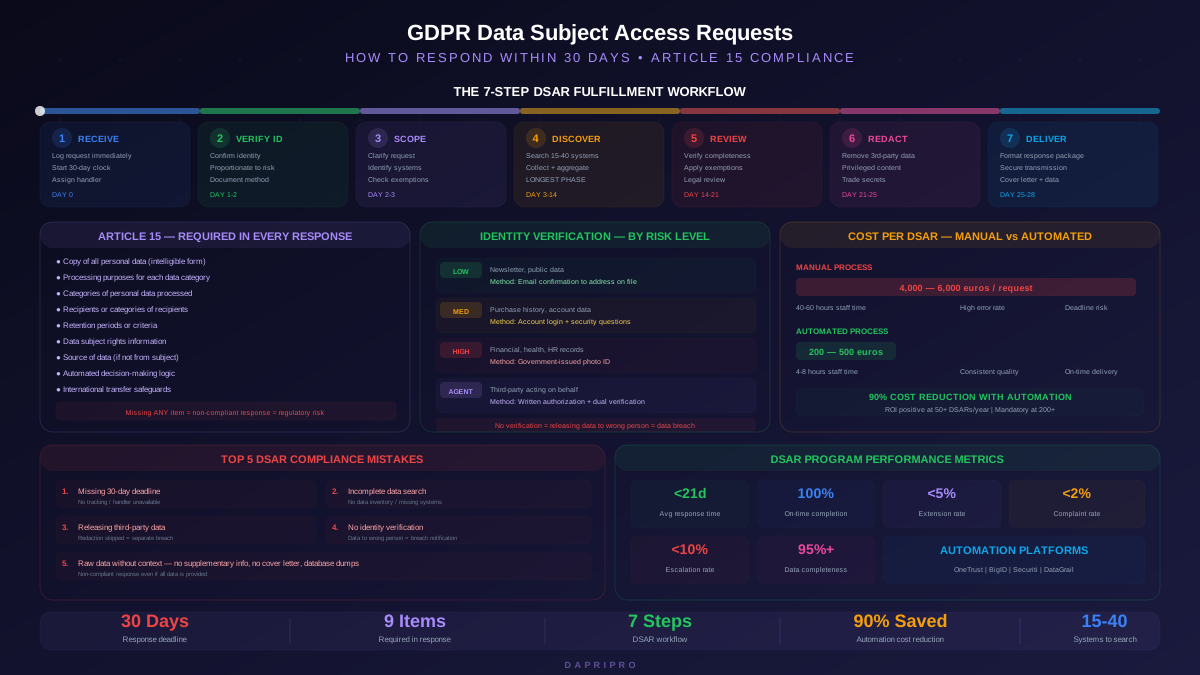
| Failing to respond to data subject access requests (DSARs) | 5,000 to 200,000 euros | Establish a DSAR process. Respond within 30 days (one extension of 60 days if complex). Verify the requester's identity before disclosing data. |
| No Data Protection Officer when required | 10,000 to 100,000 euros | Appoint a DPO if you systematically monitor data subjects at scale or process special category data as a core activity. The DPO can be external. |
| Data breach without notification | 10,000 to 300,000 euros | Report breaches to your DPA within 72 hours. Document every breach (even minor ones) in your breach register. Notify affected individuals if risk is high. |
| No records of processing activities (ROPA) | 5,000 to 50,000 euros | Maintain a processing register under Article 30. Include purposes, categories of data, recipients, retention periods. Update regularly. |
Sector-Specific Enforcement Trends
DPAs are increasingly focusing enforcement on specific sectors:
- AdTech and tracking — the advertising technology sector faces sustained enforcement pressure from CNIL (France) and the Belgian DPA. The core issue: real-time bidding systems broadcast user data to hundreds of advertisers in milliseconds, often without valid consent. IAB Europe's Transparency and Consent Framework (TCF) was itself found to violate GDPR by the Belgian DPA.
- Healthcare — DPAs have fined hospitals and clinics for insufficient access controls (staff accessing patient records without authorization), inadequate data breach responses, and failure to conduct DPIAs for electronic health record systems.
- Financial services — banks and fintechs face fines for excessive data retention (keeping customer data years after the relationship ended), sharing customer data with third parties without proper legal basis, and inadequate KYC data processing transparency.
- Employee monitoring — organizations using employee surveillance software (keystroke logging, screen monitoring, location tracking) without transparency, proportionality assessment, or employee consultation face increasing enforcement.
Practical Compliance Lessons from GDPR Fines
Every major GDPR fine contains a compliance lesson. Here are the ten most important lessons extracted from the enforcement record through 2026:
| # | Lesson | Action |
|---|---|---|
| 1 | Documentation is your defense. The accountability principle means you must prove compliance, not just claim it | Maintain ROPA, DPIAs, consent records, breach logs, training records. If you cannot show it to a DPA, it does not exist. |
| 2 | Consent must be genuine. Bundled, pre-checked, or coerced consent is invalid | Implement granular consent with equal accept/reject options. Record consent timestamps and the exact text shown. |
| 3 | International transfers need supplementary measures. SCCs alone may not be sufficient | Conduct Transfer Impact Assessments. Implement encryption where the EU entity holds keys. Consider data localization for high-risk data. |
| 4 | Children deserve extra protection. Default settings must protect, not expose, minors | Apply privacy-by-design and default for young users. Make profiles private by default. Disable tracking and profiling for users under 18. |
| 5 | Breach notification timing matters. Late notification increases the fine | Detect breaches quickly (target: under 24 hours). Report to DPA within 72 hours. Have a breach response plan tested and ready. |
| 6 | Transparency is non-negotiable. Users must understand how their data is used | Write clear, concise privacy notices. Use layered notices (summary + full version). Avoid legal jargon. |
| 7 | Respond to DSARs within 30 days. No exceptions without documented justification | Build a DSAR workflow. Train staff to recognize DSARs (they do not need to use the word "DSAR"). Verify identity before responding. |
| 8 | Data minimization reduces risk. Collecting less data means fewer compliance obligations and lower breach impact | Audit every data collection point. Ask: do we need this data? For how long? Delete data when the purpose expires. |
| 9 | Cooperate with DPA investigations. Resistance increases fines | Respond to DPA inquiries promptly and completely. Appoint a contact person. Provide requested documentation without delay. |
| 10 | Remediate quickly after discovering violations. Speed of remediation directly reduces fine amounts | When you identify a compliance gap, fix it immediately and document the fix. Show the DPA your timeline from discovery to resolution. |
How DPAs Calculate GDPR Fines
Article 83 of GDPR lists eleven criteria that DPAs must consider when determining fine amounts. Understanding these criteria helps organizations assess their risk exposure:
| Criterion | What DPAs Evaluate |
|---|---|
| Nature, gravity, and duration | How serious is the violation? How long did it persist? Ongoing violations are penalized more heavily than one-time incidents. |
| Intentional or negligent | Deliberate violations receive higher fines. However, negligence is not an excuse — DPAs expect organizations to know their obligations. |
| Actions taken to mitigate | Did the organization take steps to reduce the impact on affected individuals? Quick remediation reduces fines. |
| Degree of responsibility | What technical and organizational measures were in place? Organizations with strong compliance programs receive lower fines. |
| Previous infringements | Repeat offenders receive higher fines. Meta's cumulative penalties reflect this escalation pattern. |
| Cooperation with DPA | Did the organization cooperate during the investigation? Obstruction or delay increases the penalty. |
| Categories of data | Violations involving special category data (health, biometric, genetic, racial, political, religious, sexual orientation) trigger higher fines. |
| How the DPA learned | Self-reported violations generally receive lower fines than those discovered through complaints or DPA investigations. |
The EDPB (European Data Protection Board) published harmonization guidelines in 2023 to ensure more consistent fine calculations across EU member states. These guidelines established a five-step methodology: identify the processing operations, find the starting point for the fine based on violation severity, adjust for aggravating and mitigating factors, apply the legal maximum, and assess whether the final amount is effective, proportionate, and dissuasive.