
Data Protection Impact Assessments have evolved from a best-practice recommendation to a legal requirement that catches organizations off guard every year. In 2025 alone, three EU supervisory authorities issued enforcement actions specifically for failing to conduct DPIAs before launching high-risk processing activities — one resulting in a 1.3 million euro penalty against a healthcare provider.
The challenge is not whether you need a DPIA. If you process personal data at scale, use automated decision-making, or handle sensitive categories, you almost certainly do. The real obstacle is conducting a DPIA that actually satisfies regulators while remaining practical enough to integrate into your project workflows. This guide provides the complete framework — from initial screening through risk scoring to documentation templates that have withstood regulatory scrutiny.
What Is a DPIA and Why It Matters in 2026
A Data Protection Impact Assessment is a structured process for identifying and minimizing privacy risks before you begin processing personal data. Under GDPR Article 35, it is mandatory when processing is likely to result in a high risk to the rights and freedoms of natural persons. The term "likely" is key — you do not wait until harm has occurred.
The regulatory landscape has shifted dramatically. The EDPB's 2025 harmonized enforcement guidelines introduced standardized DPIA expectations across all 27 member states, eliminating the inconsistencies that previously allowed some organizations to take shortcuts. DPA inspection reports from France (CNIL), Ireland (DPC), and Germany (LfDI) all now include DPIA reviews as a standard audit step.
The Legal Framework Driving DPIAs
Three GDPR articles form the legal foundation for DPIAs:
| Article | Requirement | Key Detail |
|---|---|---|
| Article 35 | DPIA for high-risk processing | Must be conducted before processing begins, must include systematic risk assessment |
| Article 36 | Prior consultation | Required when residual risk remains high after mitigation; DPA has 8 weeks to respond |
| Article 25 | Privacy by design and default | DPIA is the primary mechanism for demonstrating privacy-by-design implementation |
The penalty for not conducting a required DPIA is significant: up to 10 million euros or 2 percent of worldwide annual turnover, whichever is greater — and that is separate from any penalty for the actual processing violation.
DPIA Screening: When Is a DPIA Required?
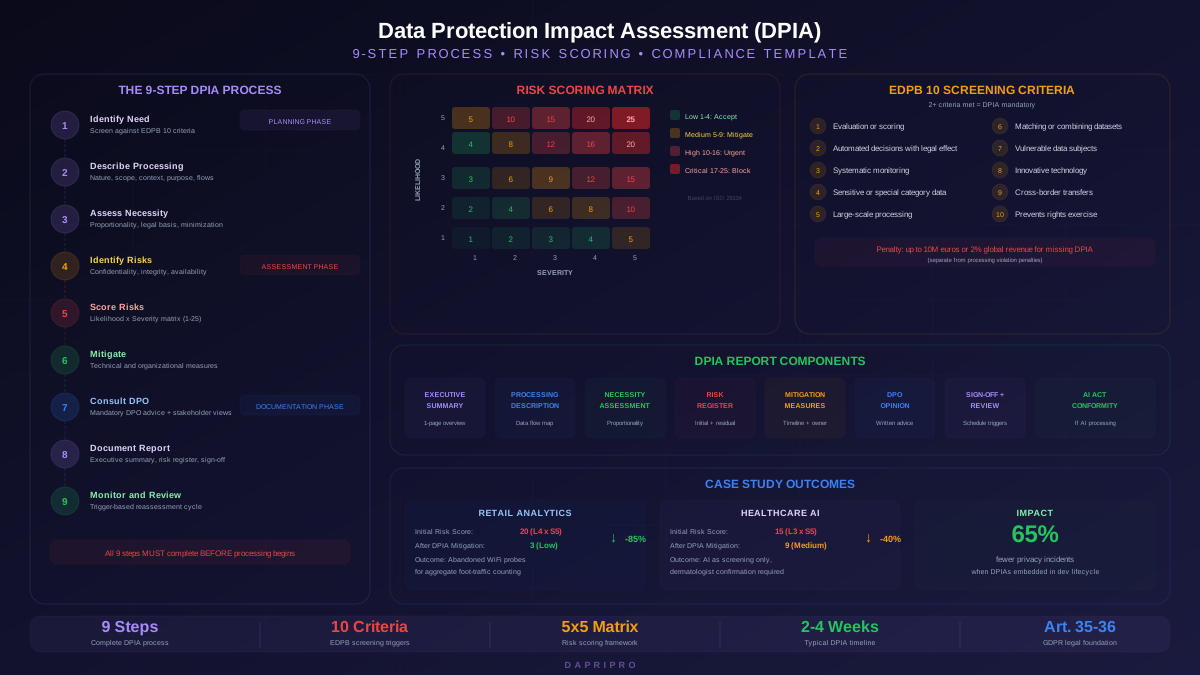
Not every processing activity needs a DPIA, but the threshold is lower than most organizations assume. The EDPB identified 10 criteria in its guidelines — if your processing meets two or more, a DPIA is mandatory.
| # | EDPB Criterion | Example Trigger |
|---|---|---|
| 1 | Evaluation or scoring | Credit scoring, employee performance profiling, behavioral analytics |
| 2 | Automated decision-making with legal effects | Automated loan approval, AI-driven hiring filters |
| 3 | Systematic monitoring | CCTV in public spaces, workplace surveillance, website tracking |
| 4 | Sensitive data or special categories | Health records, biometric data, religious beliefs, genetic data |
| 5 | Large-scale processing | National customer database, city-wide sensor network |
| 6 | Matching or combining datasets | Merging CRM data with social media profiles |
| 7 | Vulnerable data subjects | Children, elderly, patients, employees (power imbalance) |
| 8 | Innovative technology | Facial recognition, IoT wearables, brain-computer interfaces |
| 9 | Cross-border transfers | EU-to-US data flows, global cloud processing |
| 10 | Processing that prevents rights exercise | Data that blocks service access, automated denial systems |
Common Screening Mistakes
Several patterns consistently lead to enforcement action when organizations get screening wrong:
- Retrospective DPIAs — Conducting the assessment after processing has already begun. Article 35 explicitly requires DPIAs prior to processing. Retroactive DPIAs demonstrate non-compliance, not accountability.
- Copy-paste assessments — Using identical DPIA templates across fundamentally different processing activities. The CNIL specifically flagged this in its 2025 enforcement guidance as evidence of insufficient assessment.
- Ignoring joint controller scenarios — When two organizations jointly determine processing purposes, both are responsible for the DPIA. The Irish DPC penalized a publisher and an ad-tech company jointly for this failure.
- Skipping the DPO consultation — Article 35(2) mandates seeking the DPO's advice when conducting a DPIA. Multiple enforcement actions have cited failure to involve the DPO as an independent violation.
The Nine-Step DPIA Process
The following framework consolidates requirements from Article 35, EDPB guidance, and enforcement decisions into a practical nine-step process. Each step produces specific documentation artifacts that form your compliance record.
Step 1: Identify the Need for a DPIA
Run the screening checklist from Section 2 against your planned processing activity. Document which criteria are met and why. Even if a DPIA is not strictly required, document the screening decision — this demonstrates proactive accountability under Article 5(2).
Output artifacts: Screening decision record, criteria assessment matrix, sign-off from DPO.
Step 2: Describe the Processing
Map every aspect of the data processing in concrete detail. Vague descriptions are the number one reason DPIAs fail regulatory review.
| Processing Element | What to Document | Example |
|---|---|---|
| Nature | How data is collected, stored, used, and deleted | Collected via web forms, stored in AWS eu-west-1, processed by ML pipeline, deleted after 24 months |
| Scope | Volume, geographic coverage, data categories | 500K EU residents, name, email, purchase history, browsing behavior |
| Context | Relationship with data subjects, reasonable expectations | B2C customers expect personalized recommendations, not behavioral profiling for third parties |
| Purposes | Specific, explicit processing purposes | Product recommendations, inventory forecasting, fraud detection |
| Legal basis | Article 6 basis for each purpose | Recommendations: consent; Fraud: legitimate interest (LIA documented) |
| Data flows | Internal systems, processors, transfers | Web app to Kafka to Spark pipeline to PostgreSQL; Shared with payment processor (processor agreement in place) |
Step 3: Assess Necessity and Proportionality
This step answers whether the processing is necessary for the stated purpose and proportionate to the privacy intrusion. GDPR Article 35(7)(b) requires this assessment explicitly.
Five questions to evaluate necessity:
- Is this the least intrusive way to achieve the purpose?
- Can the purpose be achieved with less data or anonymized data?
- Is the legal basis appropriate and documented for each purpose?
- Are retention periods justified and enforced technically?
- Are data subjects adequately informed about the processing?
Document your answers with specific evidence — policy references, technical configurations, and process descriptions. A "yes" without supporting evidence will not survive an audit.
Step 4: Identify Privacy Risks
Privacy risks are not IT security risks, although they overlap. A privacy risk focuses on harm to individuals: discrimination, financial loss, reputational damage, loss of confidentiality, or inability to exercise rights.
Categorize risks across three domains:
| Risk Domain | Examples | Typical Sources |
|---|---|---|
| Confidentiality | Unauthorized access, data breach, insider threat | Weak access controls, unencrypted storage, excessive permissions |
| Integrity | Data corruption, unauthorized modification, inaccurate profiling | Missing input validation, no audit trail, ML model drift |
| Availability | Service denial, inability to exercise rights, data loss | No backup, single point of failure, no DSAR workflow |
Step 5: Score the Risks
Use a quantified risk scoring matrix to move beyond subjective risk assessments. The following approach is based on the ISO 29134 methodology endorsed by the EDPB.
Score each identified risk using this matrix. Risks scoring 10 or above require documented mitigation measures. Risks scoring 17 or above should block processing until mitigated — these are also strong candidates for prior consultation under Article 36.
Step 6: Identify Mitigation Measures
For each high or critical risk, identify specific technical and organizational measures that reduce either likelihood, severity, or both. Each measure must be concrete and verifiable.
| Privacy Risk | Mitigation Measure | Reduces | Residual Score |
|---|---|---|---|
| Unauthorized access to personal data (L4 x S4 = 16) | Role-based access, MFA, field-level encryption, audit logging | L: 4 to 2 | 8 (Medium) |
| Inaccurate automated decisions (L3 x S5 = 15) | Human review layer, explainability logging, regular model audits | S: 5 to 3 | 9 (Medium) |
| Excessive data retention (L4 x S3 = 12) | Automated deletion policies, retention schedule enforcement, quarterly reviews | L: 4 to 1 | 3 (Low) |
| Failure to fulfill DSARs within deadline (L3 x S4 = 12) | Automated DSAR portal, workflow tracking, escalation alerts at day 20 | L: 3 to 1 | 4 (Low) |
| Unlawful cross-border transfer (L3 x S5 = 15) | SCCs + TIA, data localization for sensitive categories, DPF certification | L: 3 to 2 | 10 (High) |
Notice the cross-border transfer example: even after mitigation, the residual score remains high at 10. This is a realistic scenario where you might need prior consultation with your supervisory authority under Article 36.
Step 7: Consult the DPO and Stakeholders
Article 35(2) requires the controller to seek the DPO's advice on the DPIA. This is not a rubber-stamp — document the DPO's specific recommendations and how each was addressed. If you overrule a DPO recommendation, document why and keep this record for five years minimum.
Beyond the DPO, GDPR Article 35(9) suggests seeking the views of data subjects (or their representatives) where appropriate. This can be done through privacy impact consultation surveys, user advisory panels, or public comment periods for large-scale processing activities.
Step 8: Document the DPIA Report
The DPIA report is your primary compliance artifact. A complete report should include these sections:
- Executive summary — One-page overview with final risk assessment and recommendation (proceed, modify, or halt)
- Processing description — Complete data flow map from Step 2
- Necessity and proportionality assessment — Answers from Step 3 with supporting evidence
- Risk register — All identified risks with initial and residual scores
- Mitigation measures — Each measure with implementation timeline, responsible owner, and verification method
- DPO opinion — Written advice and how each point was addressed
- Data subject consultation — Methodology and findings (if conducted)
- Sign-off — Controller approval with date and accountability statement
- Review schedule — Triggers and timeline for reassessment
Step 9: Monitor and Review
A DPIA is a living document. GDPR Article 35(11) requires controllers to review processing operations when there is a change in the risk represented. Establish concrete triggers:
| Review Trigger | Action | Timeline |
|---|---|---|
| New data categories added to processing | Re-run Steps 2-6, update risk scores | Before processing begins |
| New processor or sub-processor engaged | Assess new data flows, update transfer analysis | Before onboarding |
| Technology change (new ML model, cloud migration) | Full DPIA reassessment | Before deployment |
| Regulatory guidance update (EDPB, national DPA) | Review affected sections, update if needed | Within 90 days |
| Significant data breach affecting the processing | Emergency reassessment, update risk scores | Within 30 days |
| Scheduled periodic review (no event trigger) | Review all sections, confirm measures effective | Every 12 months minimum |
DPIA Templates and Tools Comparison
Rather than building a DPIA framework from scratch, evaluate the established tools and templates available. Here is how the leading options compare for 2026:
| Tool / Template | Type | Best For | Key Limitation |
|---|---|---|---|
| ICO DPIA Template | Free template (UK) | Small organizations, first DPIA | Basic risk framework, no automation |
| CNIL PIA Tool | Free software (French DPA) | Mid-size organizations, structured workflow | Interface in French (English translation available), limited integrations |
| OneTrust DPIA Module | Commercial platform | Enterprise, multiple DPIAs, integration with data mapping | Complex setup, higher cost tier |
| TrustArc Assessment Manager | Commercial platform | Multi-framework compliance (GDPR, CCPA, LGPD) | Minimum annual commitment |
| DPIA Smart (NIST-aligned) | Open-source tool | Organizations already using NIST frameworks | Requires technical setup, limited support |
Our recommendation for most organizations: start with the CNIL PIA Tool for your first few DPIAs to learn the process with structured guidance, then evaluate OneTrust or TrustArc when you need to manage multiple concurrent assessments or integrate with your data mapping platform.
Real-World DPIA Case Studies
Case Study 1: Retail Customer Analytics Platform
A European retail chain planned to deploy an AI-powered customer behavior analytics system across 200 stores. The system would track in-store movements via WiFi probe requests, correlate with purchase history, and generate personalized marketing profiles.
The DPIA screening identified five criteria: evaluation/scoring (criterion 1), systematic monitoring (criterion 3), large-scale processing (criterion 5), matching datasets (criterion 6), and innovative technology (criterion 8). Five criteria triggered — far above the two-criterion threshold.
The initial risk assessment scored the highest risk at 20 (L4 x S5): the probability of function creep — using location data for purposes beyond marketing — combined with the catastrophic impact of a breach exposing movement patterns of hundreds of thousands of individuals. After mitigation (data aggregation, 24-hour raw data deletion, opt-out kiosks, independent audit), the residual score dropped to 8.
Key lesson: The DPIA process led the retailer to abandon WiFi probe collection entirely and switch to aggregated foot-traffic counting — a less invasive method that achieved the same business objective with a residual risk score of 3.
Case Study 2: Healthcare AI Diagnostic Tool
A health-tech startup developed an AI model to screen dermatology images for potential skin cancer indicators. The processing involved special category health data (criterion 4), automated decision-making with health implications (criterion 2), innovative technology (criterion 8), and vulnerable data subjects or patients (criterion 7).
The critical risk was false negative diagnoses causing delayed treatment (L3 x S5 = 15). The DPIA mandated that every AI assessment be presented as a "screening suggestion" requiring dermatologist confirmation, with mandatory clinical referral for inconclusive cases. This single measure reduced severity from 5 (catastrophic) to 3 (significant) because the AI output could not directly prevent treatment.
The company also consulted the Belgian DPA under Article 36 prior consultation, which approved the processing with additional conditions: annual model performance audits, patient-accessible explanations of AI reasoning, and a six-month data retention limit.
Case Study 3: Employee Monitoring in Remote Work
A financial services firm implemented keystroke logging, screenshot capture, and application usage tracking for 3,000 remote employees. The DPIA flagged systematic monitoring (criterion 3), vulnerable data subjects or employees under power imbalance (criterion 7), and evaluation/scoring for performance assessment (criterion 1).
The initial assessment revealed an unacceptable risk score of 20 (L5 x S4) because the monitoring was near-certain to occur and the impact on employee autonomy and dignity was severe. The DPO recommended against proceeding.
Instead of abandoning monitoring entirely, the DPIA process led to a redesigned approach: aggregate productivity metrics (no individual keystroke logging), random screenshot review limited to four per day with employee notification, and quarterly privacy reviews with employee representatives. The residual risk dropped to 9, which management accepted with the DPO's conditional approval.
Sector-Specific DPIA Considerations
| Sector | Additional DPIA Triggers | Key Regulatory Reference |
|---|---|---|
| Healthcare | Any processing of health data at scale, telemedicine platforms, clinical trial data | Article 9(2)(h), national DPA health sector guidelines |
| Financial services | Credit scoring, fraud detection algorithms, KYC/AML profiling | Article 22 (automated decisions), EBA guidelines |
| Education | Student behavior tracking, EdTech analytics, exam proctoring | Criterion 7 (vulnerable subjects — children), EDPB guidance on children's data |
| HR / Employment | Employee surveillance, AI recruitment tools, performance analytics | WP29 Opinion 2/2017 on data processing at work |
| AdTech / Marketing | Real-time bidding, cross-device tracking, lookalike audiences | EDPB consent guidelines, ePrivacy Directive Article 5(3) |
Common DPIA Failures and Enforcement Patterns
Analysis of 2024-2026 enforcement actions reveals recurring DPIA failures that trigger regulatory penalties:
| DPIA Failure | Enforcement Example | How to Avoid |
|---|---|---|
| No DPIA conducted at all | Swedish DPA: 800K euros against a housing company for camera surveillance without DPIA | Integrate DPIA screening into project intake process |
| Retrospective DPIA (after launch) | Belgian DPA: 100K euros for DPIA conducted months after processing began | Gate project deployment behind DPIA sign-off |
| Insufficient risk mitigation | CNIL: 20 million euros (Clearview AI) — risk identified but not adequately mitigated | Require residual risk below threshold before approval |
| No prior consultation when required | Multiple DPAs flagging organizations that skipped Art. 36 consultation | Set automatic Art. 36 trigger when residual risk exceeds threshold |
| Failed to consult DPO | German LfDI: cited DPO exclusion as aggravating factor in enforcement decision | Mandate DPO review and written opinion in DPIA template |
Integrating DPIAs into Project Workflows
The biggest operational challenge with DPIAs is ensuring they happen at the right time — before processing begins — without creating bottlenecks that make teams avoid the process entirely.
Agile Integration Model
For organizations using agile development, DPIAs fit naturally into the sprint planning cycle. The key is a lightweight screening step at feature kickoff with escalation to a full DPIA only when criteria are triggered.
- Feature proposal — Product owner includes a one-page "privacy profile" answering five screening questions
- Sprint planning — If screening triggers DPIA, privacy team includes DPIA tasks in the sprint backlog
- Development sprint — Privacy team runs Steps 2-6 in parallel with feature development
- Pre-deployment gate — DPIA sign-off is a mandatory CI/CD pipeline check before production deployment
- Post-launch review — First DPIA review at 90 days, then annually
This approach reduced average DPIA cycle time from 6 weeks to 2 weeks at a European fintech company while maintaining regulatory compliance across 40 processing activities.
DPIA Governance Structure
Assign clear roles using the RACI framework:
| DPIA Activity | Project Owner | DPO | IT Security | Legal |
|---|---|---|---|---|
| Screening decision | R | A | C | I |
| Processing description | R | C | C | I |
| Risk identification and scoring | C | A | R | C |
| Mitigation measures | A | C | R | C |
| DPO advisory opinion | I | R | I | C |
| Final sign-off | A | C | I | R |
R = Responsible, A = Accountable, C = Consulted, I = Informed
AI and DPIAs: The 2026 Convergence
The EU AI Act, effective August 2025, creates a direct intersection with GDPR DPIAs. High-risk AI systems (Article 6 of the AI Act) that process personal data now require both an AI Act conformity assessment and a GDPR DPIA. The EDPB and the AI Office issued joint guidance in early 2026 recommending a unified assessment process.
For organizations deploying AI that processes personal data, the practical impact is:
- Expanded risk assessment scope — Beyond privacy risks, you must now assess AI-specific risks: bias, accuracy degradation, lack of explainability, and human oversight gaps
- Mandatory fundamental rights impact assessment — High-risk AI deployers must conduct this under AI Act Article 27, which overlaps significantly with DPIA requirements
- Documentation convergence — Combine your DPIA report with the AI Act technical documentation to avoid duplicative assessments
- Enhanced monitoring — AI systems require post-market monitoring under the AI Act, which aligns with DPIA review cycles but adds automated performance monitoring requirements
The combined assessment approach reduces duplicated effort by approximately 40 percent compared to conducting separate GDPR and AI Act assessments, based on early 2026 implementation data from organizations that have adopted the joint framework.
DPIA Completion Checklist — Quick Reference
Use this checklist to verify your DPIA is complete before sign-off:
| Check | Item | GDPR Reference |
|---|---|---|
| ☐ | Screening criteria documented with rationale | Article 35(1), EDPB WP 248 |
| ☐ | Systematic description of processing operations | Article 35(7)(a) |
| ☐ | Purposes and legal basis specified for each activity | Articles 5(1)(b), 6 |
| ☐ | Necessity and proportionality assessment completed | Article 35(7)(b) |
| ☐ | Risks to data subjects identified and scored | Article 35(7)(c) |
| ☐ | Mitigation measures documented with residual scores | Article 35(7)(d) |
| ☐ | DPO advice sought and documented | Article 35(2) |
| ☐ | Data subject views considered (if appropriate) | Article 35(9) |
| ☐ | Prior consultation triggered if residual risk high | Article 36 |
| ☐ | Controller sign-off with date | Article 5(2), accountability |
| ☐ | Review triggers and schedule established | Article 35(11) |
| ☐ | AI Act conformity assessment linked (if applicable) | AI Act Articles 6, 9, 27 |
DPIAs are one of the most effective privacy tools available — not because regulators require them, but because the structured risk assessment process consistently identifies privacy problems before they become enforcement actions, breach headlines, or lawsuits. Organizations that embed DPIAs into their development lifecycle report 65 percent fewer privacy incidents compared to those that treat them as one-time compliance exercises. The nine-step process outlined here gives you a repeatable, auditable framework that satisfies both regulatory expectations and practical business needs.