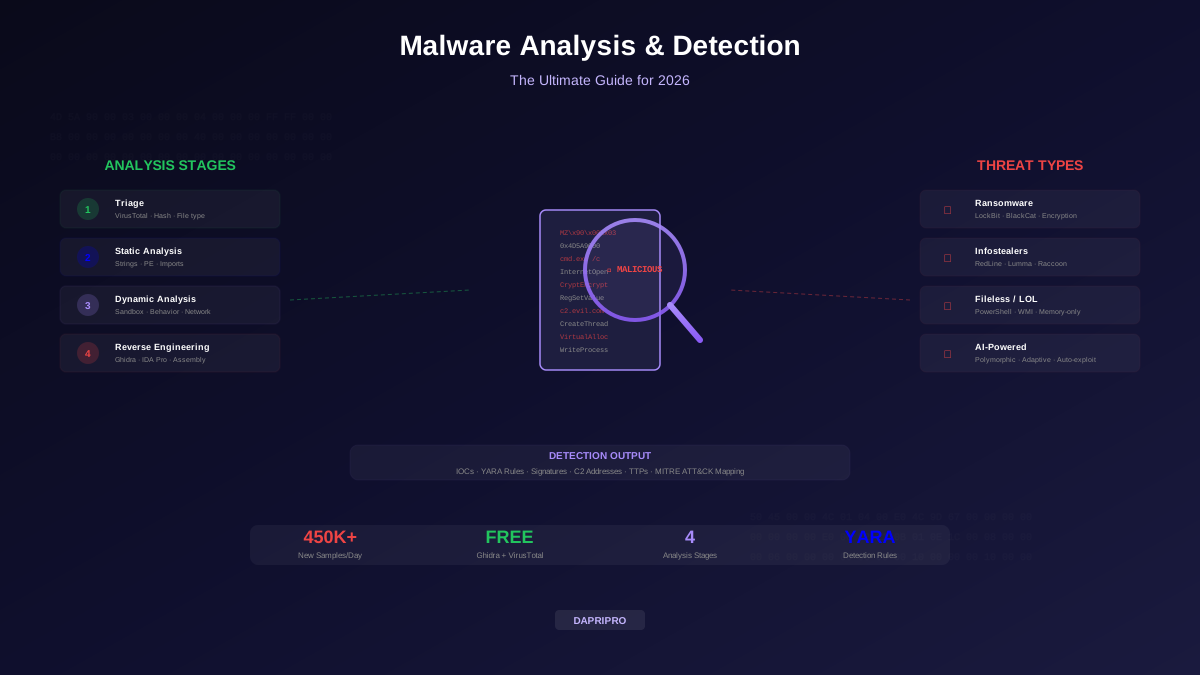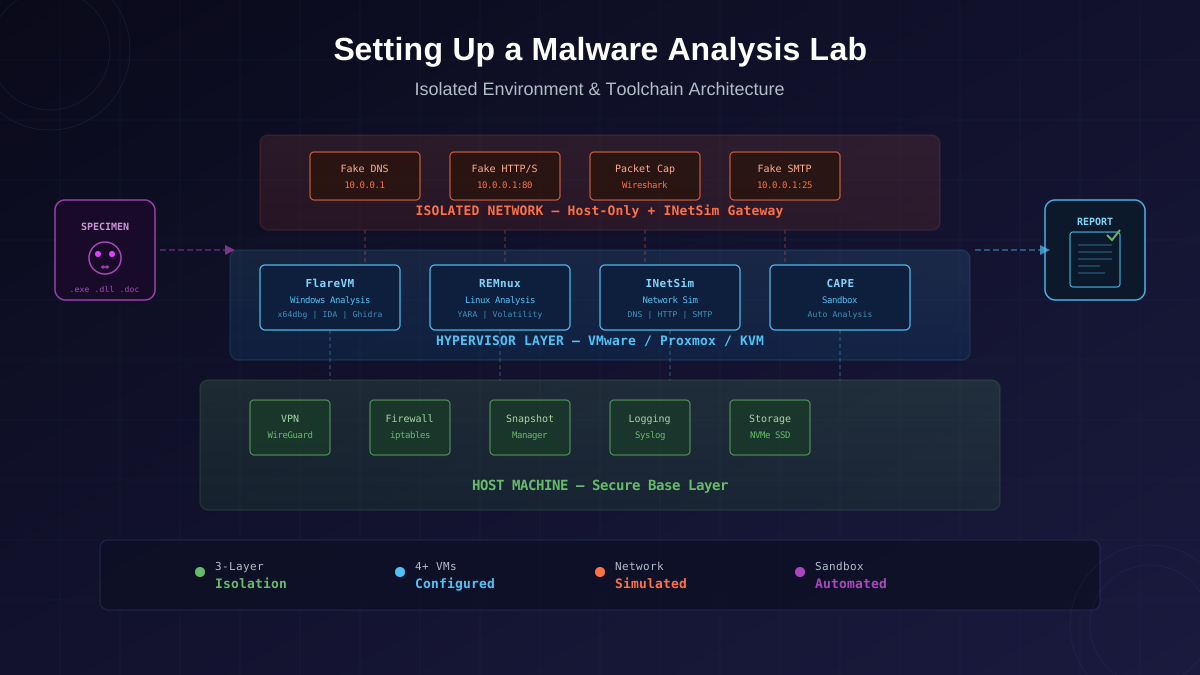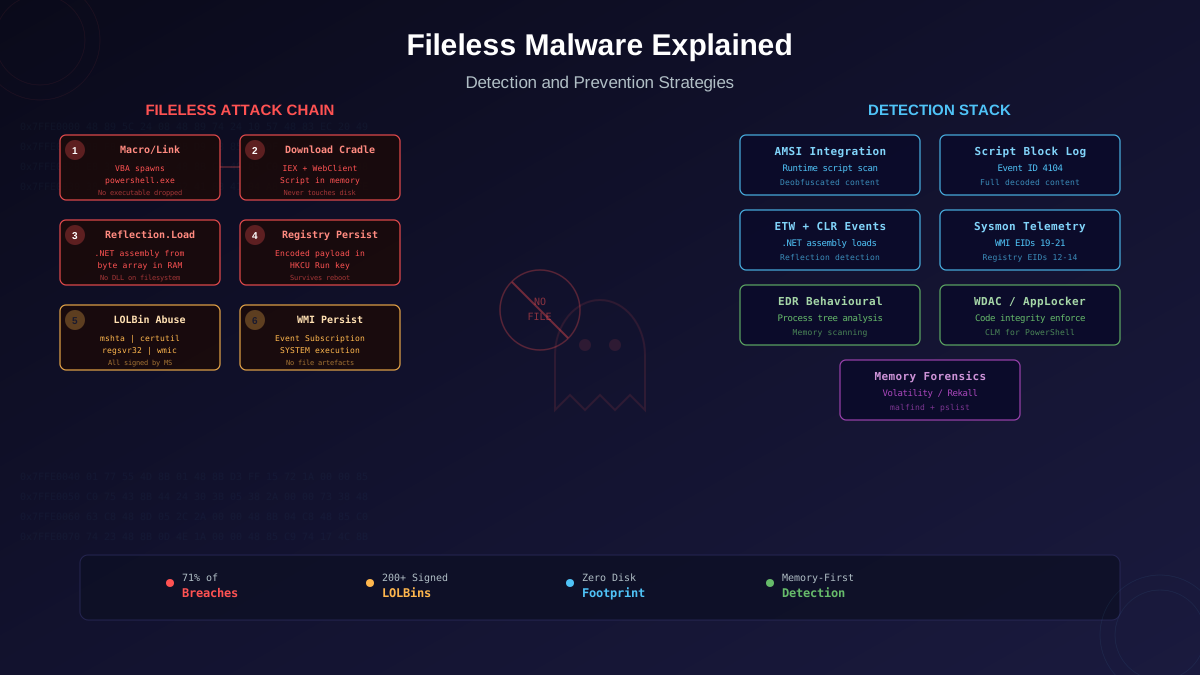

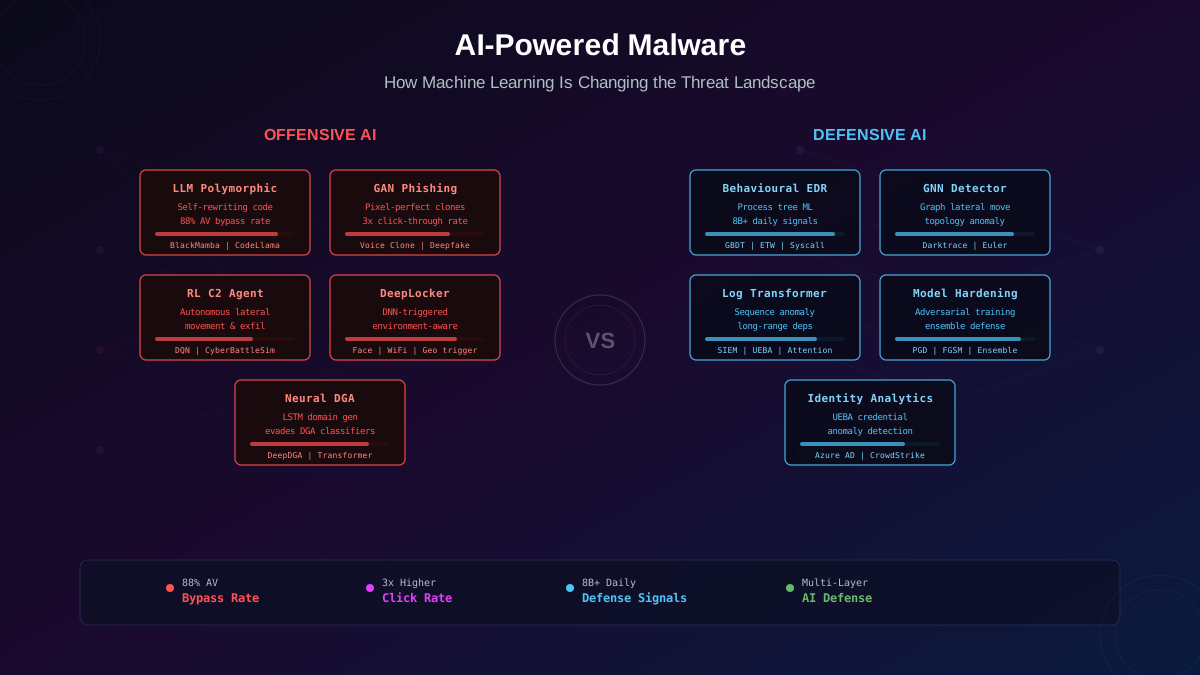
For decades, malware authors and defenders fought with roughly the same weapons: pattern matching on one side, obfuscation on the other. Machine learning shattered that equilibrium. Attackers now wield the same neural architectures that power generative AI products — large language models, generative adversarial networks, reinforcement-learning agents — to craft malware that writes its own code, forges pixel-perfect phishing lures, and navigates networks without human guidance. This article dissects every major category of AI-powered offensive technique documented through early 2026, maps each one to observable MITRE ATT&CK phases, and details the ML-driven defensive countermeasures security teams can deploy today.
Taxonomy of AI-Powered Malware Techniques
AI-powered malware is not a single technology; it is a portfolio of machine-learning applications bolted onto different phases of the kill chain. Some samples use an LLM only during initial payload generation, then operate as conventional implants. Others embed a live inference engine inside the payload itself, making real-time decisions on the target. Understanding where ML enters the attack lifecycle is the first step to choosing the right detection layer.
LLM-Powered Polymorphic Malware
Traditional polymorphic engines rely on XOR rotations, dead-code insertion, and register reassignment — techniques that produce finite variation and eventually fall to heuristic classifiers. LLM-based polymorphism is categorically different: the model rewrites functional logic, renames variables semantically, substitutes API calls with equivalent chains, and restructures control flow — all while preserving payload semantics. Every compilation produces a statistically unique binary.
How LLM Polymorphism Works
The attacker fine-tunes or prompt-engineers an LLM (often a code-specialised model like CodeLlama or StarCoder) with a meta-prompt: "Rewrite the following shellcode loader in C using different Windows API calls, variable names, and control flow. Preserve the functionality exactly." The model outputs functionally equivalent source, which is compiled into a fresh PE. A build pipeline can iterate this every deployment, producing thousands of unique binaries per hour.
HYAS Labs demonstrated this attack class with BlackMamba — a proof-of-concept keylogger that called OpenAI's API at runtime to regenerate its own code every execution cycle. The payload had zero static signatures because the code literally did not exist until the model generated it on the target. In testing, BlackMamba evaded every signature-based engine and most heuristic engines across multiple commercial AV products.
Observable Indicators
Although the binary itself is unique, the behaviour is not. Defenders should look for:
- Outbound API calls to LLM endpoints — unusual HTTPS traffic to known model hosting domains (api.openai.com, inference endpoints on Hugging Face, or custom model servers) from processes that should not need them.
- High entropy code sections — freshly generated code often has entropy profiles that differ from compiled production software.
- Runtime code compilation or eval — presence of compiler invocation (cl.exe, gcc), script interpreters (python, powershell -enc), or .NET Reflection.Emit in unexpected process trees.
- Process behaviour patterns — regardless of code structure, the payload must eventually inject into processes, access LSASS, or call CryptEncrypt. Behavioural EDR catches these actions.
GAN-Powered Phishing and Social Engineering
Generative adversarial networks have moved phishing from "spray and pray" to precision social engineering at scale. Attackers use GANs (and diffusion models like Stable Diffusion fine-tuned on brand assets) to generate pixel-perfect login pages, credential harvesting sites, and even synthetic employee headshots for LinkedIn sockpuppet accounts. Combined with LLM-generated text, the result is a phishing campaign that is visually and linguistically indistinguishable from legitimate corporate communications.
Voice Cloning and Vishing
Real-time voice cloning has crossed the uncanny valley. With as little as three seconds of reference audio — easily scraped from a conference talk, YouTube interview, or quarterly earnings call — models like VALL-E, XTTS-v2, and open-source forks can reproduce a speaker's voice with enough fidelity to fool colleagues over the phone. In a documented 2024 case, attackers used deepfake video and voice of a company's CFO on a Zoom call to authorise a $25 million wire transfer. The attack succeeded because every visual and auditory cue matched the executive's real persona.
Defensive teams need to establish out-of-band verification procedures for any financial or privileged-access request, regardless of how authentic the voice or video appears. Code words, callback procedures to known numbers, and multi-party approval are non-negotiable safeguards.
Measuring AI Phishing Effectiveness
Academic studies comparing human-written and LLM-generated phishing emails consistently show the AI versions performing at parity or better. A 2024 Harvard/MIT study found GPT-4-crafted spear-phishing emails achieved a click-through rate of 28% versus 10% for human-written templates in the same campaign. The model's advantage came from personalisation: it scraped the target's public LinkedIn, Twitter, and corporate blog, then wove those details into a contextually plausible pretext within seconds.
Reinforcement-Learning C2 Agents
Perhaps the most concerning frontier is autonomous post-exploitation. Reinforcement learning (RL) agents — trained in simulated network environments like CyberBattleSim (Microsoft) or the Network Attack Simulator (NASim) — learn optimal lateral movement, privilege escalation, and exfiltration strategies through trial and error. Once deployed in a real network, the agent observes response patterns from IDS, firewall, and endpoint agents, then adapts its strategy in real time.
How RL-Based Lateral Movement Works
The RL agent models the target network as a Markov Decision Process (MDP). The state space includes known hosts, open ports, discovered credentials, and observed defensive responses. The action space includes port scans, credential spraying, exploit attempts, and data staging. The reward function maximises access to high-value assets (domain controllers, database servers) while minimising detection — measured by the absence of alerts in the agent's observation window.
During training in a simulated environment, the agent plays thousands of episodes, learning that, for example, scanning all ports on a subnet triggers an IDS alert (negative reward), while authenticated SMB access using a harvested credential does not. The policy network converges on stealthy strategies: slow-and-low scanning, living-off-the-land binaries, and off-hours lateral pivots.
Real-World RL Agent Research
Microsoft Research's CyberBattleSim demonstrated that a Deep Q-Network (DQN) agent could learn to compromise a simulated enterprise network of 50 nodes in under 200 training episodes, eventually discovering credential reuse paths and living-off-the-land strategies without being explicitly programmed to use them. Separate academic work at the University of Edinburgh showed RL agents discovering novel attack paths that human red teamers had not considered, including chaining low-severity misconfigurations into full domain compromise.
While these remain research environments, the gap between simulation and deployment narrows with each year. The models are small (a policy network for network navigation typically fits in under 50 MB), fast (inference in milliseconds), and embeddable in any implant that supports Python or compiled ONNX runtime.
Environment-Aware Malware: The DeepLocker Model
IBM Research's DeepLocker concept demonstrated a malware design that hides its payload behind a deep neural network trigger. The payload remains encrypted and inert until the DNN classifies the environment as matching the target — for example, recognising a specific face via the webcam, a particular Wi-Fi SSID, or a combination of geolocation and system configuration. Without the trigger condition, the malware appears completely benign, and the DNN itself reveals nothing about what the trigger condition actually is, since the logic is encoded in opaque weight matrices.
This "concealment through AI" model has profound implications:
- Sandbox evasion — the payload never activates in analysis environments because the trigger condition (a specific person, location, or device) is never present.
- Attribution difficulty — the neural network does not contain human-readable rules, so reverse engineering the trigger requires reconstructing the training data, which is practically impossible.
- Targeted assassination of specific systems — this enables surgical strikes against individual targets embedded in mass-distribution campaigns.
Adversarial ML Attacks on Defensive AI
AI-powered defence is not unassailable — it is itself a software system with an attack surface. Adversarial machine learning encompasses techniques that subvert the ML models defenders rely on.
Evasion Attacks
Evasion attacks modify malicious inputs to fool a deployed classifier without requiring access to the model's internals (black-box attacks) or with full knowledge (white-box). Against malware classifiers, attackers append benign code sections, pad PE headers with legitimate-looking imports, or modify opcode sequences in ways that change the feature vector without altering execution. Research from the University of Virginia showed that adding fewer than 100 bytes of carefully chosen padding to a malicious PE could flip a gradient-boosted tree classifier's verdict from malicious to benign with 97% success.
Model Poisoning
If attackers can influence the training data — for example, by submitting crafted samples to a shared threat intelligence feed or a crowd-sourced malware repository — they can poison the model. Backdoor poisoning inserts a hidden trigger pattern: any sample containing the trigger is classified as benign, while the model performs normally on all other inputs. Label-flipping attacks more subtly shift decision boundaries by mislabelling a small percentage of training samples. Both attacks are difficult to detect because the model's overall accuracy metrics remain high.
Model Stealing
By querying a deployed detection API with carefully crafted inputs and observing the outputs (confidence scores, class labels), an attacker can train a surrogate model that approximates the defender's classifier. Once they have a local copy, they can run white-box attacks against it to generate perfectly crafted evasion samples. Model stealing has been demonstrated against commercial malware detection APIs with as few as 10,000 queries.
Domain Generation Algorithms With Neural Networks
Classic domain generation algorithms (DGAs) use seeded pseudo-random generators to produce domains for C2 communication. Defensive ML classifiers learned to detect these because the generated strings have statistical properties (character frequency, bigram distribution) that differ from legitimate domain registrations. Neural DGAs flip this: an LSTM or transformer model trained on legitimate domain name corpora generates domains that are statistically indistinguishable from real registrations.
Palo Alto Unit42 documented DeepDGA variants that produced domains with character distributions matching Alexa Top 1M entries. Traditional DGA classifiers trained on random-character patterns achieved less than 15% detection against these neural-generated domains. Detection requires shifting from character-level features to contextual features: registration timing, DNS query patterns, WHOIS age, and certificate transparency logs.
Defensive AI Countermeasures
The defensive response to AI-powered malware requires AI-powered defense — but architected with awareness of the adversarial ML risks described above.
Behavioural Analysis and EDR
Regardless of how unique the binary is, the malware must eventually perform observable actions. Modern EDR agents instrument kernel callbacks, ETW (Event Tracing for Windows) providers, and syscall hooks to build behaviour traces. ML models trained on these traces — sequences of API calls, process ancestry, file and registry modifications — classify behaviour independent of code structure. Microsoft Defender for Endpoint uses a gradient-boosted tree ensemble trained on over 8 billion daily signals to score process trees for malicious behaviour, catching polymorphic and fileless threats that signature engines miss.
Graph Neural Networks for Lateral Movement Detection
Network-level defence benefits from graph neural networks (GNNs) that model host-to-host communication as a graph. Normal authentication and data flow patterns create a baseline graph structure. When an RL C2 agent begins lateral movement — authenticating from unusual source hosts, accessing file shares outside normal patterns, or creating remote services on domain controllers — the GNN detects topological anomalies. Darktrace's Antigena and academic systems like Euler use temporal graph networks that score edge events (new connections) against historical graph evolution.
Transformer-Based Log Anomaly Detection
Transformer models pretrained on log sequences (similar to language models pretrained on text) learn the "grammar" of normal system behaviour. A SIEM ingests logs from all sources — Windows Event Logs, syslog, cloud audit trails — and the transformer model scores each log sequence for deviation from learned patterns. The model captures long-range dependencies that rule-based SIEM cannot: for example, a service account authenticating to a workstation 14 hours after a vulnerability scan of that subnet, followed by a scheduled-task creation — a sequence that is individually benign but collectively suspicious.
Adversarial Hardening of Defensive Models
Defenders must assume their own models will be attacked and harden accordingly:
- Adversarial training — augment training data with adversarially perturbed samples generated by FGSM, PGD, and C&W attacks against the current model version.
- Input sanitisation — strip PE header padding, normalise API call sequences, and reject queries with anomalous feature distributions before model inference.
- Ensemble diversity — deploy multiple model architectures (tree ensembles, CNNs, transformers) and require consensus for benign classification. An evasion attack that fools one architecture is unlikely to fool all three.
- Continuous retraining — retrain on fresh threat data weekly, validate against held-out adversarial test sets, and monitor for performance degradation that could indicate poisoning.
- Model access control — rate-limit API queries, suppress confidence scores (return only binary verdicts), and monitor for systematic probing patterns that indicate model-stealing attempts.
Practical Detection Engineering for AI Threats
Security teams do not need to build their own ML models from scratch. The following layered detection architecture addresses each AI-powered attack class:
Layer 1: Network-Level Indicators
Monitor for outbound connections to known LLM API endpoints. Create Suricata or Zeek signatures for TLS SNI values matching model hosting services. Flag any internal process making repeated HTTPS calls to inference endpoints — this can indicate a BlackMamba-style payload calling an LLM at runtime. Additionally, deploy JA3/JA3S fingerprinting to identify unusual TLS handshake characteristics from implant processes.
Layer 2: Endpoint Behavioural Rules
Write EDR detection rules (Sigma, KQL, or vendor-specific) for behaviours common to AI-assisted attacks: dynamic code compilation (csc.exe, cl.exe spawned by unusual parents), PowerShell download cradles with base64-encoded payloads, Reflection.Emit or Assembly.Load calls in .NET processes, and Python subprocess invocations from non-development machines. These catch the execution phase even when the code itself is novel.
Layer 3: Identity and Access Anomaly
RL C2 agents exploit credentials — defend with identity-layer analytics. Configure UEBA (User and Entity Behaviour Analytics) to flag authentication anomalies: impossible travel, off-hours access to sensitive shares, service accounts used interactively, and credential use from hosts outside normal patterns. Azure AD Identity Protection and CrowdStrike Falcon Identity Threat Detection provide these capabilities natively.
Layer 4: Deepfake Verification Procedures
Technical controls alone cannot stop voice-clone vishing. Establish procedural safeguards: mandatory callback to a pre-registered number for financial transactions over threshold, code-word verification for privileged-access requests, and multi-party approval with at least one in-person or pre-registered-device confirmation. Train employees to treat any request for urgent action with authority-figure voice as presumptively suspicious.
Threat Intelligence Integration
AI-powered threats evolve faster than traditional IOC feeds can track. Detection teams should subscribe to:
- MITRE ATLAS — the Adversarial Threat Landscape for AI Systems framework, which catalogues real-world adversarial ML case studies and maps them to tactics and techniques analogous to ATT&CK.
- NIST AI Risk Management Framework — provides controls for securing AI systems, applicable to both offensive and defensive AI deployments.
- Academic preprint feeds — follow arXiv cs.CR (Cryptography and Security) and cs.LG (Machine Learning) for early warning on new attack techniques; the lag between academic publication and in-the-wild exploitation is shrinking to months.
- Vendor threat reports — Microsoft Threat Intelligence, Google Mandiant, CrowdStrike, and Recorded Future publish quarterly assessments of AI-enabled threat actor activity with specific IOCs and detection guidance.
Building an AI Threat Response Playbook
When an AI-powered attack is suspected, standard incident response playbooks need augmentation:
- Identify the AI component. Determine which phase of the attack uses ML: is it the delivery mechanism (LLM-crafted phish), the payload (polymorphic malware), the C2 (RL agent), or the evasion technique (adversarial perturbation)? This determines which detection layer failed and which containment action is appropriate.
- Collect model artefacts. If the malware embeds an ML model (ONNX, TensorFlow Lite, PyTorch), preserve it for analysis. Model architecture and weight inspection can reveal training data provenance, target conditions (DeepLocker-style triggers), and capability boundaries.
- Assess defensive model compromise. If attackers had access to detection API endpoints, assume model stealing. Rotate model versions, change feature engineering pipelines, and deploy ensemble architectures to invalidate any surrogate the attacker may have trained.
- Update detection for the specific AI technique. Create YARA rules for embedded model file signatures (ONNX magic bytes, TFLite headers). Write behavioural rules for the observed inference patterns (Python runtime loading, GPU memory allocation from non-ML processes).
- Brief executive stakeholders on the AI dimension. AI-powered attacks generate media and board-level interest. Prepare a non-technical summary that explains what AI contributed to the attack, what it did not (avoid over-attribution), and what additional investments in defensive AI are needed.
Future Trajectory: 2026 and Beyond
Several trends will accelerate AI-powered threats through 2026-2027:
- On-device model execution — as edge AI hardware (NPUs in laptops and phones) becomes ubiquitous, malware can run inference locally without calling external APIs, eliminating the network-level detection opportunity.
- Multi-modal attacks — combining text, voice, video, and code generation in a single campaign. An attack might start with a deepfake CEO video email, link to a GAN-cloned intranet portal, and deploy LLM-generated malware — a seamless AI-powered kill chain.
- Open-source model proliferation — the release of capable open-source models (Llama, Mistral, Falcon) means attackers no longer need API access; they can fine-tune models locally with no logging or rate limiting.
- AI-vs-AI automated red/blue — defensive systems will increasingly use AI red teams (automated adversarial testing) to probe their own models, while attackers use AI to probe defenses, creating a continuous automated arms race.
The asymmetry is real but not hopeless. Attackers must still perform observable actions — exfiltrate data, encrypt files, move laterally — and those actions leave traces that well-instrumented environments can detect. The defender's advantage is scale: a single behavioural model can protect millions of endpoints, while each attack must succeed against the specific target's defenses. Investing in behavioural detection, identity analytics, adversarial model hardening, and procedural safeguards against social engineering will keep defenders ahead of the AI-powered threat curve.